Vijesti: The Evolution of a Montenegrin Media Powerhouse
Founded during a period of intense political volatility, Vijesti emerged as a pivotal force in the Montenegrin media landscape. From its inception as a challenger to state-owned monopolies to its transformation into a diversified media house, the publication's journey reflects the complex intersection of journalism and politics in the Balkans.
Founding and Early Years
The legal entity behind the newspaper, Daily Press d.o.o., was established on November 25, 1996, and officially registered on December 16, 1996. The company was launched with a founding capital of $5,000, provided by Miodrag Perović's company Montenegropublic, journalist Milka Tadić, and Slavica Popović (acting for Podgorica Tobacco Factory director Dragoljub "Mićo" Dautović).
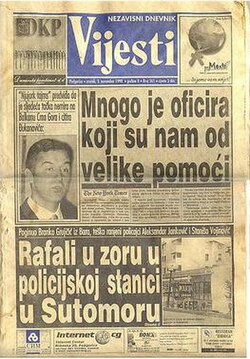
When Vijesti launched on September 1, 1997, it became only the second daily newspaper in Montenegro, competing directly with the long-standing state-owned publication, Pobjeda. The initial ownership group consisted of Miodrag Perović, Ljubiša Mitrović, Slavoljub Šćekić, and Željko Ivanović.
The paper entered the market during a tense political climate. Montenegro, then part of the Federal Republic of Yugoslavia (FR Yugoslavia), was divided between supporters of Momir Bulatović, who remained loyal to Slobodan Milošević, and Milo Đukanović, who was beginning to distance himself from Milošević. Vijesti openly supported Đukanović, who eventually won the controversial 1997 presidential elections.
Political Controversies and Criticisms
Due to its early alignment, Vijesti faced criticism from across the political spectrum. The pro-Serbian camp viewed the paper as an aggressive advocate for Montenegro's separation from Serbia. Conversely, the pro-independence camp—specifically the Liberal Socialists of Montenegro (LSCG)—criticized the paper for tailoring its stance to serve the immediate political needs of Milo Đukanović.
Some critics, including LSCG leader Slavko Perović, alleged that Đukanović himself provided the initial funding to create a facade of independent media support. Former employee Nebojša Redžić, who worked at the paper for six months, claimed in 1999 that the publication was designed to manipulate the electorate and steer pro-independence voters toward the Democratic Party of Socialists (DPS).
During this era, while the paper was occasionally critical of the DPS on minor municipal issues, it remained a firm supporter of Đukanović's major policies. Notably, the publication was accused of ignoring foreign reports regarding state-sponsored oil and tobacco smuggling and Đukanović's role in the early 1990s war efforts.
Strategic Partnerships and Global Investment
In May 2002, Vijesti entered a strategic partnership with the German media conglomerate WAZ-Mediengruppe, which acquired a 50% stake in the company. This deal was officially inaugurated on March 15, 2003, in a ceremony attended by WAZ director Bodo Hombach. Following this acquisition, the newspaper shifted its editorial focus toward the everyday problems of ordinary citizens.
However, the partnership was relatively short-lived. In October 2007, WAZ sold its stake back to the four original individual owners. WAZ representative Andreas Rudas vaguely attributed the exit to the "weight of the past."
The Path to Independence and Editorial Shift
During the 2006 Montenegrin independence referendum, Vijesti acted as a moderate supporter of independence, eventually fully embracing the campaign by distributing pro-independence insignia, such as flags and bracelets, alongside its issues. Despite the political nature of the event, the OSCE/ODIHR (Organization for Security and Co-operation in Europe/Office for Democratic Institutions and Human Rights) praised Vijesti for maintaining the highest professional journalistic standards among Montenegrin media during the referendum.
Following the referendum, the paper's editorial stance shifted dramatically, becoming a vocal critic of Milo Đukanović and the DPS.
Violence and Legal Battles
The shift in editorial tone was accompanied by significant tension. On September 1, 2007, director Željko Ivanović was severely beaten by three men near the Ribnica restaurant. From his hospital bed, Ivanović accused the "biological or criminal family" of Milo Đukanović of orchestrating the attack to stifle press freedom.
In response, Milo Đukanović sued Ivanović for libel. The trial began on November 26, 2007, in Podgorica, with Đukanović represented by a legal team that included his sister, Ana Kolarević.
Expansion and Diversification
Beyond news reporting, Vijesti expanded into cultural publishing, becoming the first Montenegrin newspaper to publish a collection of 20th-century authors, an anthology of Montenegrin authors (2006), and the art edition Pečat umjetnosti (2007).
The organization also expanded its reach into broadcasting, establishing a television division in October 2007, which launched nationwide on May 11, 2008. Later, in March 2009, Styria Medien AG acquired a 25% stake in the Daily Press company.
Key Facts
- Founded: November 25, 1996 (Daily Press d.o.o.).
- Launch Date: September 1, 1997.
- Initial Capital: $5,000.
- Key Figures: Željko Ivanović (Director), Miodrag Perović (Founder).
- Major Investors: WAZ-Mediengruppe (2002–2007) and Styria Medien AG (from 2009).
- Diversification: Launched a television division in May 2008.
| Year | Event/Entity | Impact |
|---|---|---|
| 1996 | Daily Press d.o.o. founded | Legal entity established with $5,000 capital. |
| 1997 | Vijesti Launch | Became the second daily newspaper in Montenegro. |
| 2002 | WAZ-Mediengruppe | German firm bought 50% stake; shift to citizen-centric news. |
| 2006 | Independence Referendum | Supported independence; praised by OSCE/ODIHR. |
| 2007 | WAZ Exit / TV Division | WAZ sold stake; television division established. |
| 2009 | Styria Medien AG | Acquired 25% stake in Daily Press. |
Frequently Asked Questions
Who founded Vijesti?
The paper was established by the company Daily Press d.o.o., with founding capital provided by Miodrag Perović's company Montenegropublic, journalist Milka Tadić, and Slavica Popović (on behalf of Dragoljub Dautović). The listed owners at launch were Miodrag Perović, Ljubiša Mitrović, Slavoljub Šćekić, and Željko Ivanović.
What was Vijesti's relationship with Milo Đukanović?
Initially, Vijesti strongly supported Milo Đukanović during his 1997 presidential campaign and his policies regarding Serbia. However, following the 2006 independence referendum, the paper shifted its stance and became a prominent critic of Đukanović and the DPS.
Did international companies invest in the newspaper?
Yes. The German media group WAZ-Mediengruppe held a 50% stake from 2002 until 2007. Later, in 2009, Styria Medien AG purchased a 25% stake in the parent company, Daily Press.
What other media formats does Vijesti operate?
In addition to its daily newspaper, Vijesti established a television division that began broadcasting throughout Montenegro on May 11, 2008.
Was the newspaper recognized for its professionalism?
Yes, during the 2006 Montenegrin independence referendum, the OSCE/ODIHR gave Vijesti the highest marks among all Montenegrin media for adhering to professional journalistic standards.