View-Master History: From Scenic Postcards to Virtual Reality
Long before the digital age of 3D cinema and virtual reality, the View-Master revolutionized how people experienced the world. What began as a small photo-finishing business in Portland, Oregon, evolved into a global phenomenon, blending photography and engineering to simulate binocular depth perception. For decades, these iconic viewers allowed millions to travel to the Grand Canyon or visit Disneyland from the comfort of their own living rooms.
The Early Years: Sawyer's Photo Finishing
The story begins in 1919 when Edwin Eugene Mayer, a pharmacist and U.S. Army veteran, purchased Sawyer's Photo Finishing Service. With financial support from his father, August Mayer, and his fiancée and future sister-in-law, Eva and Vi McAnulty, Mayer built a business that specialized in photographic postcards and album sets. By the 1920s, Sawyer's had become the largest producer of scenic postcards in the United States.
The transition from 2D cards to 3D images happened through a pivotal partnership with William Gruber, a player-piano technician and photography enthusiast. Gruber developed a stereo imaging rig using two Kodak Bantam Special cameras and designed a machine to mount 16-mm Kodachrome color transparency film—a new technology at the time—into reels made from heavy player-piano paper stock.
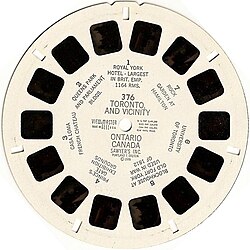
The Birth of the View-Master
A View-Master reel contains 14 film transparencies arranged in seven pairs. When viewed through the device, each eye sees a slightly different image, simulating the way human eyes perceive depth. This stereoscopic effect created a vivid, three-dimensional experience that far surpassed the flat postcards of the era.
The View-Master officially debuted at the 1939 New York World's Fair. While the name was eventually recognized by 65% of the global population, Gruber famously disliked it, fearing it sounded too much like a kitchen appliance such as a Toast-Master. Despite his reservations, the product was an instant success, initially focusing on scenic attractions like the Grand Canyon and Carlsbad Caverns.
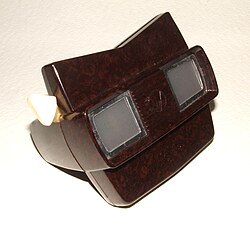
Military Use and Corporate Expansion
During World War II, the United States military recognized the educational value of stereoscopic imagery. Between 1942 and 1945, the military purchased 100,000 viewers and nearly six million reels for personnel training. This surge in demand fueled the company's growth, leading Sawyer's to transition from a partnership to a corporation and expand its manufacturing facilities in Washington County, Oregon.
In the 1950s, Sawyer's expanded its portfolio by acquiring its main competitor, Tru-Vue, which granted them the licensing rights to Walt Disney Studios. This allowed the company to produce popular reels featuring Disney characters and the newly opened Disneyland. During this era, the company also introduced the Personal Stereo Camera, allowing consumers to create their own custom reels.
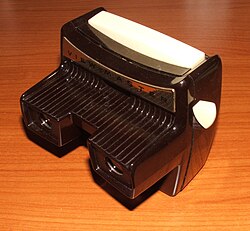
Evolution of the Viewer Models
As the product evolved, the hardware changed to meet modern tastes and technical needs:
- Model A: The original 1940 patented design.
- Model D: A high-quality viewer available until the early 1970s.
- Model E: Introduced in 1955, featuring a modern design with ivory buttons and a "V" slot for easier reel insertion.
- Model F: Released in 1958, this model introduced internal lighting powered by C-cell batteries.
![A model G View-Master viewer from the last years of the Sawyer's era[13]](/images/56/3d/563d3a8bfbec0b72c31b3b86ebf4c9cb1fc8a548b0dcb09de2f0992669dde5c1.jpg)
The Shift to Toys and Mass Media
In 1962, the company shifted from heavy Bakelite and Kodak Tenite plastics to lighter thermoplastics, starting with the Model G. By 1966, the General Aniline & Film (GAF) Corporation acquired Sawyer's. Under GAF, the content shifted from scenic landscapes to child-friendly subjects, including popular TV shows like Star Trek, Doctor Who, and The Beverly Hillbillies.
Innovation continued with the Talking View-Master in the 1970s, which added audio, and the Show Beam Projector in 1980, which used 2D film cartridges. After a series of corporate acquisitions involving the Ideal Toy Company and Tyco Toys, the brand eventually merged with Mattel in 1997, where it was placed under the Fisher-Price imprint.
The Leap into Virtual Reality
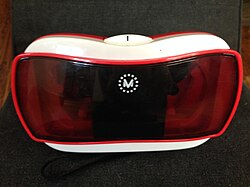
In 2015, Mattel collaborated with Google to modernize the brand for the digital age. The View-Master Virtual Reality Viewer utilized smartphones and the Google Cardboard platform. Instead of traditional film, users accessed 360-degree panoramas and 3D models via a mobile app. An updated DLX version was released in 2016 with focal adjustments and a headphone port, though both VR editions were discontinued in November 2019.
Key Facts
- Total Production: Approximately 1.5 billion reels and 25 different viewer models have been produced.
- Compatibility: The internal mechanism of the reels has remained consistent, meaning any reel works in any model.
- Military Impact: Nearly 6 million reels were used for US military training during WWII.
- Technological Shift: The product evolved from Bakelite plastic to thermoplastics and eventually to smartphone-based VR.
- Disney Partnership: The acquisition of Tru-Vue in 1951 gave View-Master access to Disney licensing.
| Era | Primary Owner | Key Focus | Material/Tech |
|---|---|---|---|
| 1939–1966 | Sawyer's, Inc. | Scenic Travel & Education | Bakelite / Kodachrome |
| 1966–1981 | GAF Corporation | Children's Toys & TV Shows | Thermoplastics / Audio |
| 1981–1997 | View-Master International/Tyco | Educational Video & Toys | Video/Projectors |
| 1997–Present | Mattel (Fisher-Price) | Preschool Content & VR | Digital/Smartphone VR |
Frequently Asked Questions
How does a View-Master create a 3D effect?
It uses stereoscopy, where a reel holds pairs of slightly different images. By presenting one image to each eye simultaneously, the viewer simulates binocular depth perception, making the image appear three-dimensional.
Will old reels work in newer View-Master models?
Yes. Despite changes in the exterior materials and viewer models over the decades, the basic design of the reels and internal mechanisms remained the same, ensuring universal compatibility.
Who invented the View-Master?
The View-Master was the result of a partnership between Edwin Eugene Mayer of Sawyer's Photo Finishing Service and William Gruber, a technician who designed the imaging rig and the reel system.
What happened to the scenic reels?
While the View-Master began as an alternative to scenic postcards, Mattel ceased the production of these tourist-attraction reels in December 2008, shifting focus toward animated characters.
Was the View-Master ever used for more than entertainment?
Yes, during World War II, the US military used the View-Master extensively for personnel training, purchasing millions of reels and thousands of viewers for this purpose.