Victory Ships: The Workhorses of World War II and Beyond
During the height of World War II, the United States required a robust fleet of cargo vessels capable of sustaining global military operations. The result was the Victory ship, a faster and more modern successor to the earlier Liberty ships. Designed for efficiency and versatility, these vessels played a critical role not only in the final years of the war but also in the subsequent decades of Cold War logistics and scientific exploration.
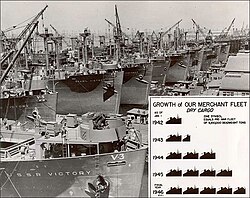
The first of these vessels, the SS United Victory, was launched at the Oregon Shipbuilding Corporation on January 12, 1944, and completed by February 28 of the same year. While early deliveries were slow—with only 15 ships delivered by May 1944—production rapidly accelerated. By the end of the war, 531 ships had been constructed, with a final total of 534 built in the United States after three additional vessels were completed in 1946 for the Alcoa Steamship Company.
Naming Conventions and Variants
The naming of these ships followed specific patterns. Most American vessels included the word "Victory" in their name. Following the SS United Victory, the next 34 ships were named after allied countries, 218 after American cities, and 150 after educational institutions. The remaining ships received miscellaneous names.
A notable exception was the AP5 type attack transports. These were named after United States counties and did not include "Victory" in their titles, with the sole exception of the USS Marvin H. McIntyre, named in honor of President Roosevelt's late personal secretary.
Technical Classifications
Victory ships were produced in several variants to meet different operational needs, ranging from general cargo to specialized attack transports:
- VC2-S-AP2: General cargo vessels powered by 6,000 hp (4.5 MW) engines.
- VC2-S-AP3: More powerful general cargo vessels with 8,500 hp (6.3 MW) engines.
- VC2-M-AP4: A rare diesel-powered variant.
- VC2-S-AP5: Known as Haskell-class attack transports.
- VC2-S-AP7: Post-war completions.
Key Facts
- Total Built: 534 vessels were constructed in the United States.
- Wartime Loss: No Victory ships were sunk by U-boats; three were lost to Japanese kamikaze attacks in April 1945.
- Cost: Each ship cost approximately $2,522,800 (roughly $36.5 million in 2024), based on a rate of $238 per deadweight ton.
- Versatility: 97 ships were converted into troopships for Operation Magic Carpet.
- Longevity: They served in both the Korean War (184 ships) and the Vietnam War (100 ships).
Post-War Evolution and Special Missions
Following the cessation of hostilities, many Victory ships were repurposed. During Operation Magic Carpet, 97 ships were converted into troopships to return US soldiers home. This conversion involved transforming cargo holds into bunk beds and hammocks stacked three high for "hot bunking," and adding mess halls and exercise areas.
Beyond troop transport, these ships were adapted for highly specialized roles. The diesel-powered MV Emory Victory (VC2-M-AP4) operated as the North Star III for the Bureau of Indian Affairs in Alaska. Others, like the South Bend Victory and Tuskegee Victory, became hydrographic surveying ships (USNS Bowditch and USNS Dutton). Notably, the USNS Dutton helped locate a lost hydrogen bomb after the 1966 Palomares B-52 crash.
NASA and Cold War Service
In 1959, NASA began refitting reserve fleet ships for space-age missions. The SS Kingsport Victory became the USNS Kingsport, the world's first satellite communications ship. Another vessel, the former Haiti Victory, recovered the nose cone of Discoverer 13—the first man-made object to return from orbit—on August 11, 1960.
The U.S. Navy also utilized them as fleet ballistic missile cargo ships (such as the USNS Norwalk and USNS Victoria) and technical research ships (AGTR). The USS Liberty, a converted Victory ship, was famously attacked by Israeli forces in June 1967. In the Vietnam War, the Baton Rouge Victory was sunk by a Viet Cong mine in August 1966, briefly blocking the channel to Saigon.
Production and Shipyards
To maximize efficiency, Victory ships were designed to be assembled using the smallest capacity cranes available at the emergency shipyards. Production was concentrated in six primary locations across the West Coast and Baltimore.
| Shipyard | Location | Total Built | Primary Types |
|---|---|---|---|
| Bethlehem Fairfield | Baltimore, Maryland | 95 | VC2-S-AP2, VC2-M-AP4 |
| California Shipbuilding | Wilmington, California | 232 | VC2-S-AP3, VC2-S-AP5, VC2-S-AP2 |
| Kaiser Vancouver | Vancouver, Washington | 31 | VC2-S-AP5 |
| Oregon Shipbuilding | Portland, Oregon | 136 | VC2-S-AP3, VC2-S-AP5, VC2-S-AP7 |
| Kaiser Richmond No. 1 | Richmond, California | 53 | VC2-S-AP3, VC2-S-AP2 |
| Kaiser Richmond No. 2 | Richmond, California | 89 | VC2-S-AP5, VC2-S-AP2 |
Frequently Asked Questions
Why were Victory ships created?
They were designed as a faster, more capable improvement over the Liberty ships to support Allied logistics during World War II.
How many Victory ships were lost to U-boats?
None. Because the Battle of the Atlantic had been largely won by the time Victory ships entered service, none were sunk by German U-boats.
What was Operation Magic Carpet?
It was the massive effort to bring US soldiers home after World War II, which saw 97 Victory ships converted into troopships with high-density bunking.
Did Victory ships serve after World War II?
Yes, they served extensively in the Korean and Vietnam Wars, and were later used by NASA for satellite communications and space object recovery.
What was the cost of a Victory ship?
The relative cost was $238 per deadweight ton, totaling approximately $2,522,800 per vessel, which is roughly $36.5 million in 2024 currency.