Victorian Corsets: Evolution, Controversy, and the Dress Reform Movement
During the mid- to late-Victorian era, the corset was more than just a garment; it was a central element of female identity, social standing, and medical debate. As fashions shifted, so did the architecture of the corset, evolving from structural supports to highly decorative pieces that mirrored the changing silhouettes of the 19th century.
The Evolution of Victorian Corset Styles
Corsets of this period were typically strapless, featuring fastenings at both the front and back. To add aesthetic appeal, designers often incorporated lace trims and boning in contrasting colors. The shape of these garments was heavily influenced by the accompanying skirts of the day.
In 1856, the invention of the cage crinoline—a structured petticoat designed to support large skirt volumes without the weight of multiple fabric layers—changed the requirements for corsetry. Because the crinoline provided the necessary volume at the hips, corsets became less dramatically shaped. However, by the 1870s, as skirts became smaller and less voluminous, the trend shifted back toward achieving a smaller waistline.
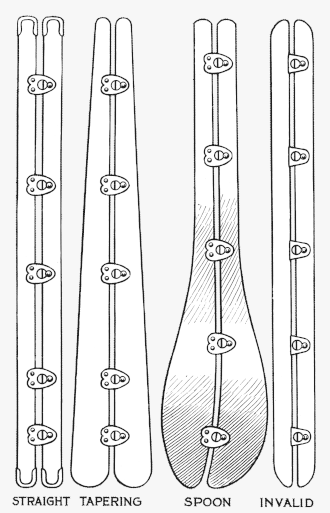
A significant technical innovation of the 1870s was the spoon busk. The busk is the rigid center-front stay of the corset; the "spoon" variety was specifically curved to shape the stomach and distribute pressure more effectively across the abdomen.
The Dress Reform Movement and Social Conflict
The 1850s and 1860s saw the rise of the dress reform movement, which campaigned against the use of corsets. Reformists were particularly critical of tightlacing, the practice of tightening a corset to achieve an unnaturally small waist.
This conflict was not merely about fashion, but about morality and power. Supporters of traditional corsetry argued that the garment maintained an upright "good figure," which they viewed as a physical manifestation of a moral and well-ordered society. Conversely, dress reformists viewed these fashions as a means of making women subservient, suggesting that the restrictive clothing cultivated a "slave psychology." They believed that liberating women from corsets would lead to greater social mobility, independence from marriage, and the ability to earn wages.
Science, Eugenics, and Medical Criticism
The debate over corsetry often intersected with social Darwinism and eugenics. Some critics expressed anxiety that corsets damaged the uterus, ovaries, and fetus, posing a threat to the European "race." They compared Western women to "primitive" races who did not wear corsets and were perceived as more vigorous and less prone to birth complications. Paradoxically, some proponents of the corset used Darwinian logic to argue that women were naturally frailer and less evolved, thus requiring the structural support of a corset.
Medical professionals also weighed in. Obstetricians linked lifelong corset-wearing to difficult childbirths. Physician Alice Bunker Stockham famously criticized the practice, sardonically suggesting that a corset should not be worn for two hundred years before pregnancy occurs.
Writer Elizabeth Stuart Phelps Ward captured the spirit of the reformists in 1873, urging women to "burn up the corsets" and discard the "cruel steels" that restricted the abdomen and thorax to achieve true emancipation.
The Rise of the "Hygienic" Corset
Despite intense pressure from doctors and reformists, the corset remained popular for decades. However, manufacturers began to adapt by introducing "hygienic" corsets. In this context, hygiene referred to the general health of the body rather than cleanliness.
These updated designs featured lightweight fabrics, buttons instead of metal clasps, and the integration of elastic. A notable figure in this movement was designer Roxey Ann Caplin, who collaborated with her husband—a physician and anatomist—to create anatomically forgiving corsets, including specialized versions for maternity wear.
Key Facts
- Cage Crinoline (1856): Reduced the need for dramatically shaped corsets by providing skirt volume.
- Spoon Busk (1870s): A curved front stay designed to shape the stomach and distribute pressure.
- Tightlacing: The controversial practice of extreme waist reduction.
- Dress Reform: A movement linking restrictive clothing to social subservience and physical ill-health.
- Hygienic Corsets: Health-conscious designs featuring elastic and lightweight materials.
| Era/Period | Dominant Silhouette | Key Technical Feature | Social Context |
|---|---|---|---|
| Mid-Victorian (1850s-60s) | Wider hips, less dramatic waist | Cage Crinoline | Rise of Dress Reform movement |
| Late-Victorian (1870s-80s) | Smaller, defined waists | Spoon Busk | Medical criticism of tightlacing |
| Turn of the Century (1890s-1900s) | Anatomically forgiving | Elastic and lightweight fabrics | Introduction of "hygienic" and maternity styles |
Frequently Asked Questions
What was the purpose of the spoon busk?
Developed in the 1870s, the spoon busk was a curved front stay used to shape the stomach and distribute pressure more evenly across the wearer's abdomen.
How did the cage crinoline affect corset design?
The cage crinoline, invented in 1856, allowed for massive skirt volumes without heavy petticoats. This shifted the focus away from the corset's role in creating hip volume, leading to less dramatically shaped corsets.
What did the dress reform movement believe about corsets?
Reformists believed corsets were physically detrimental and served as a tool of male conspiracy to make women subservient. They argued that removing corsets would increase women's independence, social mobility, and ability to work.
What were "hygienic corsets"?
Hygienic corsets were a response to health concerns. They utilized more flexible materials like elastic, lightweight fabrics, and buttons instead of metal clasps to promote better overall body health.
Why did some people use Social Darwinism to support corsets?
Some argued that women were less evolved and naturally frailer than men, and therefore required the physical support of a corset to maintain their posture and structure.