Valemount: A Journey of Growth and Resilience
Nestled in the heart of the mountains, Valemount has evolved from a small, itinerant settlement into a modern village with robust infrastructure. Its history is a testament to the impact of transportation, the volatility of the forestry industry, and a steadfast commitment to community development.
The early years of the settlement were marked by challenges. In 1950, the community witnessed the Canoe River train crash south of Valemount Station. For years, the population remained small and transient, hampered by unreliable electric power and poor winter road conditions. This changed significantly in the 1960s with the construction of the Yellowhead Highway 5, which opened the region to greater accessibility. On December 13, 1962, Valemount was officially incorporated as a village under the Municipal Act (now known as the Community Charter).
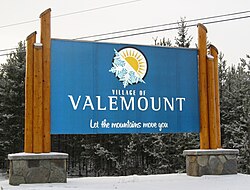
Rapid Expansion in the 1970s
The 1970s served as a decade of explosive growth. The population surged from 600 residents to 1,160 by the end of the decade. To support this influx, the village invested heavily in essential services and infrastructure:
- 1975: Completion of the sewer system.
- 1977: Installation of a 300,000-gallon water tower.
- 1978: Opening of a local clinic and a new shopping mall.
- 1979: Inauguration of the Community Hall in February.
During this era, several hotels were also constructed along Highway 5 to accommodate the increasing flow of travelers.
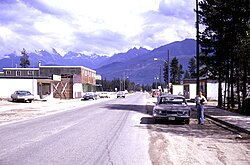
Economic Shifts: The 1980s and 1990s
By the 1980s, the pace of population growth slowed, and the community shifted its focus toward environmental and educational initiatives. In 1980, a clean-up operation began at an old dumpsite to establish the Starratt Wildlife Sanctuary. Education also became a priority with the 1984 founding of the Canoe Robson Education Development Association (CREDA), designed to provide residents with continued training.
The local economy was heavily tied to the lumber industry. Clearwater Timber Industries replaced Canyon Creek Forestry Products, employing 400 people across Clearwater and Valemount. However, the industry faced instability; after crises in 1984 and 1986, Clearwater Timber Industries went bankrupt and was purchased by Slocan Forest Products in May 1987.
The 1990s saw a brief peak in production. Between 1993 and 1996, the mill operated three full-time shifts with 160 employees, driving a 17 percent population increase. This prosperity was short-lived; Slocan reduced its workforce by two-thirds in 1998, leading to a 7.7 percent population drop by 2001. Although the mill was later acquired by Carrier Lumber, it never regained its previous levels of employment and closed permanently in 2006.
Infrastructure and Regional Integration
Despite economic fluctuations, Valemount continued to modernize its village infrastructure. Between 1993 and 2000, all village streets were paved. The community also saw the renovation of the Arena and Curling Rink, and the completion of the airport terminal in 1996.
A significant milestone occurred in 1995 when Valemount joined the Columbia Basin Trust. This organization was created by the Columbia Basin Trust Act to support regions adversely affected by the Columbia River Treaty, which had led to the flooding of the Canoe River Basin following the completion of the Mica Dam in 1974.
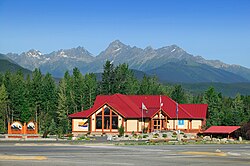
Education services also expanded; in 1997, CREDA evolved into the Valemount Learning Centre. This center grew from a one-person office to a professional hub employing three full-time and three part-time staff to provide employment and training services.
Valemount in the 21st Century
Today, Valemount is a connected community featuring high-speed wireless internet, bus, train, and highway services. The village is served by The Rocky Mountain Goat News, a locally owned weekly newspaper. Recognized as a top newspaper in its circulation category by the BC Yukon Community Newspapers Association in 2015, it covers Valemount, McBride, Dunster, Tête-Jaune, and parts of Jasper and Blue River.
Technological and utility upgrades have continued into the new millennium. A second 300,000-gallon water tower was added in 2003, alongside a new water treatment plant. Connectivity improved with a wireless wide-area network in 1999, ADSL service in 2003, and cell phone service in 2004, with rural high-speed internet arriving by 2005.
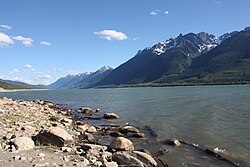
Looking toward the future, Valemount is exploring sustainable energy. On October 27, 2010, Borealis Geopower received three permits to explore the Canoe Reach area of Kinbasket Lake for geothermal development (the process of harnessing heat from the earth), making it the second region in British Columbia opened for such exploration.
Key Facts
- Incorporation: Officially became a village on December 13, 1962.
- Population Peak: Experienced significant growth in the 1970s and a secondary spike between 1993 and 1996.
- Industry: Historically dependent on lumber, with the final sawmill closing in 2006.
- Infrastructure: All village streets were paved by 2000; two 300,000-gallon water towers are in service.
- Energy: One of only two regions in B.C. permitted for geothermal exploration (Canoe Reach area).
| Year/Period | Key Event/Development |
|---|---|
| 1950 | Canoe River train crash |
| 1962 | Incorporated as a village |
| 1974 | Mica Dam completed; Canoe River Basin flooded |
| 1975-1979 | Sewer, water tower, clinic, and Community Hall completed |
| 1984 | CREDA founded |
| 1995 | Joined the Columbia Basin Trust |
| 2006 | Permanent closure of the local sawmill |
| 2010 | Geothermal exploration permits granted |
Frequently Asked Questions
When was Valemount officially incorporated?
Valemount was incorporated as a village on December 13, 1962, under the Municipal Act.
How did the Yellowhead Highway 5 affect the village?
Before the highway's construction in the 1960s, Valemount had a small, mostly itinerant population and suffered from poor winter road conditions.
What happened to the lumber industry in Valemount?
The industry saw a peak between 1993 and 1996 under Slocan Forest Products, but workforce reductions began in 1998. The sawmill, later owned by Carrier Lumber, closed permanently in 2006.
What is the purpose of the Columbia Basin Trust in Valemount?
Valemount joined the trust in 1995 to receive benefits as a region adversely affected by the Columbia River Treaty and the flooding of the Canoe River Basin.
What is the current status of geothermal energy in the area?
In October 2010, Borealis Geopower obtained permits to explore the Canoe Reach area of Kinbasket Lake for geothermal development.