UTC+03:00 Time Zone: Global Usage and Regional Variations
UTC+03:00 is a time offset identifier indicating that a region is three hours ahead of Coordinated Universal Time (UTC). Following the ISO 8601 international standard, a timestamp in this zone is represented as +03:00 (for example, 2019-02-08T23:36:06+03:00). This time zone is centered on the 45 degrees East meridian and is designated by the date-time group C.
Because it spans vast regions of Africa, Asia, and Europe, UTC+03:00 serves as a critical temporal anchor for millions of people, ranging from the bustling streets of Istanbul and Moscow to the highlands of Ethiopia and the coasts of Saudi Arabia.
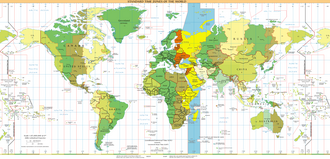
Key Facts
- Offset: 3 hours ahead of Coordinated Universal Time (UTC+3).
- Central Meridian: 45° East.
- Primary Use: Used as standard year-round time in East Africa, the Middle East, and much of European Russia.
- Seasonal Use: Serves as Daylight Saving Time (DST) for several Eastern European and Middle Eastern nations.
- Major Cities: Includes Moscow, Istanbul, Riyadh, Baghdad, Nairobi, and Addis Ababa.
UTC+03:00 as Standard Year-Round Time
Many regions utilize UTC+03:00 as their permanent standard time, meaning they do not shift their clocks for seasonal changes.
Africa
In East Africa, this offset is the norm for several nations and territories, including Kenya, Ethiopia, Tanzania, Uganda, Somalia, Djibouti, Eritrea, Madagascar, and the Comoros. It also extends to French territories such as Mayotte and the Scattered Islands in the Indian Ocean (including Europa and Juan de Nova Islands).
![Time in Africa: Light Blue Cape Verde Time[a] (UTC−1) Blue Greenwich Mean Time (UTC) Red Central European TimeWest Africa Time (UTC+1)[b] Yellow Central Africa TimeEastern European TimeSouth African Standard Time (UTC+2) Ochre Egypt Standard Time (UTC+2) Egypt Summer Time (UTC+3) Green East Africa Time (UTC+3) Turquoise Mauritius Time[d]Seychelles Time[d] (UTC+4) a The islands of Cape Verde lie west of the African mainland. b In September 2026, Morocco will switch permanently to Greenwich Mean Time. d Mauritius and the Seychelles lie to the east and northeast of Madagascar, respectively.](/images/dd/c2/ddc252eec4cac936b4731a46d89b8cfaa93646b0ccd8e1b5daa00c025697629e.webp)
Asia and Arabia Standard Time (AST)
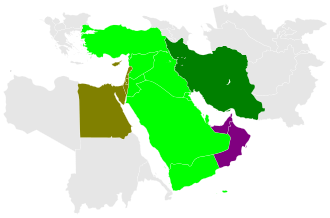
In the Middle East, this offset is known as Arabia Standard Time (AST). Because these regions are located near the equator, day length remains relatively consistent throughout the year, making Daylight Saving Time unnecessary. AST is used by Saudi Arabia, Iraq, Jordan, Kuwait, Qatar, Bahrain, Syria, and Yemen.
Europe and Russia
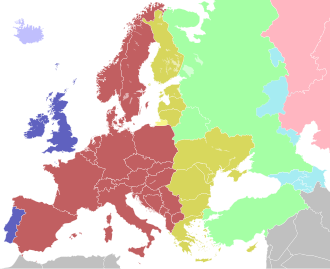
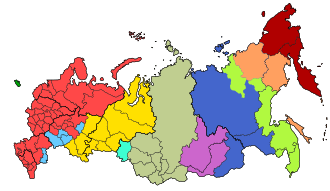
A significant portion of European Russia uses UTC+03:00, known as Moscow Time. This includes the Central, Northwestern, and Southern Federal Districts (with some exceptions like Kaliningrad and Astrakhan). Turkey also adopted UTC+03:00 as its year-round time on September 7, 2016. Additionally, Belarus and various Russian-occupied territories in Ukraine utilize this offset.
UTC+03:00 as Daylight Saving Time
For several countries in the Northern Hemisphere, UTC+03:00 is not the standard time but is instead used during the summer months to extend evening daylight.
- Europe: Countries such as Greece, Finland, Estonia, Latvia, Lithuania, Romania, Bulgaria, Moldova, and Cyprus shift to this offset during the summer.
- Asia: Israel, Lebanon, and Palestine utilize UTC+03:00 as their summer time.
- Africa: Egypt employs this offset as its daylight saving time.
Geographical vs. Official Time Discrepancies
There is often a difference between the physical time (the time based on actual longitude) and the official time (the time mandated by a government).
Some areas that geographically fall within the UTC+03:00 longitude range actually use different offsets. For example, Georgia, Armenia, and Azerbaijan use UTC+04:00. Conversely, some areas outside the physical UTC+03:00 range adopt it for political or economic reasons. Turkey and Belarus are primary examples of nations whose official time is shifted east of their physical longitude.
| Region | Usage Type | Key Countries/Areas |
|---|---|---|
| East Africa | Standard (Year-round) | Kenya, Ethiopia, Tanzania, Uganda |
| Middle East | Standard (AST) | Saudi Arabia, Iraq, Qatar, Kuwait |
| European Russia | Standard (Moscow Time) | Moscow, Saint Petersburg |
| Eastern Europe | Daylight Saving (Summer) | Greece, Finland, Romania, Bulgaria |
| Turkey | Standard (Year-round) | Istanbul, Ankara |
Frequently Asked Questions
What is Arabia Standard Time (AST)?
Arabia Standard Time is the name given to the UTC+03:00 offset in the Middle East. It is used year-round by countries like Saudi Arabia and Iraq because their equatorial location results in minimal seasonal variation in daylight.
Why does Russia use UTC+03:00 for Moscow Time?
Russia has undergone several time zone changes. After an unpopular experiment with permanent summer time between 2011 and 2014, the government returned to standard time on October 26, 2014, establishing UTC+03:00 as the permanent offset for Moscow and surrounding regions.
Does Turkey observe Daylight Saving Time?
No. Since September 7, 2016, Turkey has remained on UTC+03:00 year-round, effectively abandoning the practice of switching clocks twice a year.
Which European countries use UTC+03:00 in the summer?
Several Eastern European nations, including Finland, Estonia, Latvia, Lithuania, Romania, Bulgaria, and Greece, shift to UTC+03:00 during the Northern Hemisphere summer as part of their daylight saving observations.
What is the difference between physical time and official time in this zone?
Physical time is determined by a location's longitude (15 degrees equals one hour). Official time is the legal time set by a government. For instance, the westernmost point of contiguous Russia using UTC+03:00 is roughly 1 hour and 11 minutes ahead of its physical solar time.