Usman Buzdar's Tenure as Chief Minister of Punjab (2018–2022)
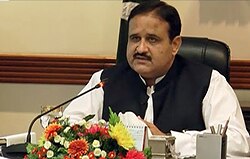
The appointment of Usman Buzdar as the Chief Minister of Punjab in 2018 marked a controversial chapter in Pakistan's provincial governance. Nominated by Imran Khan, the leader of the Pakistan Tehreek-i-Insaf (PTI), Buzdar's rise to power was unexpected, as he was a relatively unknown figure in the national political landscape at the time.
Imran Khan defended the nomination by highlighting Buzdar's origins in an economically disadvantaged area of Punjab, noting that he was the only member of the Punjab Assembly who lacked electricity at his home. However, critics and political analysts suggested the choice was strategic, arguing that Buzdar lacked an independent power base and was therefore entirely dependent on Khan's support to maintain his position.
On August 19, 2018, Buzdar was elected Chief Minister with 186 votes, defeating Hamza Shahbaz Sharif, who received 159 votes. He officially took the oath of office on August 20, 2018.
Cabinet Formation and Governance
Following his swearing-in, Buzdar established a 23-member cabinet on August 27, 2018. This was later expanded on September 13, 2018, with the addition of 12 provincial ministers, bringing the total cabinet size to 35. Additionally, Chaudhry Sarwar was appointed as the Governor of Punjab on September 5, 2018.
Key Facts
- Election Result: Won with 186 votes against 159.
- Cabinet Size: Expanded from 23 to 35 members.
- Education Goal: Aimed to enroll 4.8 million out-of-school children via "The New Deal."
- Health Initiative: Launched the Insaaf Medicine Card for AIDS, hepatitis, and tuberculosis.
- COVID-19 Relief: Provided a Rs 10 billion package for 2.5 million daily-wage families.
- Resignation: Stepped down in April 2022 to help mitigate a political crisis.
Criticism and Administrative Challenges
Buzdar's administration faced persistent criticism regarding competence and stability. A notable sign of instability was the replacement of five different Inspector Generals of the Punjab Police during his term. Internal friction also existed within the PTI; prominent members such as Asad Umar and Jahangir Tareen reportedly opposed his appointment.
Furthermore, the government struggled with labor promises. By April 9, 2022, the promised Punjab Mazdoor Card (a worker's identification and benefit card) had not been issued, and minimum wages had not been provided to laborers despite previous registration efforts and deadlines.
Education and Healthcare Initiatives
In Dera Ghazi Khan, the administration focused on infrastructure, establishing the district's first technical university, constructing a Boys Degree College, and introducing a Bachelor of Science program in the Tonsa District. Schools in tribal areas were also solarized. In 2019, Buzdar introduced "The New Deal," a five-year policy targeting the enrollment of 4.8 million children.
Healthcare efforts were centered on the Punjab Sehat Sahulat Program. Key developments included:
- The Insaaf Medicine Card for treating tuberculosis, hepatitis, and AIDS.
- A Rs 400 billion health-card program for the Lahore Division (January 2022).
- A Rs 13.80 billion universal health insurance program for Layyah District, providing Rs 725,000 annual insurance per family.
- The completion of a mother and child hospital costing Rs 5.73 billion.
Despite these launches, the program faced severe criticism. In 2019, only 93,000 people benefited out of 5 million eligible families—a success rate of 0.2%. Reports indicated that the CEO and COO positions of the Punjab Health Insurance Initiative Management Company (PHIIMC) remained vacant for two years, and the lack of coverage for emergency services and outpatient departments (OPD) rendered the program largely ineffective for the general public.
Development Budget and Spending
In March 2021, Buzdar announced "uplift" projects totaling Rs 25 billion, with Rs 8.41 billion dedicated to new projects. However, reports from June 2021 suggested that a significant portion of the provincial budget—specifically a Rs 560 billion three-year district package—was primarily allocated to schemes recommended by PTI legislators for their own constituencies.
COVID-19 Response
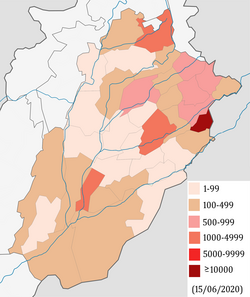
The pandemic prompted several emergency measures starting in March 2020. The government enacted a two-day closure of public centers and urged social distancing. To support the economy, a Rs 10 billion relief package was announced for 2.5 million daily-wage families, providing Rs 4,000 per family (excluding BISP beneficiaries).
Other measures included:
- Reducing provincial taxes by Rs 18 billion.
- Introducing the Punjab Infectious Diseases Prevention and Control Ordinance, 2020.
- Granting a 90-day imprisonment rebate to approximately 3,100 prisoners.
- Providing an additional month's salary to all healthcare workers.
- Allocating Rs 11.5 billion for the health sector and the Provincial Disaster Management Authority (PDMA).
- Recruiting 10,000 doctors and paramedics and establishing testing capacity for 3,200 people daily.
Summary of Key Programs and Figures
| Category | Initiative/Metric | Details/Value |
|---|---|---|
| Election | Vote Count | 186 (Buzdar) vs 159 (Sharif) |
| Education | The New Deal | Target: 4.8 million children |
| Healthcare | Layyah Insurance | Rs 13.80 billion (Rs 725k per family) |
| Healthcare | Sehat Sahulat (2019) | 0.2% success rate (93k/5m families) |
| COVID-19 | Financial Relief | Rs 10 billion for daily-wage earners |
| Budget | District Package | Rs 560 billion over 3 years |
Resignation and Departure
On March 28, 2022, Usman Buzdar offered his resignation to Prime Minister Imran Khan in an attempt to ease the political tension surrounding a no-confidence motion against the Prime Minister. The Governor of Punjab accepted the resignation on April 1, 2022, though Buzdar remained in a caretaker capacity until a successor was appointed.
Buzdar officially left office on April 30, 2022, when Hamza Shahbaz was sworn in as the new Chief Minister of Punjab.
Frequently Asked Questions
Why was Usman Buzdar's appointment controversial?
His appointment was criticized because he was a little-known political figure and was perceived by some as lacking the competence and independent power base necessary for the role, making him entirely reliant on Imran Khan.
What was "The New Deal" in Punjab's education sector?
"The New Deal" was a five-year education policy announced in 2019 with the goal of enrolling an estimated 4.8 million out-of-school children into the provincial school system.
How effective was the Sehat Sahulat Program in 2019?
The program had a very low success rate of 0.2% in 2019, benefiting only 93,000 people out of 5 million eligible families, partly due to vacant leadership positions and a lack of coverage for emergency and OPD services.
What financial aid was provided during the COVID-19 pandemic?
The government provided a Rs 10 billion relief package for 2.5 million daily-wage families (Rs 4,000 per family), reduced provincial taxes by Rs 18 billion, and gave healthcare workers an additional month's salary.
When and why did Usman Buzdar resign?
He offered his resignation on March 28, 2022, to help resolve the political crisis involving the no-confidence motion against Prime Minister Imran Khan, eventually leaving office on April 30, 2022.