Urban Parks: The Evolution and Impact of City Green Spaces
An urban park—also referred to as a city, municipal, or public park—is a landscaped green space located within cities, densely populated suburbs, or other incorporated areas. Unlike wild lands, these spaces are intentionally designed to provide residents and visitors with areas for recreation and relaxation. While typically managed by local government agencies, some parks are maintained through partnerships with private sector companies, "friends of" groups, or park conservancies.
From sprawling regional estates to tiny neighborhood plots, urban parks offer a variety of amenities. Depending on their budget and land features, common inclusions range from playgrounds, gardens, and sports courts to hiking trails, performance venues, and picnic facilities. Experts suggest that placing these spaces within a 10-minute walk of urban residents provides significant community benefits.
![Central Park, one of the world's most visited tourist attractions,[1] is surrounded by the skyscrapers of Manhattan in New York City.](/images/3d/a3/3da37b9c8ee226bea93b81936e0ecacbce1f3317290001c089c4c704106045cc.jpg)
Key Facts
- Purpose: Designed for recreation, aesthetic beauty, and the mitigation of the urban heat island effect (the phenomenon where urban areas are warmer than surrounding rural areas due to human activity and infrastructure).
- Management: Primarily handled by local governments, though often supported by non-profit advisory boards.
- Types of Use: Divided into active recreation (intensive, developed) and passive recreation (low-intensity, natural).
- Global Reach: Examples range from the Alameda Central in Mexico City (the oldest in the Americas) to the massive Casa de Campo in Madrid.
The History of Public Green Spaces
The concept of the public park has evolved over centuries. Early examples include Seville's La Alameda de Hércules, built in 1574, and Budapest's Városliget, which began as a city property in the mid-18th century before a formal design competition was held in 1813.
In the 19th century, the movement toward purpose-built public parks gained momentum. In 1843, Princes Park opened in Liverpool, designed by Joseph Paxton. This project was revolutionary because it provided open space for townspeople in a rapidly developing urban area. Paxton's work, particularly his use of serpentine carriageways and informal lakes, heavily influenced the design of Birkenhead Park. This, in turn, served as a primary inspiration for Frederick Law Olmsted and Calvert when they designed New York's Central Park in 1857.
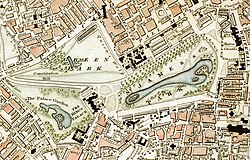
Development in the United States
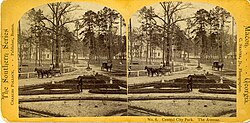
The trajectory of American parks began with the Boston Common in 1634, which served as a military parade ground and cow pasture before incorporating recreational elements in 1728. Interestingly, early outdoor recreation for the general public often took place in rural cemeteries, which functioned as civic institutions featuring art and sculpture.
Professor Galen Cranz identifies four distinct phases of U.S. park design:
- Pleasure Grounds: Late 19th-century large tracts on city outskirts designed for workers to relax in nature. These often evolved into regional parks containing zoos and museums.
- Neighborhood Parks: Early 1900s spaces featuring swimming pools and playgrounds, often intended to help immigrant residents assimilate.
- Post-WWII Recreation: 1950s parks focusing on indoor and outdoor sports leagues and gymnasia for all age groups.
- Pocket Parks: From the 1960s onward, small-scale greenery (such as Glendale's Chess Park) created to fit into expensive urban land.
The United Kingdom Landscape
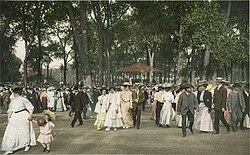
The UK boasts approximately 27,000 public parks, attracting 2.6 billion visits annually. While many are of national historical importance, funding remains a challenge. A 2016 report indicated that 92% of park managers had seen their maintenance budgets decrease over the preceding three years.
Understanding Park Uses and Types
Urban parks are generally categorized by the intensity of their use:
Active vs. Passive Recreation
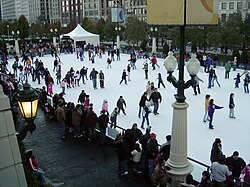
Active recreation involves intensive development and cooperative activities. This includes high-maintenance facilities like skateparks, ball fields, and swimming pools. In contrast, passive recreation (or low-intensity recreation) emphasizes the preservation of natural habitats. This includes walking trails, bird watching, and picnicking, which require minimal management and lower costs.
Specialized Park Formats
- Linear Parks: Parks that are significantly longer than they are wide, such as New York's High Line or Toronto's Village of Yorkville Park. These are often converted from former railways (rail trails).
- Pocket Parks: Tiny urban plots providing a quick refuge of greenery in dense areas.
- Recreation Grounds: Common in the UK and EU, these "recs" often feature play areas for children, duck ponds, and large grassy zones.
Summary of Urban Park Characteristics
| Park Type | Primary Focus | Maintenance Level | Example |
|---|---|---|---|
| Regional/Pleasure Ground | Nature, Zoos, Museums | High | Central Park, NY |
| Neighborhood Park | Community Sports, Playgrounds | Moderate | Local municipal parks |
| Pocket Park | Quick respite, seating | Low to Moderate | Chess Park, CA |
| Linear Park | Walking, Cycling, Connectivity | Moderate | The High Line, NY |
Frequently Asked Questions
What is the difference between active and passive recreation?
Active recreation requires developed infrastructure for team sports or intensive activity (like swimming pools), while passive recreation focuses on low-impact activities in natural settings (like bird watching or walking).
How do urban parks help with city temperatures?
Parks use trees and vegetation to reduce the urban heat island effect, providing shade and cooling the surrounding air in densely built environments.
What is a linear park?
A linear park is a narrow, elongated green space, often created by converting old infrastructure like railways into "rail trails" or greenways.
Which is the oldest public park in the Americas?
The Alameda Central in Mexico City is recognized as the oldest public park in the Americas.
Who typically manages city parks?
They are usually managed by local government agencies, though they may be supported or maintained by private companies or "friends of" non-profit groups.