Upton Sinclair: The Muckraker Who Shaped American Social Reform
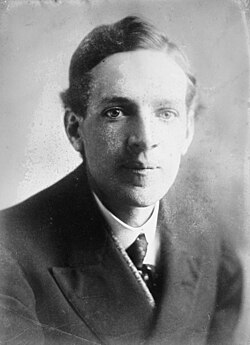
Upton Sinclair was a powerhouse of American letters and political activism, a man whose pen was as potent as any political platform. As a novelist, journalist, and lifelong activist, Sinclair dedicated his career to exposing the systemic failures of industrial capitalism and advocating for the marginalized. From the slaughterhouses of Chicago to the gubernatorial races of California, his life was a relentless pursuit of social justice.
Throughout the first half of the 20th century, Sinclair became a household name, producing nearly 100 books across various genres. His ability to blend rigorous research with compelling narrative earned him the 1943 Pulitzer Prize for Fiction and cemented his legacy as one of the most influential muckrakers—investigative journalists who expose corruption and social ills—in United States history.
Key Facts
- Most Famous Work: The Jungle (1906), which exposed the meatpacking industry.
- Major Award: Won the Pulitzer Prize for Fiction in 1943.
- Political Reach: 1934 Democratic Party nominee for Governor of California.
- Literary Output: Authored nearly 100 books, including the expansive Lanny Budd series.
- Political Affiliations: Member of the Socialist Party (1902–1934) and the Democratic Party (1934–1968).
Early Life and Intellectual Foundation
Born on September 20, 1878, Upton Beall Sinclair Jr. developed an early appetite for social critique. He pursued higher education at the City College of New York, where he earned his BA, and later attended Columbia University. These formative years provided the academic grounding for his lifelong exploration of economic inequality and political theory.
A Career of Literary Activism
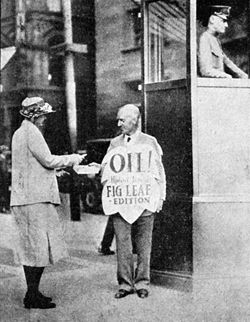
Sinclair's writing was rarely just for entertainment; it was a tool for change. His most enduring work, The Jungle (1906), remains a landmark of American literature for its visceral depiction of the meatpacking industry and the plight of immigrant workers. While Sinclair intended the book to highlight the exploitation of laborers, it famously sparked a public outcry over food safety.
Beyond his early success, Sinclair explored a vast array of themes. He wrote the Sylvia novels and the Lanny Budd series, a sprawling collection of 11 novels spanning from 1940 to 1953 that examined global politics. He also ventured into non-fiction with works like The Brass Check (1919) and The Fasting Cure (1911), reflecting his interests in journalism and health.
Venturing into Film
Sinclair's influence extended to the silver screen. During his time in Pasadena, California, he produced several films. Notably, he was recruited by Charlie Chaplin and worked with Mary Craig to produce Eisenstein's ¡Qué viva México! between 1930 and 1932.
The Political Journey: From Socialism to the Democratic Party
Sinclair's political life was as prolific as his writing. He joined the Socialist Party in 1902, though he briefly broke away in 1917 to support the World War I effort before returning to the party in the 1920s. His early political attempts included a 1906 run for Congress in New Jersey, where he polled 3% of the vote.
After moving to California, Sinclair founded the state chapter of the American Civil Liberties Union (ACLU). He ran for the House of Representatives in 1920 and the Senate in 1922, both unsuccessfully. He later sought the governorship of California on the Socialist ticket in 1926 and 1930, garnering nearly 46,000 and 50,000 votes, respectively.
The 1934 Gubernatorial Campaign
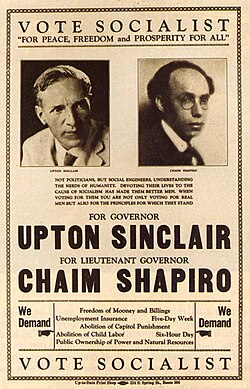
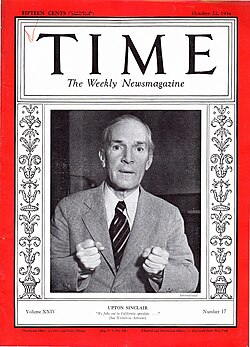
The pinnacle of his political career came in 1934 when he ran for Governor of California as the Democratic Party nominee. His campaign was centered on the EPIC (End Poverty in California) plan, a bold proposal to combat the Great Depression. Although he did not win, the campaign made him a national figure and a symbol of radical reform during a time of economic crisis.
Personal Life and Legacy
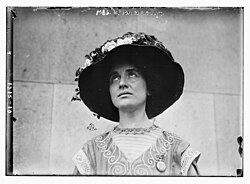
Sinclair's personal life was marked by three marriages. He first married Meta Fuller, with whom he divorced in 1911. In 1913, he married Mary Craig Kimbrough, an author from an elite Mississippi family who had been drawn to him after attending a lecture on The Jungle. They remained married until her death in 1961. Later that year, he married Mary Elizabeth Willis, who passed away in 1967.
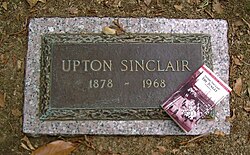
Sinclair passed away in a nursing home in Bound Brook, New Jersey, on November 25, 1968, at the age of 90. He is buried in Rock Creek Cemetery in Washington, D.C.
Summary of Upton Sinclair's Life
| Category | Details |
|---|---|
| Lifespan | September 20, 1878 – November 25, 1968 |
| Education | City College of New York (BA), Columbia University |
| Key Literary Works | The Jungle, Oil!, Lanny Budd series |
| Political Parties | Socialist (1902–1934), Democratic (1934–1968) |
| Major Political Bid | Democratic nominee for Governor of California (1934) |
| Notable Award | Pulitzer Prize for Fiction (1943) |
Frequently Asked Questions
What was the impact of The Jungle?
The Jungle is most famous for exposing the unsanitary conditions of the American meatpacking industry, which led to significant public outcry and subsequent food safety reforms, although Sinclair's primary goal was to highlight the exploitation of workers.
What was the EPIC plan?
The End Poverty in California (EPIC) plan was the centerpiece of Sinclair's 1934 gubernatorial campaign, proposing a radical economic restructuring to provide relief and employment during the Great Depression.
Did Upton Sinclair ever win a political election?
No, despite several runs for Congress and the governorship of California under both the Socialist and Democratic tickets, Sinclair was never elected to public office.
Which books are part of the Lanny Budd series?
The series includes 11 novels: World's End, Between Two Worlds, Dragon's Teeth, Wide is the Gate, Presidential Agent, Dragon Harvest, A World to Win, Presidential Mission, One Clear Call, O Shepherd, Speak!, and The Return of Lanny Budd.
What other interests did Sinclair have besides writing and politics?
Sinclair was interested in health and hygiene, as seen in his book The Fasting Cure, and he was involved in the film industry, producing works such as ¡Qué viva México!.