University of Pittsburgh School of Law Academic Programs and Opportunities
The University of Pittsburgh School of Law provides a comprehensive legal education designed to prepare students for the complexities of modern legal practice. While the school offers four distinct degrees, the Juris Doctor (J.D.)—the primary degree required to practice law in most of the United States—comprises the majority of the student body.
Key Facts
- Primary Degree: The J.D. is the most common degree pursued for U.S. legal practice.
- Practical Training: Extensive clinical programs and moot court competitions provide hands-on experience.
- Global Reach: Specialized area studies in five international legal systems.
- Unique Media: Home to JURIST, the only law school-based comprehensive legal news service.
- D.C. Integration: Dedicated Semester in D.C. program for externships and public policy study.
Academic Specializations and Certificates
To allow students to tailor their education to specific career goals, Pitt Law offers a variety of certificate programs and specialized areas of study. These include the John P. Gismondi Civil Litigation Certificate Program, as well as concentrations in Environmental Law, Science and Policy, Health Law, and Intellectual Property and Technology Law.
Students can also focus their studies on International and Comparative Law, Disability Studies, or Law and Entrepreneurship. For those interested in the intersection of law and government, the Washington, D.C. Externship Program provides critical professional exposure.
Pitt Law Center for International Legal Education
The Center for International Legal Education supplements the core study of International Law by offering focused area studies. These programs are designed to prepare students for global careers by immersing them in specific legal systems:
- Asian Studies
- Global Studies
- Latin American Studies
- Russia and Eastern European Studies
- Western European Studies
Experiential Learning and Clinical Programs
Pitt Law emphasizes experiential skills, ensuring students apply theoretical knowledge to real-world scenarios before graduation. This is primarily achieved through clinical programs, where students work as lawyers under supervision.
Legal Clinics
The school currently operates several specialized clinics, including:
- Tax Clinic
- Securities Arbitration Clinic
- Family Law Clinic
- Environmental Law Clinic
- Health Law Clinic
- Elder Law Clinic
- Immigration Law Clinic
Lawyering Skills and Competitions
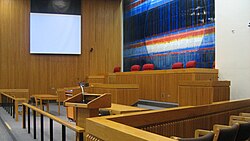
Beyond clinics, the school fosters competitive excellence through its Moot Court Board, which manages three annual intramural competitions: the Appellate Moot Court Competition, the Murray S. Love Trial Moot Court Competition, and the Negotiations Competition.
Pitt Law also fields teams for interscholastic and international competitions in fields such as Energy Law, Environmental Law, Health Law, International Arbitration, Workers' Compensation Law, Client Counseling, and Intellectual Property. Additionally, the Mock Trial Program utilizes adjunct coaches from the local practicing bar. The impact of these programs is significant; in the 2014-2015 academic year, over 20% of second- and third-year students participated in interscholastic competitions.
The Semester in D.C. Program
Second- and third-year students have the opportunity to spend their spring semester in Washington, D.C. This program combines a full-time externship—a practical internship for academic credit—with a seminar class hosted at the school's Washington Center.
Students may also pursue a Public Policy Concentration, which involves additional coursework focused on applying legal research, writing, and advocacy skills within a policy-making context.
Legal Publications and Research
The University of Pittsburgh School of Law is a hub for legal scholarship, hosting several student-edited journals and law reviews.
Law Reviews and Journals
The school publishes the University of Pittsburgh Law Review and the Journal of Law and Commerce. Notably, the Pittsburgh Law Review was recognized as one of the 40 most-cited law reviews in the country according to a 1996 Faculty Scholarship Survey by the Chicago-Kent Law Review.
Other publications include the Pittsburgh Tax Review and the Pittsburgh Journal of Technology Law & Policy. (Note: The Pittsburgh Journal of Environmental and Public Health Law ceased publication in 2024).
JURIST
A unique asset of the institution is JURIST, the world's only comprehensive legal news and research service based within a law school. Staffed by law faculty and students, JURIST provides real-time reporting on legal developments, prioritizing substantive importance over commercial appeal.
Academic Summary
| Category | Key Offerings |
|---|---|
| Primary Degree | Juris Doctor (J.D.) |
| International Studies | Asian, Global, Latin American, Russia/Eastern European, and Western European Studies |
| Clinical Areas | Tax, Securities Arbitration, Family, Environmental, Health, Elder, and Immigration Law |
| Major Publications | University of Pittsburgh Law Review, Journal of Law and Commerce, JURIST |
| External Programs | Semester in D.C. Program, Washington, D.C. Externship |
Frequently Asked Questions
What is the most common degree earned at Pitt Law?
The Juris Doctor (J.D.) is the most common degree, as it is the requirement for practicing law in most parts of the United States.
What is JURIST?
JURIST is a law school-based legal news and research service that reports on substantive legal developments for the public and the legal community.
How does the Semester in D.C. program work?
Second- and third-year students spend a spring semester in Washington, D.C., combining a full-time externship for credit with a seminar class at the school's Washington Center.
What types of practical experience are available to students?
Students can gain practical experience through various legal clinics (such as the Tax or Immigration clinics), moot court competitions, and the Mock Trial Program.
Does Pitt Law offer international legal studies?
Yes, the Pitt Law Center for International Legal Education offers area studies in Asian, Global, Latin American, Russia and Eastern European, and Western European legal systems.