Université de Montréal: A History of Academic Independence and Innovation
The Université de Montréal stands today as a beacon of French-language higher education and research in North America. Its journey from a satellite branch to a world-class public institution is a story of persistence, navigating financial hardships, and a relentless pursuit of academic autonomy.
Foundations and the Path to Autonomy
The institution began in 1878 as a branch of Université Laval from Quebec City, operating under the name Université Laval à Montréal. Its inception was not without conflict; Bishop Édouard-Charles Fabre of Montréal had originally advocated for a fully independent university within the city. While some facilities, such as the Faculty of Medicine (established in 1843 as the Montreal School of Medicine and Surgery) and the Séminaire de Québec (1876), were already present, the university remained tied to Quebec City for decades.
The road to independence occurred in stages. In 1889, the Vatican granted the university administrative autonomy, allowing it to appoint its own professors and issue its own diplomas. Full autonomy finally arrived on May 8, 1919, via a papal charter from Pope Benedict XV. This transition established the institution as an independent Catholic university under its current name, followed by its first provincial charter on February 14, 1920.
In its early years, the university was modest, with fewer than 100 students spread across three faculties located in Old Montreal: Theology (at the Grand séminaire de Montréal), Law (hosted by the Society of Saint-Sulpice), and Medicine (at the Château Ramezay).
Academic Expansion and Structural Evolution
To address inconsistencies in secondary education across Québec, the university established a preparatory school in 1887 known as the "Faculty of Arts." This school served as a bridge to harmonize student education levels until 1972 and is considered the predecessor to the modern CEGEP (Collège d'enseignement général et professionnel) system. During this era, the university also adopted graduate training models inspired by German and American systems, emphasizing specialized coursework and research theses.
The university's scope expanded through the affiliation of specialized schools. The École Polytechnique (engineering), founded in 1873, joined in 1887, and the École des Hautes Études Commerciales (HEC), a business school founded in 1907, became part of the university in 1915. Furthermore, in 1907, the university launched Canada's first francophone school of architecture within the École Polytechnique.
Between 1920 and 1925, the institution grew rapidly with the addition of seven new faculties: Philosophy, Literature, Sciences, Veterinary Medicine, Dental Surgery, Pharmacy, and Social Sciences. The Faculty of Social Sciences, founded in 1920, was notably led by Édouard Montpetit, the first layperson (non-clergy) to lead a faculty.
The Move to Mount Royal
From 1876 to 1895, classes were primarily held at the Grand séminaire de Montréal. Between 1895 and 1942, the university operated out of a building in the Quartier Latin, located at the intersection of Saint-Denis and Sainte-Catherine streets.
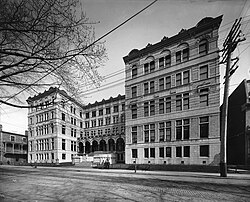
Unlike its English-language counterparts, such as McGill University, the institution struggled with funding due to the relative poverty of the French Canadian population and the inefficiencies of being managed remotely from Quebec City. These financial strains were exacerbated by three separate fires between 1919 and 1921, which forced the university to divert limited resources toward infrastructure repair.
By 1930, plans were drawn by architect Ernest Cormier for a new campus on the northwest slope of Mount Royal. However, the Great Depression halted construction, leading to fears that the university might have to sell its unfinished projects to survive. It was only through a 1939 injection of public funds from the provincial government that construction resumed.
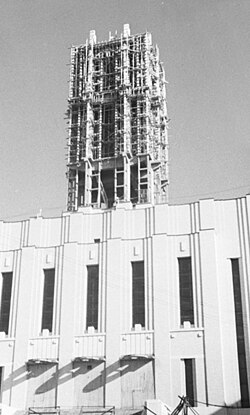
The new Côte-des-Neiges site, which included land expropriated from the Northmount Heights residential development, was officially inaugurated on June 3, 1943. The former downtown facilities were later utilized by the Université du Québec à Montréal (UQAM).
Scientific Contributions and Modernization
During World War II, the university played a critical role in the Allied effort. In 1943, it provided laboratory space for scientists working on the Manhattan Project. These researchers conducted heavy water experiments to develop a nuclear reactor and produced the first atomic battery to function outside the United States. Additionally, scientist Pierre Demers discovered a series of radioactive elements originating from Neptunium.
The mid-20th century brought significant structural changes. A second provincial charter was issued in 1950, and a third in 1967 following the Quiet Revolution—a period of intense social and political change in Québec. The 1967 charter redefined the university as a public institution dedicated to research and higher learning, granting students and teachers a voice in administration.
Modernization accelerated in 1965 with the appointment of Roger Gaudry, the first secular rector. This era saw the launch of the first adult-education degree program by a French Canadian university in 1968, as well as the inauguration of the 3200 Jean-Brillant and Lionel-Groulx buildings. In 1969, the Louis Collin parking garage was built, later winning a Governor General's medal for architecture in 1970.
Challenges and Contemporary Growth
The university's history is also marked by tragedy. On December 6, 1989, the École Polytechnique massacre occurred when a gunman entered the building and killed 14 women before committing suicide.
In more recent years, the university has continued to evolve. In 2016, the Faculty of Theology was closed and its functions transferred to the Institute of Religious Studies within the Faculty of Arts and Sciences. Since 2002, the institution has undertaken its most ambitious expansion since the 1960s, planning five new buildings dedicated to advanced research in biotechnology, cancer studies, aerospace, engineering, and pharmacology.
Key Facts
- Founded: 1878 as a branch of Université Laval.
- Independence: Granted full autonomy by Pope Benedict XV on May 8, 1919.
- Campus Move: Transitioned from downtown (Quartier Latin) to Mount Royal in 1943.
- Scientific Milestone: Contributed to the Manhattan Project and developed the first non-US atomic battery.
- Architectural Legacy: The Mount Royal campus was designed by Ernest Cormier.
- Public Status: Defined as a public institution via a provincial charter in 1967.
| Year | Event | Significance |
|---|---|---|
| 1878 | Foundation | Established as Université Laval à Montréal. |
| 1887 | Faculty of Arts created | Precursor to the CEGEP system. |
| 1919 | Papal Charter | Achieved full independence from Université Laval. |
| 1943 | Campus Inauguration | Official opening of the Mount Royal site. |
| 1965 | Roger Gaudry appointed | First secular rector, leading modernization. |
| 1967 | Third Provincial Charter | Became a public institution for research and learning. |
Frequently Asked Questions
How did the Université de Montréal become independent?
The university began as a branch of Université Laval. It gained administrative autonomy in 1889 and finally achieved full independence on May 8, 1919, through a papal charter granted by Pope Benedict XV.
What was the university's role in the Manhattan Project?
In 1943, the university provided laboratories for scientists conducting heavy water experiments to develop a nuclear reactor. This work led to the creation of the first atomic battery to operate outside the United States.
Why did the university move from downtown to Mount Royal?
The downtown campus suffered from severe funding shortages and was damaged by three fires between 1919 and 1921. This precarious situation, combined with a desire for growth, led to the construction of the Mount Royal campus, which opened in 1943.
What is the relationship between the university and the CEGEP system?
The university's "Faculty of Arts," established in 1887 as a preparatory school to standardize student education levels, served as the predecessor to Québec's current CEGEP system.
Who was the first secular leader of the university?
Roger Gaudry was appointed as the university's first secular rector in 1965, a move that paved the way for the modernization of the institution.