United Nations General Assembly
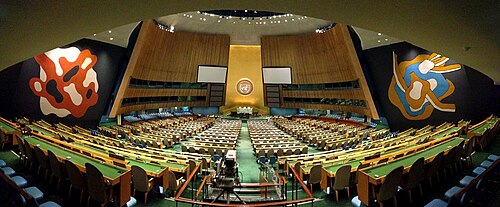
The United Nations General Assembly (UNGA) serves as the principal organ of the United Nations, acting as a unique global forum where all member states possess equal representation. Established in 1945, the Assembly provides a platform for multilateral discussion on the most pressing international issues, from security and human rights to economic development and environmental sustainability.
Over the decades, the UNGA has evolved from a small gathering of 51 nations to a massive diplomatic body of 193 members. This growth has shifted the Assembly's dynamics, particularly during the 1980s, when it became a central hub for "North–South dialogue"—the diplomatic exchange between industrialized nations and developing countries. Today, because more than two-thirds of the membership consists of developing nations, these states often wield significant influence over the Assembly's agenda and decisions, frequently coordinating through groups such as the G77.
Key Facts
- Founded: 1945
- Membership: 193 Member States
- Primary Function: Principal deliberative organ of the United Nations
- Headquarters: New York City, USA
- Key Event: The annual General Debate, attended by heads of state and government
- Budgetary Power: Responsible for approving the UN budget (per Article 17 of the UN Charter)
History and Evolution
The journey of the General Assembly began on January 10, 1946, with its first session held at the Methodist Central Hall in London. In its early years, the Assembly lacked a permanent home, convening at the former New York City Pavilion of the 1939 World's Fair in Flushing, New York, between 1946 and 1951.
![Methodist Central Hall, London, the location of the first meeting of the United Nations General Assembly in 1946[6]](/images/e4/73/e473a82654e08240df56dfae059ebe6e71f010f88991d13d0939f0bf950a0cd7.jpg)
It was during this interim period in Flushing that the Assembly voted to adopt the United Nations Partition Plan for Palestine on November 29, 1947. Other early proceedings were conducted at the interim headquarters in Lake Success, New York, which gained public visibility through the CBS Television series "United Nations in Action" in 1949.
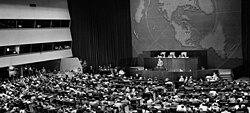
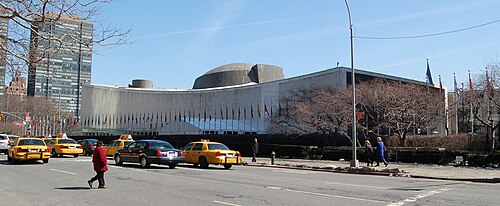
The Assembly finally moved to its permanent headquarters in Manhattan on October 14, 1952. While New York remains its primary base, the Assembly has occasionally convened elsewhere for specific diplomatic needs, such as the 43rd session held at the Palace of Nations in Geneva in December 1988 to hear Yasser Arafat.
The General Debate and Sessions
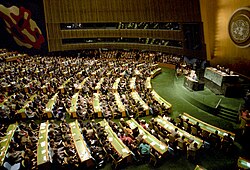
The most visible aspect of the UNGA is the General Debate. Held annually in September, this high-level event lasts nine working days and allows heads of state, government ministers, and delegates to address the world on issues of national and global importance.
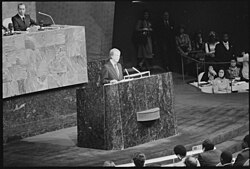
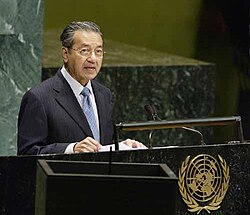
Between October 1946 and September 2025, there have been 80 general debates featuring a total of 11,127 speeches. Since 2008, the majority of these addresses have been delivered by heads of state or government. While participation is generally high, some nations have historically been absent more frequently, including Nicaragua, Saudi Arabia, Luxembourg, and Ivory Coast. Full participation by all member states occurred only twice, in 2017 and 2018.
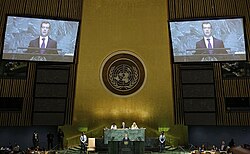
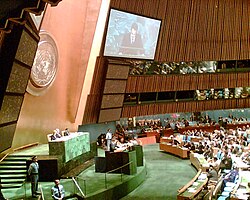
A historic milestone occurred during the 66th session on September 21, 2011, when President Dilma Rousseff of Brazil became the first woman to open a United Nations session.
![President of Brazil Dilma Rousseff delivers the opening speech at the 66th session of the UN General Assembly on 21 September 2011, marking the first time a woman opened a United Nations session.[35]](/images/9c/43/9c434ef7b685c4655bd4c8df9ba3c25cb21e6f5c33535097dc09de0af5f38900.jpg)
Organizational Structure and Governance
To manage its vast workload, the General Assembly operates through a complex system of committees, commissions, and boards.
Main Committees
The Assembly utilizes six numbered main committees to process specific issues:
- Second Committee: Economic and Financial questions.
- Third Committee: Social, Cultural, and Humanitarian issues.
- Fifth Committee: Administrative and Budgetary matters.
- Sixth Committee: Legal matters.
Commissions and Boards
The UNGA also oversees specialized commissions, such as the International Law Commission and the United Nations Commission on International Trade Law (UNCITRAL), as well as executive boards for agencies like UNICEF and the World Food Programme.
Regional Groupings
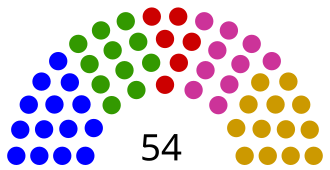
Member states are organized into regional groups to facilitate the election of representatives and the distribution of seats. These include the African Group, Asia and the Pacific Group, Eastern European Group, Latin American and Caribbean Group (GRULAC), and the Western European and Others Group (WEOG).
Resolutions and Budgetary Process
The Assembly expresses its will through resolutions. The numbering system for these documents changed after the 30th session. Originally, resolutions were numbered consecutively (e.g., Resolution 1514 (XV)). From the 31st session onward, they are numbered by session (e.g., Resolution 41/10 denotes the 10th resolution of the 41st session).
Financially, the UNGA holds the authority to approve the budget under Article 17 of the UN Charter, while the Secretary-General is responsible for preparing it. The process for planning and monitoring the budget has been refined through several key resolutions, including those passed in 1986, 1987, and 1990.
| Component | Primary Focus/Function | Example/Detail |
|---|---|---|
| General Debate | High-level policy addresses | Annual September sessions |
| Main Committees | Detailed issue processing | 6 numbered committees (e.g., Legal, Budgetary) |
| Regional Groups | Representation and elections | African, Asia-Pacific, GRULAC, WEOG, Eastern European |
| Commissions | Specialized legal/technical work | UNCITRAL, International Law Commission |
| Executive Boards | Agency oversight | UNICEF, World Food Programme |
Frequently Asked Questions
How has the membership of the General Assembly changed since its inception?
The Assembly began in 1945 with 51 member nations. By the 21st century, this number nearly quadrupled to 193 members, with more than two-thirds being developing countries.
What is the purpose of the General Debate?
The General Debate is a high-level event held annually where Member States' heads of state, government ministers, and delegates raise attention to topics they deem important on a global scale.
How are UNGA resolutions numbered?
For the first 30 sessions, resolutions were numbered consecutively. Starting with the 31st session, they are numbered by individual session (e.g., Resolution 41/10).
Who is responsible for the United Nations budget?
According to the UN Charter, the Secretary-General is responsible for preparing the budget, while the General Assembly is responsible for approving it.
What are the regional groups in the UNGA?
The member states are divided into the African Group, Asia and the Pacific Group, Eastern European Group, Latin American and Caribbean Group (GRULAC), and the Western European and Others Group (WEOG).