Unión Argentina de Rugby
The Unión Argentina de Rugby (UAR) serves as the official governing body for rugby union in Argentina. As a member of World Rugby—where it holds a seat on the Executive Council—and a founding member of Sudamérica Rugby, the UAR oversees the development and administration of the sport across the nation.
The UAR is responsible for managing all national representative teams. This includes the senior men's team, known as the Pumas, the U-20 side (Pumitas), the Argentina XV, and the national Sevens and Women's squads. Additionally, the union managed the Jaguares franchise during its participation in SANZAAR's Super Rugby competition.
Key Facts
- Founded: 10 April 1899, originally as the "River Plate Rugby Union."
- Current President: Gabriel Travaglini.
- Men's Coach: Felipe Contepomi.
- Global Affiliations: World Rugby (joined 1987) and Sudamérica Rugby (joined 1988).
- Major Competition: Full member of SANZAAR and participant in The Rugby Championship since 2016.
The Origins of Rugby in Argentina
Rugby's roots in Argentina date back to 1873. The first recorded match took place at the Buenos Aires Cricket Club Ground in Palermo, featuring 24 English players divided into two teams: Bancos ("Banks") and Ciudad ("City"). That same year, another match occurred at the Polo Field of Flores AC between a team of Royal Navy officers and English residents (Inglaterra) and a mixed group of British Isles residents and Argentine-born players of English descent (El Mundo).
By May 14, 1874, the Rugby Football Union rules were formally adopted. While some records cite a match at the Buenos Aires Cricket Club between the sides of Mr. Trench and Mr. Hogg, other sources suggest the first game under these rules occurred at David Mathven's country house in Caballito. The sport expanded geographically by June 28, 1886, when Buenos Aires FC played the first inter-provincial match against Rosario AC.
Foundation and Evolution of the UAR
The formal organization of the sport began in 1899 when the clubs Belgrano, Rosario, Lomas, Buenos Aires, and Flores founded the River Plate Rugby Union, with Leslie William Corry-Smith serving as the first president. The union organized its first championship that year, which was won by Lomas after an inaugural victory over Buenos Aires (11–4).
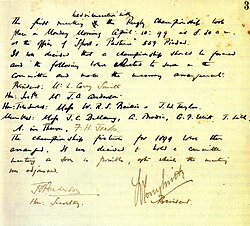
Over the decades, the organization underwent several name changes to reflect its national identity. Following advice from the International Olympic Committee (COI), the body officially became the Unión Argentina de Rugby on November 29, 1951. The UAR joined the International Rugby Board (IRB) in 1987 after being invited to the first Rugby World Cup.
Professionalism and Structural Shifts
In 1995, while much of the global rugby community transitioned to professionalism, the UAR initially chose to remain amateur. This period saw the Buenos Aires clubs split from the UAR to form the Unión de Rugby de Buenos Aires (URBA), which operates as a provincial union.
For many years, the national team relied heavily on players based in Europe (primarily France, Italy, and England). However, in 2016, the UAR established the Jaguares to compete in Super Rugby and implemented a policy of selecting Pumas players exclusively from Super Rugby teams, excluding those from European clubs.
National Team and International Competition
The Argentine national team made its international debut on June 12, 1910, playing against the "Combined British" (British Lions) as part of the centennial celebrations of the Revolución de Mayo. Argentina lost the match 28–3.
A major milestone was reached on November 23, 2011, when Argentina officially joined The Rugby Championship. By the start of 2016, Argentina became a full member of SANZAAR, the governing body for both The Rugby Championship and Super Rugby.
Organizational Structure
The UAR operates through a network of affiliated regional unions that manage the sport across various provinces.
| Union | Region | Established |
|---|---|---|
| Rosario | Rosario, Córdoba | 1928 |
| Córdoba | Córdoba | 1931 |
| Tucumán | Tucumán | 1944 |
| Cuyo | Mendoza | 1945 |
| Mar del Plata | Mar del Plata, Tandil | 1951 |
| San Juan | San Juan | 1952 |
| Sur | Buenos Aires, La Pampa, Viedma | 1954 |
| Santa Fe | Santa Fe | 1955 |
| Salta | Salta | 1958 |
| Alto Valle del Rio Negro y Neuquén | Neuquén, Río Negro | 1959 |
| Nordeste | Chaco, Corrientes | 1963 |
| Jujuy | Jujuy | 1966 |
| Santiago del Estero | Santiago del Estero | 1968 |
| Austral | Chubut, Río Negro | 1971 |
| Valle de Chubut | Chubut | 1971 |
| Misiones | Misiones | 1977 |
| Entre Ríos | Entre Ríos | 1979 |
| Oeste de Buenos Aires | Buenos Aires, La Pampa | 1986 |
| Formosa | Formosa | 1988 |
| Tierra del Fuego | Tierra del Fuego, Argentine Antarctica | 2000 |
| Lagos del Sur | Bariloche, Río Negro, Chubut, Neuquén | 2001 |
| San Luis | San Luis | 2003 |
| Santa Cruz | Santa Cruz (includes some Chilean clubs) | 2008 |
| Andina | La Rioja, Catamarca | 2009 |
| Buenos Aires (URBA) | Greater Buenos Aires | 1995 |
Frequently Asked Questions
When was the Unión Argentina de Rugby founded?
The organization was founded on April 10, 1899, under the original name "River Plate Rugby Union."
Who are the Pumas?
The Pumas is the nickname for the Argentine senior men's national rugby union team.
How did the UAR become a member of World Rugby?
The UAR became a member of the International Rugby Board (now World Rugby) in 1987 after being invited to participate in the inaugural Rugby World Cup.
What is the relationship between the UAR and URBA?
The Unión de Rugby de Buenos Aires (URBA) was formed in 1995 when Buenos Aires clubs split from the UAR during the transition to professionalism; URBA now operates as a provincial union.
When did Argentina join The Rugby Championship?
Argentina officially joined the competition following a meeting on November 23, 2011, and became a full member of SANZAAR in 2016.