Ulm Tramway Network
The Ulm tramway network (German: Straßenbahnnetz Ulm) is a vital component of the public transportation system in Ulm, located in the federal state of Baden-Württemberg, Germany. Operated by Stadtwerke Ulm/Neu-Ulm GmbH (SWU) and integrated into the Donau-Iller-Nahverkehrsverbund (DING), the network provides efficient electric transit across the city.
Key Facts
- Opening Year: 1897
- Operator: Stadtwerke Ulm/Neu-Ulm GmbH (SWU)
- Total Route Length: 19.1 km (11.9 mi)
- Track Gauge: 1,000 mm (meter gauge)
- Current Fleet: 28 Siemens trams (10 Combino, 18 Avenio M)
- Number of Lines: 2
History of the Network
The first trams in Ulm began service on May 15, 1897. The initial system featured a ring line connecting the main station, Olgastraße, Fraunstraße, and Münsterplatz, alongside a second line linking Ulm to the railway station in Neu-Ulm. Originally managed by the private "Ulmer Straßenbahn- und Elektrizitätswerk," the city acquired the network on April 1, 1905.
By 1929, the system had expanded to four lines. However, the aftermath of the Second World War saw a decline, with only two lines reopening. Further closures in 1964 left the city with a single 5.6 km line connecting Donauhalle and Söflingen.
A modern era of expansion began in 2007. A 4.6 km extension from Donauhalle to Böfingen opened on March 21, 2009. This was followed by the launch of Line 2 on December 8, 2018, adding 9.8 km of track to connect Science Park in the north-west to Kuhberg in the south-west.
Lines and Infrastructure
The current network consists of two primary lines that share approximately one kilometer of track in the city center between Theater and Ehinger Tor, including the stop at the main railway station.
| Line | Route | Length | Stations | Journey Time |
|---|---|---|---|---|
| 1 | Söflingen – Böfingen Ostpreußenweg | 10.3 km | 22 | 30 min |
| 2 | Kuhberg Schulzentrum – Science Park II | 9.8 km | 21 | 28 min |
A notable geographic feature of the network is the Botanischer Garten (Botanical Gardens) stop on Line 2, which holds the distinction of being Germany's highest tram stop at 617 meters above sea level.
Rolling Stock
The SWU fleet consists entirely of vehicles manufactured by Siemens Mobility, all designated as NGT 6 UL. A unique tradition in Ulm is that every tram is named after a prominent person associated with the city.
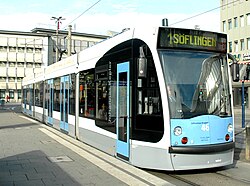
Siemens Combino
In 2003, SWU replaced its GT4 fleet with eight Combino NGT 6 UL vehicles, adding two more in 2008 for the Line 1 extension. These are five-section unidirectional vehicles, measuring 31 meters in length and 2.4 meters in width, with a seating capacity of 72.
Notable names in the Combino fleet include Albert Einstein, Johannes Kepler, and Sophie Scholl.
Siemens Avenio M
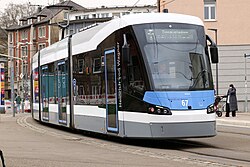
To support the opening of Line 2, SWU ordered twelve Avenio M trams in 2015, with an additional six ordered in 2020. Like the Combino, these vehicles are 31 meters long and 2.4 meters wide across five sections.
To meet growing demand, SWU announced in 2024 that all 18 Avenio M trams will be extended with two additional modules. This upgrade will increase passenger capacity from 185 to 256 per vehicle, with the first modified tram expected to enter service in 2027.
Frequently Asked Questions
Who operates the Ulm tramway?
The network is operated by Stadtwerke Ulm/Neu-Ulm GmbH (SWU) and is part of the Donau-Iller-Nahverkehrsverbund (DING) transport association.
What is the highest tram stop in Germany?
The Botanischer Garten (Botanical Gardens) stop on Line 2 is the highest tram stop in Germany, situated 617 meters above sea level.
How many lines are currently in operation?
There are currently two operational lines: Line 1 (Söflingen to Böfingen) and Line 2 (Kuhberg to Science Park II).
What is the capacity of the Avenio M trams?
The current capacity is 185 passengers, but all 18 Avenio M vehicles are scheduled to be extended to a capacity of 256 passengers by 2027.
What is the track gauge used in Ulm?
The Ulm tramway network uses a track gauge of 1,000 mm, commonly known as meter gauge.