UHMWPE Fibers: High-Performance Applications of Dyneema and Spectra
Ultra-high-molecular-weight polyethylene (UHMWPE) represents a leap in material science, offering a combination of extreme strength and incredibly low weight. Marketed under well-known brand names such as Dyneema and Spectra, these oriented-strand gels are spun through a spinneret to create fibers that outperform traditional materials in the most demanding environments.
The primary appeal of UHMWPE lies in its physics. With a density as low as 0.97 g/cm (specifically for Dyneema SK75), it is lighter than water. Despite this, it boasts yield strengths up to 2.4 GPa (350,000 psi). When compared to high-strength steels, UHMWPE offers a strength-to-weight ratio eight times greater, and it is approximately 40% stronger relative to its weight than aramid fibers.
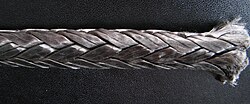
Key Facts
- Extreme Strength: Yield strengths reach 2.4 GPa, comparable to high-strength steels.
- Ultra-Lightweight: A density of 0.97 g/cm allows the material to float on water.
- Superior Ratio: Strength-to-weight ratio is 8x that of high-strength steel and 40% higher than aramid.
- Low Friction: High lubricity makes it ideal for bearings and specialized medical loops.
- Versatility: Used in everything from bulletproof vests and surgical sutures to space tethers.
Industrial and Consumer Applications
Personal Armor and Safety
UHMWPE is a cornerstone of modern ballistic protection. For personal armor, fibers are aligned and bonded into sheets, then layered at varying angles to ensure multi-directional strength. This technology is utilized in the US Military's Interceptor body armor for limb protection, as well as in stab-resistant vests, fencing clothing, and vehicle composite liners.
Automotive and Marine Rigging
In automotive winching, UHMWPE rope is replacing steel wire due to critical safety advantages. Because it has lower mass and less elongation at breaking, it carries far less energy, virtually eliminating the dangerous "snap-back" effect if a line breaks. Additionally, it does not kink and cannot pierce the skin like broken steel strands.
In marine environments, the material's low density is a major asset. Ships' hawsers and "Spectra wires" float on seawater, making recoveries easier. Its extreme abrasion resistance also makes it ideal for fender systems on berthing structures, where it provides low friction in both wet and dry conditions.
Sports and Outdoor Gear
- Sailing and Paragliding: Used for high-performance sails, backstays, and suspension lines due to low stretch and high strength.
- Archery: Preferred for bowstrings because of low creep (permanent deformation) and stretch, often blended with Vectran.
- Climbing: Used in pre-sewn "slings" for low bulk. However, due to high lubricity, it has poor knot-holding ability; the triple fisherman's knot is recommended over the double.
- Winter Sports: Reinforces fiberglass in skis and snowboards to improve stiffness and flex.
- Camping: Dyneema Composite Fabric (DCF)—a grid of threads between polyester membranes—is used for ultralight tents and backpacks.
Specialized Engineering
The material's utility extends to the extremes of engineering. It was used for a 30 km long space tether in the ESA/Russian Young Engineers' Satellite 2 in 2007. In manufacturing, it serves as a chamber filler for shaping PVC windows and doors, and as a durable component in hydraulic seals and bearings.
Medical Advancements and Biomaterials
Since 1962, UHMWPE has been a critical biomaterial for joint replacements. It became the dominant bearing material for total hip and knee replacements in the 1970s.
Evolution of Medical Grade UHMWPE
Early attempts to improve the material, such as blending it with carbon fibers (Poly Two) or high-pressure recrystallization (Hylamer), faced challenges with compatibility and oxidation. This led to the development of highly cross-linked UHMWPE in the late 1990s. These materials are treated with gamma or electron beam radiation (50–105 kGy) and thermally processed to resist oxidation, becoming the standard of care for hip replacements in the US.
Recent innovations include the incorporation of antioxidants, most notably Vitamin E (a-tocopherol), which quenches free radicals from the irradiation process without requiring thermal treatment. Additionally, medical-grade fibers under the "Dyneema Purity" brand are now used for high-strength surgical sutures.
Material Comparison Summary
| Property | UHMWPE (Dyneema/Spectra) | High-Strength Steel | Aramid / Nylon |
|---|---|---|---|
| Density | ~0.97 g/cm (Floats) | ~7.8 g/cm (Sinks) | Variable |
| Strength-to-Weight | Highest (8x Steel) | Baseline | ~40% lower than UHMWPE |
| Elasticity | Very Low / Inelastic | Moderate | Higher (Nylon) |
| Key Weakness | UV and Heat Sensitivity | Weight / Corrosion | Wear / Bulk |
Frequently Asked Questions
Why is UHMWPE safer than steel for winching?
UHMWPE is safer because its lower mass and low elongation mean it stores far less kinetic energy. If the rope breaks, there is almost no snap-back, and unlike steel, it does not produce sharp, broken wire strands that can pierce the skin.
Can you use standard knots with UHMWPE climbing gear?
It is generally not recommended to rely on knots because the fiber's high lubricity (slipperiness) causes poor knot-holding. Pre-sewn slings are preferred, but if a knot is necessary, the triple fisherman's knot is recommended over the double.
What are the main drawbacks of UHMWPE?
The material is susceptible to UV damage from sunlight and can be damaged by heat from contact with hot components. In skydiving, it can also shrink when exposed to heat, leading to dimensional instability in suspension lines.
How has UHMWPE been improved for medical implants?
Modern implants use highly cross-linked UHMWPE, created via radiation and thermal processing to prevent oxidation. Newer versions incorporate Vitamin E as an antioxidant to stabilize the material and improve long-term clinical performance.
What is Dyneema Composite Fabric (DCF)?
DCF is a laminated material featuring a grid of Dyneema threads sandwiched between two thin, transparent polyester membranes. It is exceptionally strong and lightweight, used primarily in racing sails and ultralight backpacking gear.