UEFA Cup Winners' Cup: The History of Europe's Forgotten Trophy
For nearly four decades, the UEFA Cup Winners' Cup stood as a prestigious pillar of European football. Designed specifically for the champions of domestic cup competitions, it offered a unique pathway to continental glory, distinct from the league-based European Cup. From its humble beginnings as a pilot project to its eventual merger into the modern UEFA Europa League, the tournament captured the drama of knockout football across the continent.
Key Facts
- Founded: 1960 (officially recognized by UEFA in 1963).
- Abolished: 1999, after 39 seasons.
- Most Successful Club: Barcelona, with 4 titles.
- Last Champion: Lazio (1998–99).
- Format: Straight knockout with two-legged ties and a single-match final.
- Unique Record: No club ever managed to retain the trophy in consecutive seasons.
The Origins and Rise of the Competition
The concept of a pan-European tournament for cup winners was championed by sports journalists, following the success of the European Cup and the Fairs Cup. The inaugural tournament took place in the 1960–61 season. Initially, it was a semi-official pilot organized by the Mitropa Cup's committee and was not formally recognized by UEFA until 1963, following an initiative by the Italian Football Federation (FIGC).
Early adoption was mixed. In many European nations, domestic cups were held in low esteem, leading some major clubs, such as Monaco and Atlético Madrid, to decline entry in the first edition. However, the public response was overwhelmingly positive, and by 1968, every UEFA member nation had established a domestic cup to ensure participation in the tournament.
As the competition grew, it became the second most prestigious trophy in Europe, sitting below the European Cup (now the UEFA Champions League) but above the Fairs Cup (later the UEFA Cup). Starting in 1972, the winner of the Cup Winners' Cup earned the right to face the European Cup champion in the European Super Cup.
Tournament Format and Eligibility
The Cup Winners' Cup utilized a strict knockout format. Most rounds consisted of two-legged home and away ties, with the away goals rule used to break ties on aggregate scores. The final was typically a single match held at a neutral venue, except for the very first season, which featured a two-legged final.
Entry was generally limited to one club per member association. However, specific rules handled overlapping qualifications:
- If a club won the domestic "double" (both league and cup), they entered the European Cup, and the domestic cup runner-up took the Cup Winners' Cup spot.
- The defending champion was allowed to enter alongside their nation's new cup winner to defend their title.
- If a club qualified for both the UEFA Cup and the Cup Winners' Cup, the latter took priority.
In the 1990s, as more UEFA member nations joined, a preliminary round in August was introduced to maintain a first-round field of 32 teams.
The Decline and Abolition
The prestige of the Cup Winners' Cup began to wane in the early 1990s with the rebranding and expansion of the UEFA Champions League. By 1997, the Champions League began allowing more than one team from top-ranked nations to enter. This meant that many elite clubs who previously would have contested the Cup Winners' Cup—such as Barcelona and Bayern Munich—now qualified for the Champions League via their league position.
By the late 1990s, the tournament was increasingly viewed as a second-rate competition. Despite considerations to expand the field to 64 teams, UEFA ultimately decided to abolish the competition after the 1998–99 season. It was merged into the UEFA Cup, which is known today as the UEFA Europa League.
The Trophy
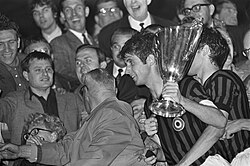
The trophy remained the property of UEFA, though winning clubs were permitted to keep replicas. The design evolved over time; the first trophy awarded to Fiorentina differed significantly from later versions. In the 1990s, a wooden-based trophy became the standard, with the notable exception of 1993, when Parma was awarded a special version with a metal base.
Competition Summary and Records
| Category | Detail |
|---|---|
| Total Seasons | 39 (1960–1999) |
| Most Titles | Barcelona (4) |
| Last Winner | Lazio (1999) |
| Most Titles (Player) | Lobo Carrasco (3) |
| Most Titles (Manager) | Nereo Rocco, Valeriy Lobanovskyi, Johan Cruyff, Alex Ferguson (2 each) |
Frequently Asked Questions
Why was the UEFA Cup Winners' Cup abolished?
The competition lost prestige due to the expansion of the UEFA Champions League, which began absorbing the top clubs that previously would have competed in the Cup Winners' Cup. This led to a decline in public and club interest, resulting in its merger with the UEFA Cup in 1999.
Which club won the most Cup Winners' Cup titles?
Barcelona holds the record for the most championships, winning the title four times.
Did any team ever win the trophy in back-to-back years?
No club ever managed to retain the Cup Winners' Cup. While eight teams reached the final in the season immediately following a victory, none were able to win it twice in a row.
How did the competition affect the European Super Cup?
From 1972 until the competition's abolition, the winner of the Cup Winners' Cup played the winner of the European Cup in the European Super Cup. After 1999, this spot was taken by the winner of the UEFA Cup (now the UEFA Europa League).
What happened to English clubs in the mid-1980s?
Following the Heysel Stadium disaster in 1985, English clubs were banned from European competitions. This prevented teams like Manchester United, Everton, and Liverpool from competing in the Cup Winners' Cup until the 1990–91 season.