U.S. State Flags: History, Design, and Evolution
The flags representing the various states, territories, and the District of Columbia of the United States serve as vibrant windows into regional influences and local histories. While they vary significantly in style and design principles, many share common threads that connect them to the broader American narrative.
Most modern U.S. state flags were adopted during a specific era at the turn of the 20th century. This movement was largely spurred by the 1893 World's Columbian Exposition in Chicago, Illinois, where states sought distinctive symbols to represent their identities. Consequently, the majority of current designs were established between 1893 and the beginning of World War I.
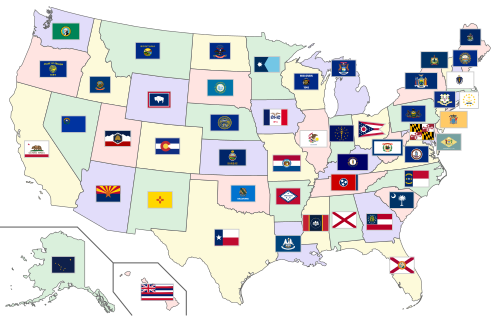
Key Facts
- Most Recent State Flag: Minnesota, adopted on May 11, 2024.
- Most Recent Territorial Flag: Northern Mariana Islands, adopted on July 1, 1985.
- Common Design: Many states use a monochrome background (often blue) with the state seal superimposed.
- Flag Redesign Trends: Recent legislative efforts have begun in Massachusetts (2021) and Illinois (2024).
- District of Columbia: The current flag for Washington, D.C. was adopted in 1938.
Design Patterns and Variations
A prevalent design pattern among American states involves placing the state seal—an official emblem representing the state's authority—on a solid-colored background. A shade of blue is the most common choice for this monochrome backdrop.
State Ensigns and Historical Flags
Beyond standard state flags, some jurisdictions utilize ensigns, which are specific flags used primarily at sea. Currently, Maine and Massachusetts maintain ensigns for maritime use. History also shows various former naval ensigns, such as those used by the Georgia State Navy (1778–1779) and the Pennsylvania Navy (1775–1783).
The evolution of these symbols is often marked by standardization. Many states, such as California, Colorado, and Florida, underwent multiple design changes or standardizations of their seals over the decades to refine their visual identity.
Territories and Tribal Sovereignty
The United States also includes several territories and recognizes the unique status of Native American nations. While the U.S. national flag is the official flag for the United States Minor Outlying Islands, unofficial flags are sometimes used for specific areas like Wake Island or the Midway Islands.
Native American nations possess tribal sovereignty, meaning they have jurisdiction over their members and reserved lands. While reservations exist on state land, state laws do not always apply. Under Public Law 83-280, certain states may handle specific legal matters involving Native Americans on reservations, but they cannot control tribal governments or infringe upon hunting and fishing rights.
| Entity Type | Name | Date of Adoption |
|---|---|---|
| State | Minnesota | May 11, 2024 |
| Territory | Northern Mariana Islands | July 1, 1985 |
| Federal District | District of Columbia | 1938 |
Frequently Asked Questions
What is the newest state flag in the U.S.?
The most recently adopted state flag belongs to Minnesota, which was officially adopted on May 11, 2024.
Why do so many state flags look similar?
Many states follow a common design principle of superimposing their official state seal onto a single-color background, typically blue.
Did all states always have the same flags?
No. Many states have undergone multiple redesigns or standardizations. For example, states like Utah, Mississippi, and Oklahoma have had several different versions of their flags throughout history.
What is the difference between a state flag and a state ensign?
A state flag is a general symbol of the state, whereas an ensign is a specific type of flag intended for use at sea.
Are there flags for Native American reservations?
Yes, many Native American nations have their own flags that represent their sovereignty and identity, such as the flags for the Northern Arapaho and Eastern Shoshone of the Wind River Indian Reservation.