U.S.-China Relations: The Shift Toward Strategic Competition
For decades, the relationship between the United States and the People's Republic of China (PRC) was defined by engagement and the hope that economic integration would lead to political liberalization. However, recent years have seen a fundamental shift. The U.S. has transitioned from a policy of cooperation to one of strategic competition, viewing China not as a partner, but as a primary challenger to its global leadership, security, and democratic values.
This evolution is marked by a bipartisan consensus in Washington that the previous approach—assuming that inclusion in global commerce would turn China into a benign actor—has failed. From trade wars and technology bans to military repositioning in the Indo-Pacific, the U.S. is now employing a "whole-of-government" approach to counter China's rising influence.
Key Facts
- Policy Shift: The U.S. has moved from a policy of engagement to one of strategic competition across multiple administrations.
- Economic Warfare: The U.S. has utilized tariffs, sanctions, and the CHIPS and Science Act to limit China's technological growth.
- Military Strategy: The U.S. is strengthening alliances in the Indo-Pacific and maintaining military bases to deter aggression.
- Human Rights: The U.S. has officially recognized the treatment of Uyghurs in Xinjiang as genocide and revoked Hong Kong's special trade status.
- Global Influence: Tensions center on China's Belt and Road Initiative and the U.S.'s Indo-Pacific Economic Framework.
The Evolution of U.S. Strategic Thinking
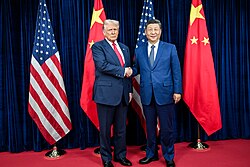
The ideological shift began to crystallize during the first Trump administration. Groups like the Committee on the Present Danger: China (CPDC), formed in 2019, argued that coexistence with China is impossible as long as the Communist Party governs. Some officials even framed the competition in civilizational terms, suggesting that the U.S. was facing a competitor with a fundamentally different ideology and heritage.
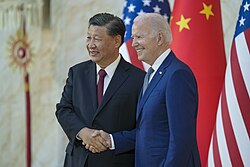
By 2020, the Trump administration's "U.S. Strategic Approach to the People's Republic of China" report formally called for a reevaluation of past policies. This hardline stance was maintained and refined by the Biden administration. President Joe Biden described China as the "most serious competitor," while Secretary of State Antony Blinken acknowledged that the tougher approach initiated by the previous administration was correct.
Legislative Responses
Congress has mirrored this executive shift through significant legislation. The Strategic Competition Act of 2021 sought to unify the U.S. response to Beijing's diplomatic initiatives. This eventually evolved into the CHIPS and Science Act (passed August 9, 2022), which authorized billions of dollars for technology research to ensure the U.S. maintains a competitive edge in critical semiconductors and advanced tech.
Economic Conflict and the Trade War
The economic relationship between the two superpowers has deteriorated significantly since China's entry into the World Trade Organization (WTO) in 2001. While globalization initially benefited both, the U.S. grew concerned over "unfair trade practices," including intellectual property theft and forced technology transfers.
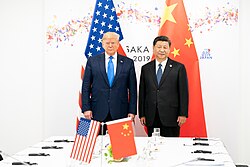
In 2018, the U.S. launched a trade war, imposing heavy tariffs to force structural changes in China's economy. This conflict extended to the tech sector, where the U.S. attempted to stifle companies like Huawei, ZTE, and ByteDance, citing national security risks. To further isolate China economically, the U.S. withdrew from the Trans-Pacific Partnership (TPP) in 2017, though the TPP was originally intended to reduce regional dependence on Chinese trade.
Competing Global Visions
The two nations are currently locked in a battle for global influence through infrastructure and finance. The U.S. has criticized China's Belt and Road Initiative—a massive global infrastructure project—labeling it "debt trap diplomacy." In response, the Biden administration promoted the Indo-Pacific Economic Framework to strengthen ties with friendly regional economies like Japan and India.
Military Strategy and Regional Security
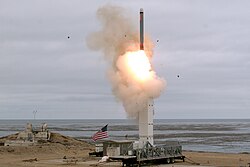
To blunt China's influence, the U.S. employs a strategy of containment in the Indo-Pacific. This involves strengthening military and diplomatic bonds with South Korea, Japan, and India, while maintaining a network of bases equipped with warships and nuclear-capable bombers.
A primary focus remains the First Island Chain and the Taiwan Strait. The second Trump administration's National Security Strategy (December 2025) emphasized deterring conflict over Taiwan by preserving military overmatch and opposing any unilateral change to the status quo.
Human Rights and International Law
The U.S. has leveraged human rights concerns to put international pressure on Beijing. Central to this is the situation in the Xinjiang Uygur Autonomous Region, where the U.S. has recognized the government's treatment of the Muslim Uyghur minority as genocide. This led to the passage of the Uyghur Human Rights Policy Act in 2019.
Similarly, the U.S. shifted its stance on Hong Kong. Following the 2019–2020 protests and the imposition of a national security law by China, the U.S. passed the Hong Kong Autonomy Act. Under Executive Order 13936, the U.S. ceased treating Hong Kong as a separate entity from the PRC.

Summary of U.S.-China Strategic Pillars
| Domain | Previous Approach (Engagement) | Current Approach (Competition) |
|---|---|---|
| Economic | WTO Integration & Globalization | Tariffs, Sanctions, & Tech Restrictions |
| Diplomatic | Cooperation & Inclusion | Indo-Pacific Framework & Alliances |
| Military | Regional Stability | Containment & First Island Chain Defense |
| Political | Hope for Liberalization | Recognition of Systemic Rivalry |
Frequently Asked Questions
What is the "First Island Chain" strategy?
It is a military strategy where the U.S. maintains a series of bases and alliances across the islands of the Pacific to limit China's naval access to the open ocean and deter aggression in the region.
Why did the U.S. pass the CHIPS and Science Act?
The act was designed to reduce reliance on foreign semiconductor manufacturing and invest in domestic advanced technology research to ensure the U.S. can out-compete China in critical tech sectors.
How has the U.S. status of Hong Kong changed?
Previously, the U.S. treated Hong Kong as separate from mainland China. However, due to the imposition of China's national security law and the erosion of autonomy, the U.S. now treats Hong Kong as part of the People's Republic of China.
What is "debt trap diplomacy" in the context of the Belt and Road Initiative?
It is a term used by U.S. officials to describe China's practice of providing large loans for infrastructure projects to developing nations, which may lead to those nations becoming overly dependent on China when they cannot repay the debt.
What was the purpose of the Strategic Competition Act of 2021?
The act aimed to create a unified, strategic response to counter China's diplomatic and strategic initiatives, focusing on rebuilding American leadership and grounding diplomacy in core values.