TVRI: The History and Evolution of Indonesia's National Public Broadcaster
LPP Televisi Republik Indonesia, commonly known as TVRI, stands as a cornerstone of Indonesia's media landscape. As the nation's oldest television network, it serves as one of two primary Public Broadcasting Institutions (Lembaga Penyiaran Publik or LPP) in the country, alongside the national radio network RRI. From its origins as a tool for national preparation to its modern role as an independent public service provider, TVRI has mirrored the political and social transformations of Indonesia.

Key Facts
- Founded: 24 August 1962 (established for the IV Asian Games).
- Status: Independent Public Broadcasting Institution (LPP).
- Headquarters: Gelora, Central Jakarta.
- Primary Channels: TVRI, TVRI World, and TVRI Sport.
- Broadcast Reach: Indonesia, with partial coverage in Singapore, Malaysia, Papua New Guinea, and East Timor.
The Early Years: From Concept to Broadcast
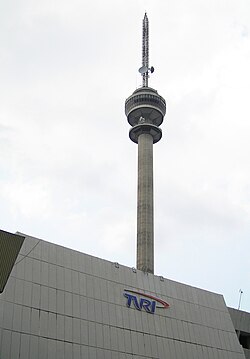
The foundations of TVRI were laid in preparation for the 1962 Asian Games. The technical infrastructure was a massive undertaking, involving the construction of two transmitters—one 100W and one 10 kW—supported by an 80-meter tower located in the TVRI Senayan complex.
TVRI conducted its first trial broadcasts on 17 August 1962, airing the 17th Indonesian Independence Day celebrations from the Merdeka Palace in black and white. The network officially began its regular operations just before the start of the Asian Games, with the broadcast complex being inaugurated on 23 August 1962.
Governance and Early Growth
In October 1963, the Yayasan TVRI (TVRI Foundation) was established to serve as the governing authority, with the President of Indonesia acting as the chairman. During this era, TVRI held a monopoly over television broadcasting in Indonesia, a position it maintained until the arrival of the first commercial network, RCTI, in August 1989.
Transformation into an Independent Institution
A significant shift in TVRI's identity occurred through legislative reform. Under Act No. 32/2002 on Broadcasting, TVRI was transitioned from a state-controlled department into an independent public broadcaster. This process was finalized on 18 March 2005, following Government Regulation No. 13/2005.
As an LPP, TVRI is defined as a legal entity established by the state that is independent, neutral, and non-commercial. Its core mandate is to provide healthy information, education, and entertainment while preserving the nation's culture and maintaining social unity across the Unitary State of the Republic of Indonesia.
Modernization and Rebranding
To keep pace with the digital age, TVRI has undergone several periods of modernization. One of the most notable changes occurred on 29 March 2019, during the Menggapai Dunia (Reaching the World) special concert, when the network adopted its current visual identity. This rebranding effort extended to all regional stations, ensuring a unified look across the archipelago.

Organizational Structure and Workforce
As of 2018, TVRI employed approximately 4,300 people, with roughly 1,800 staff members based at the Jakarta headquarters. While the network operates independently, approximately 90% of its employees are civil servants under the Ministry of Communication and Digital Affairs.
Service Channels and Regional Presence
TVRI maintains a vast network to ensure its services reach the furthest corners of Indonesia. The network operates several national channels, including TVRI World and TVRI Sport, alongside a robust system of regional stations.
Summary of TVRI Institutional Profile
| Category | Details |
|---|---|
| Type | Public Television Broadcaster |
| Founded | 24 August 1962 |
| Headquarters | Jalan Gerbang Pemuda, Gelora, Central Jakarta |
| Revenue (2016) | Rp 137 billion |
| Current Slogan | Media Pemersatu Bangsa |
Frequently Asked Questions
What is the primary role of TVRI?
TVRI is a public broadcasting institution tasked with providing information, education, and entertainment that serves the public interest, maintains social control, and preserves Indonesian culture.
How does TVRI differ from commercial stations?
Unlike commercial networks, TVRI is an independent, non-commercial entity. Its mandate is to serve the public benefit and maintain national unity rather than focusing on profit maximization.
When did TVRI lose its broadcasting monopoly?
TVRI held a monopoly on Indonesian television until 24 August 1989, when the first commercial television network, RCTI, began broadcasting.
What are the main TVRI channels available today?
The network currently operates several channels, including the main TVRI national channel, TVRI World, and TVRI Sport, as well as various regional stations across Indonesia.
What is the meaning of TVRI's current slogan?
The current slogan, "Media Pemersatu Bangsa," translates to "The Nation's Unifying Media," reflecting its mission to connect and unite the diverse people of Indonesia.