Tudor Watches: A Legacy of Precision and Professional Tooling
Founded in the heart of Geneva, Switzerland, Tudor has established itself as a powerhouse of Swiss watchmaking. Registered in 1926 by Hans Wilsdorf—the visionary founder of Rolex—Tudor was conceived to offer a reliable, high-quality timepiece at a more accessible price point than its sibling brand. Today, both companies remain under the ownership of the Hans Wilsdorf Foundation, maintaining a shared commitment to excellence.
From its early days providing rugged equipment for military divers to its modern status as a luxury icon, Tudor has evolved from a "tool watch" specialist into a comprehensive manufacturer of high-performance timepieces.
Key Facts
- Founded: 1926 in Geneva, Switzerland.
- Founder: Hans Wilsdorf (also founder of Rolex).
- Ownership: Hans Wilsdorf Foundation.
- Specialization: Originally known for military and professional diving watches.
- Key Innovation: Introduction of the first titanium watch in the Rolex group (Pelagos).
- Production: Approximately 200,000 units as of 2015.
The Evolution of a Tool Watch Giant
Origins and the Rolex Connection
Tudor's early strategy was based on a clever synergy: utilizing off-the-shelf movements paired with Rolex cases and bracelets. This allowed the brand to maintain rigorous quality standards while remaining affordable. In the mid-1940s, Tudor introduced the Oyster collection, adopting the waterproof Oyster case previously exclusive to Rolex.
The brand's reputation for endurance was cemented in 1952 with the release of the Prince, the first self-winding model. Its reliability was proven in the field when 26 Tudor Oyster Princes accompanied the British North Greenland expedition between 1952 and 1954.
Military Heritage and Diving Excellence
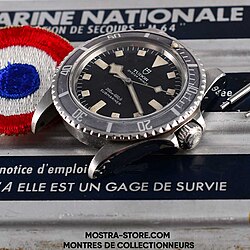
Tudor's history is deeply intertwined with naval operations. In 1954, the brand launched the Oyster Prince Submariner, initially waterproof to 100 metres, a specification that increased to 200 metres by 1958. Between the 1960s and mid-1980s, Tudor supplied bulk quantities of Submariners to the French Marine Nationale and the US Navy SEALs.
These military versions often omitted bracelets to accommodate standard-issue military straps and featured distinctive elements like the "snowflake hands," which have since become a hallmark of the brand's current aesthetic.
Diversification: Chronographs and Alarms
Beyond diving, Tudor expanded into specialized complications. The 1957 Tudor Advisor introduced an alarm complication, the first Oyster model to amplify sound. By 1970, the brand entered the chronograph market with the Oysterdate, followed by the "Montecarlo" in 1971, named for its roulette-wheel-inspired dial. In 1976, the "Big Block" series introduced the first self-winding movement to the Tudor chronograph line.
Modern Era and Brand Relaunch
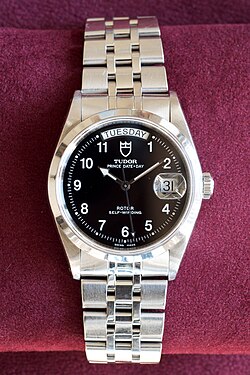
In 2009, Tudor underwent a significant brand relaunch, shifting its focus from pure utility to a blend of performance and elegance. This era saw the introduction of the Grantour Chronograph and the Glamour collection.
The 2010s marked a return to heritage. The Heritage Black Bay, a reinterpretation of early Submariners, and the Pelagos—a 500-metre waterproof watch featuring a 42mm titanium case—became instant successes. In 2015, the North Flag debuted as the first model featuring an in-house movement, the calibre MT5621.
Current Product Portfolio
Tudor now organizes its offerings into five primary categories:
- Black Bay Line: Heritage-inspired dive watches featuring GMT, bronze, and chronograph options.
- Sports Watches: Including the Ranger, Royal, and Pelagos FXD.
- Classic Watches: The 1926 and Clair de Rose lines.
- Diving Watches: The specialized Pelagos line.
- Women's Watches: Dedicated feminine designs.
Technical Mastery and Manufacturing
In-House Movements
While Tudor previously relied on movements from ETA, Sellita, or Valjoux, the brand has transitioned toward Manufacture Calibres. A notable collaboration occurred in 2017 with Breitling, where the two brands exchanged movement expertise for their respective chronograph and diver models.
Modern Tudor movements are often COSC-certified (Contrôle Officiel Suisse des Chronomètres), typically functioning within a tolerance of -4/+6 seconds per day. The Black Bay Ceramic, released in 2021, features the MT5602-1U movement, which is METAS Master Chronometer certified with a precision of 0/+5 seconds per day.
The Art of the Fabric Strap
Tudor has embraced the NATO strap—a durable nylon band originally developed by the British Ministry of Defence in 1973. To maintain luxury standards, Tudor's fabric straps are woven by a specialized passementerie manufacturer near St.-Etienne, France, the same region that produces ribbons for Vatican medals and haute couture houses like Chanel.
Branding and Global Presence
The visual identity of Tudor has evolved from a simple signature to the iconic shield and rose. The Tudor rose, emblem of the English Tudor dynasty, was once the primary logo but is now prominently featured on the winding crowns of the watches.

Tudor's marketing has shifted from showcasing everyday professionals (like coal miners and rescue divers) in the 1950s to high-profile global ambassadors. The "Born To Dare" campaign features figures such as David Beckham and Lady Gaga. The brand also maintains a strong presence in sports, serving as the Official Timekeeper for the Rugby World Cup and partnering with the Racing Bulls VCARB 02 Formula 1 team in 2024.
| Feature | Details |
|---|---|
| Founder | Hans Wilsdorf |
| Headquarters | Geneva, Switzerland |
| Key Models | Black Bay, Pelagos, Ranger, 1926 |
| Movement Standards | COSC and METAS Certification |
| Notable Materials | Titanium, Bronze, Steel, Ceramic |
Frequently Asked Questions
What is the relationship between Tudor and Rolex?
Tudor is a sister company to Rolex. Both brands were founded by Hans Wilsdorf and are currently owned by the Hans Wilsdorf Foundation.
What is a "Manufacture Calibre"?
A Manufacture Calibre is a movement designed and produced in-house by the watch brand itself, rather than being sourced from an external supplier like ETA or Sellita.
What makes the Pelagos model unique?
The Pelagos is distinguished by its 42mm titanium case—the first titanium watch produced within the Rolex group—and its high water resistance of 500 metres.
What is the significance of the "snowflake" hands?
The snowflake hands are a distinctive design element originally found on military-issued Tudor Submariners, designed for high visibility, and have since been reintroduced in modern heritage models.
Where are Tudor fabric straps manufactured?
Tudor's fabric straps are woven by a traditional passementerie manufacturer located near St.-Etienne, France, a historic center for silk weaving.