Trust Territory of the Pacific Islands Flag: History and Symbolism
The Trust Territory of the Pacific Islands (TTPI) was a unique political entity in the Pacific, and its visual identity was reflected in a flag that symbolized unity across a vast oceanic region. This flag served as a collective emblem for several districts before they transitioned toward individual sovereignty and their own distinct national symbols.
The Design and Symbolism of the TTPI Flag
The flag featured a light blue field, a color chosen to represent freedom and loyalty. At the center of this field were six white stars arranged in a circular pattern. These stars were not merely decorative; they represented the six specific districts that comprised the Trust Territory:

The Origin and Adoption Process
The flag was the result of a design contest won by Gonzalo Santos, a government employee residing in the Yap district. For his winning contribution, Santos was awarded US$ 250.
The path to official adoption involved several stages of approval. The design was first endorsed by the Council of Micronesia—an unofficial body—on October 3, 1962, and saw its first use on October 24 of that same year. Later, in July 1965, the flag received further approval from the Congress of Micronesia and the TTPI High Commissioner. It officially became the territory's flag on August 19, 1965.
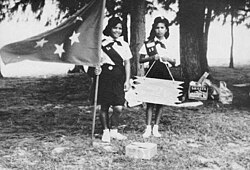
Flags Used Prior to 1965
Before the adoption of the light blue flag with six stars, the Trust Territory did not have a dedicated local emblem. Instead, it relied on the flags of the international and national bodies overseeing the trusteeship.
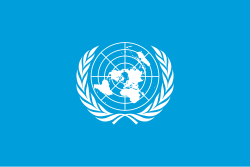
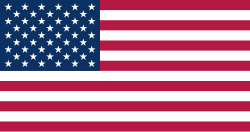
From 1947 to 1965, the flag of the United Nations was utilized within the TTPI. Additionally, the flag of the United States was used from 1944 through the early 1980s, with the 50-star version appearing after 1960.
The Decline and Legacy of the Flag
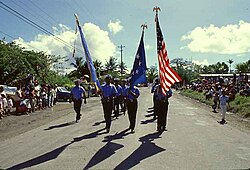
The TTPI flag remained in use through the 1970s and into the early 1980s. As the political landscape shifted and the districts moved toward autonomy, the need for a single collective flag diminished. Eventually, each district adopted its own unique flag, marking the end of the TTPI flag's era.
Key Facts
- Designer: Gonzalo Santos of the Yap district.
- Official Date: August 19, 1965.
- Symbolism: Light blue for freedom and loyalty; six stars for the six districts.
- Prize: The designer received US$ 250.
- Preceding Flags: United Nations and United States flags.
| Feature | Detail |
|---|---|
| Field Color | Light Blue |
| Central Elements | Six white stars in a circle |
| Represented Districts | Marianas, Marshall Islands, Yap, Chuuk, Pohnpei (incl. Kosrae), Palau |
| Approval Date | August 19, 1965 |
| Usage Period | 1965 to early 1980s |
Frequently Asked Questions
Who designed the flag of the Trust Territory of the Pacific Islands?
The flag was designed by Gonzalo Santos, a government employee from the Yap district, who won a contest for the design.
What do the six stars on the flag represent?
The six stars represent the six districts of the TTPI: the Marianas, the Marshall Islands, Yap, Chuuk, Pohnpei (including Kosrae), and Palau.
What is the meaning of the light blue color in the flag?
The light blue field was chosen to symbolize freedom and loyalty.
Which flags were used in the TTPI before the official flag was adopted?
Prior to the 1965 official flag, the United Nations flag (used 1947–1965) and the United States flag (used 1944–early 1980s) were utilized.
When did the TTPI flag stop being used?
The flag was used until the 1970s and early 1980s, at which point the individual districts adopted their own unique flags.