Trinomial Nomenclature in Biological Classification
In the world of biology, naming organisms requires a precise system to ensure scientists worldwide are discussing the same creature or plant. While most are familiar with the two-part species name, trinomial nomenclature is the specialized system used for taxa—groups of one or more populations of an organism—that fall below the rank of species.
A trinomial name consists of three distinct parts. While the goal of providing a specific identity is universal, the application of this system differs significantly between the fields of zoology and botany.
Key Facts
- Trinomial nomenclature uses three parts to name organisms below the species level.
- In zoology, a trinomen specifically identifies a subspecies.
- In botany, trinomials can represent various infraspecific ranks, such as variety or form.
- Zoological trinomina are written in italics, with only the first letter of the generic name capitalized.
- The modern zoological standard was heavily promoted by Elliott Coues in the early 20th century.
Trinomial Nomenclature in Zoology
In zoological nomenclature, a trinomen (plural: trinomina) is the formal name of a subspecies. This name is composed of three elements: the generic name, the specific name, and the subspecific name. The first two elements together form the binomen, or the species name.
Formatting is strict: all three parts are typeset in italics, and only the first letter of the generic name is capitalized. Unlike other systems, zoology does not include a rank indicator because the subspecies is the only recognized rank below the species level.
For example, the red-tailed hawk is Buteo jamaicensis, but one of its subspecies is Buteo jamaicensis borealis.

Examples of Zoological Trinomina
- Western lowland gorilla: Gorilla gorilla gorilla (Savage and Wyman, 1847)
- Cross River gorilla: Gorilla gorilla diehli (Matschie, 1903)
- Plains bison: Bison bison bison (Linnaeus, 1758)
- Wood bison: Bison bison athabascae (Rhoads, 1898)
Author Citations and Abbreviations
In professional taxonomic publications, a name is considered incomplete without an author citation. This includes the name of the person who published the name, the publication source, and the date. For instance, Phalacrocorax carbo novaehollandiae (Stephens, 1826) identifies a subspecies of the great cormorant introduced by James Francis Stephens in 1826.
To improve readability, if the generic and specific names have already been mentioned in a paragraph, they are often abbreviated to their initial letters. A writer might refer to the great cormorant Phalacrocorax carbo and subsequently refer to its Australasian subspecies as P. c. novaehollandiae.
Historical Development
While binomial nomenclature was widely accepted by the mid-18th century, the unified standard for trinominal nomenclature was not agreed upon until the early 20th century. Although pioneered in 1828 by Carl Friedrich Bruch and used around 1850 by John Cassin and Hermann Schlegel, it was the tireless promotion of Elliott Coues that established the current standard. Because the system was not fully established in all zoological fields until the 1930s, older European works may not align with contemporary standards.
Trinomial Nomenclature in Botany
Botany—which includes the study of plants, algae, fungi, and their fossils—utilizes a more flexible system. There is an indeterminate number of infraspecific ranks (ranks below the species level) allowed.
The primary secondary ranks are variety and form. Further subdivisions can be created using the prefix "sub," resulting in ranks such as subspecies, subvariety, or subform. In rare instances, even more complex terms like supersubspecies are used. Depending on the author's preference, a species may be divided into either subspecies or varieties.
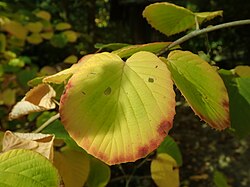
It is important to distinguish between biological classification and the actual name. For example, a plant might be classified as Corylopsis sinensis var. calvescens f. veitchiana. However, the actual trinomial name consists of only three parts: the two parts of the species name and the forma epithet, resulting in Corylopsis sinensis f. veitchiana.
Summary of Nomenclature Systems
| Feature | Zoology | Botany (Plants, Algae, Fungi) |
|---|---|---|
| Primary Rank Below Species | Subspecies | Variety or Form |
| Number of Infraspecific Ranks | One (Subspecies) | Indeterminate (Subspecies, Variety, Form, etc.) |
| Rank Indicators | None used | Used (e.g., "var." or "f.") |
| Formatting | Italicized; Generic name capitalized | Italicized; Generic name capitalized |
Frequently Asked Questions
What is the difference between a binomen and a trinomen?
A binomen is a two-part scientific name consisting of the generic name and the specific name (the species). A trinomen adds a third part to identify a taxon below the species level, such as a subspecies.
Why does botany use rank indicators like "var." or "f." while zoology does not?
Botany allows for multiple infraspecific ranks (such as variety and form), so indicators are necessary to specify which rank is being referenced. Zoology recognizes only one rank below species—the subspecies—making an indicator redundant.
Who was instrumental in standardizing zoological trinomials?
While Carl Friedrich Bruch pioneered the usage in 1828, Elliott Coues is credited with the tireless promotion that led to the unified standard agreed upon in the early 20th century.
How are trinomial names abbreviated in scientific writing?
If the genus and species have already been mentioned in the same paragraph, they are often abbreviated to their first initials. For example, Phalacrocorax carbo novaehollandiae becomes P. c. novaehollandiae.
What is an author citation in taxonomy?
An author citation is the addition of the name of the person who first published the scientific name, along with the publication details and the date, ensuring the name is complete and traceable.