Treehouse Support Methods and Construction Technology
Building a treehouse begins with a fundamental challenge: creating a stable, rigid platform that can support a structure while minimizing damage to the living tree. Because trees are dynamic organisms that grow and sway, the methods used to fasten a house to its host must balance structural integrity with biological health.
Most modern constructions start by establishing a platform that rests on branches. However, when natural supports are insufficient, builders rely on specific engineering techniques to distribute weight and ensure safety.
Key Facts
- Treehouse Attachment Bolts (TABs), developed in the 1990s, are designed to support significantly higher weights than traditional invasive fasteners.
- Stilts are the most effective way to support larger structures while reducing the physical load on the tree.
- Noninvasive methods utilize friction and tension rather than punctures to secure beams.
- Stay rods are primarily used to manage movement caused by wind or natural tree growth.
Non-Invasive Support Systems
Struts and Stilts
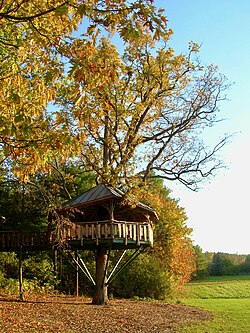
Struts and stilts transfer the weight of the structure to a lower elevation or directly to the ground. By shifting the load away from the tree, these supports prevent stress, strain, and the injuries associated with puncture holes. While stilts are traditionally anchored in concrete, modern innovations like the Diamond Pier allow for faster installation and are less disruptive to the tree's root system.
Friction and Tension Fasteners
For those seeking to avoid piercing the bark entirely, friction and tension fasteners are the most common choice. These systems secure beams to the trunk using counter-beams, threaded bars, or tying mechanisms. Because they do not rely on nails or bolts, they are considered noninvasive.
Advanced and Invasive Fastening Techniques
Stay Rods
Stay rods are designed to relieve weight at higher elevations and are particularly useful for controlling movement caused by wind or the tree's own growth. These systems may utilize ropes, wire cables, springs, or tension fasteners. However, their use is limited because higher elevations often have fewer branches, which can increase the structure's sensitivity to wind.
Invasive Methods
Invasive methods involve any technique that punctures the tree, including the use of screws, bolts, kingpins, and nails. Because these methods create wounds, they must be carefully planned to minimize stress. The impact of punctures varies by plant species, depending on whether the sap conduits—the vessels that transport nutrients—are located in the bark or the pith (the central core of the stem).
While nails are generally discouraged, the treehouse attachment bolt, introduced in the 1990s, provides a specialized solution capable of supporting much heavier loads than previous invasive methods.
Comparison of Support Methods
| Method | Type | Primary Benefit | Primary Drawback |
|---|---|---|---|
| Stilts/Struts | Non-Invasive | Maximum weight support; protects tree | Requires ground installation |
| Friction Fasteners | Non-Invasive | No punctures to the tree | Limited by grip strength |
| Stay Rods | Hybrid/Support | Controls wind and growth movement | High wind sensitivity at height |
| TABs/Bolts | Invasive | High weight capacity | Causes puncture wounds |
Frequently Asked Questions
Are nails recommended for treehouse construction?
No, nails are generally not recommended because they can cause unnecessary stress and damage to the tree.
What is a treehouse attachment bolt?
Developed in the 1990s, it is a specialized invasive bolt designed to support significantly greater weights than traditional screws or nails.
How do stilts help the tree?
Stilts reduce the weight load on the tree, which helps prevent structural stress, potential strain, and injuries caused by puncture holes.
What are the risks of using stay rods?
Stay rods are often limited by the natural constraints of the tree; as elevation increases and branches thin out, the system's capacity decreases and its sensitivity to wind increases.
How do noninvasive fasteners work?
They secure beams to the tree trunk using tension, tying, threaded bars, or counter-beams rather than piercing the wood with hardware.