Understanding Tree Girth: A Guide to Measuring Forest Giants
Tree girth is a fundamental measurement representing the circumference of a tree trunk. As one of the oldest and simplest methods used by foresters, it provides a vital record of the size and growth of living, standing trees. While methods and equipment vary by country, girth is a primary tool used to compare outstanding individual trees across different species and geographic locations.
Key Facts
- Standard Measurement: In the United States, girth is typically measured at "breast height," which is 4.5 feet (1.4 m) above the ground.
- The Pith: The base of a tree is defined by the pith—the central core of the stem—where it intersects the ground.
- Single vs. Multi-trunk: A single-trunk tree has one pith at ground level, while a multi-trunk tree has two or more.
- Calculation: When measuring remotely, girth is calculated by multiplying the diameter by π (pi).
- Data Accuracy: It is recommended to record raw girth numbers rather than converting them to diameters to avoid overstating the cross-sectional area.
The Fundamentals of Girth Measurement
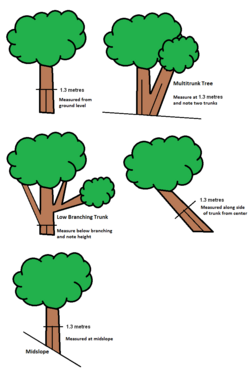
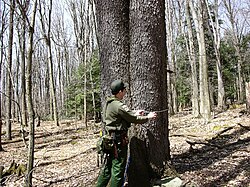
Girth is measured as the distance around the trunk, taken perpendicular to the axis of the tree. Because tree trunks often flare outward at the base—a feature known as basal flare or buttressing—standardizing the height of measurement is essential for consistency. In the United States, the standard is 4.5 feet (1.4 m) above the ground, often referred to as breast height. In other parts of the world, measurements may be taken at 1.3, 1.35, 1.4, or 1.5 meters.
When measuring on a slope, the base of the tree is determined by finding the elevation where the pith intersects the ground. This is calculated as the midpoint between the ground level on the upper and lower sides of the tree. If the basal flare is so significant that it extends above the standard breast height, researchers should ideally take a second measurement above the flare and record that specific height.
Girth is often one of several parameters used in champion tree programs. Other common measurements include height, crown spread (the width of the tree's canopy), and wood volume. For example, the American Forests Big Tree Program uses a specific formula to award "Big Tree Points": 1 point per foot of height, 1 point per inch of girth, and ¼ point per foot of average crown spread. The tree with the highest total for its species is recognized as the champion.
Single-Trunk vs. Multi-Trunk Trees
Distinguishing between single-trunk and multi-trunk trees is critical for scientific accuracy. A single-trunk tree is defined as having only one pith if cut at ground level. Conversely, a multi-trunk tree has two or more piths at the ground level, regardless of whether the trunks are genetically identical or growing from a single root mass. Because multiple trunks growing together can achieve a large combined girth much faster than a single trunk, mixing these two types in a dataset can bias scientific results.
When measuring multi-trunk trees, if the trunks have grown together at breast height, their combined girth should be measured and the number of trunks included should be noted. If the trunks are separate at breast height, they should be measured individually. If one trunk is significantly larger than the others, it may be treated as a single-trunk tree, with its girth measured where it emerges from the shared mass.
Challenges and Corrective Procedures
Measuring tree girth is not always straightforward. Irregularities such as burls (knots or bumps), low branches, or epicormic sprouts (new shoots growing from the trunk) can falsely inflate measurements. If a burl or knot occurs at the standard 4.5-foot height, the measurement should be taken at the narrowest point below the growth, and the specific height must be recorded. Similarly, if a tree has significant branching below breast height, the girth should be measured at the narrowest point below those branches.
Leaning trees also require specific techniques. For a slanted tree, the circumference should be measured at 4.5 feet along the actual axis of the trunk, ensuring the measurement is taken at a 90-degree angle to that axis. For trees on slopes, measuring from the midslope point is the recommended method to ensure a consistent reference point for height and girth across different specimens.
Record-Breaking Trees
Throughout history, certain trees have set massive benchmarks for girth. The Glencoe Baobab in South Africa once held a record with a diameter near ground level of 52.2 feet (15.9 m), resulting in a girth of 164 feet (50 m). The General Grant Tree, a single-trunk Sequoia in California, has a recorded girth of 91.2 feet (27.80 m) at breast height.
The Árbol del Tule in Mexico presents a unique case. While its tape-wrap girth is 119.8 feet (36.5 m), the tree is heavily buttressed and irregular. To get a more accurate representation of its size, researchers use nominal diameter—the diameter of a circle that represents the tree's actual cross-sectional wood area. For the Tule tree, this results in a diameter of 30.8 feet (9.4 m) at breast height, which is significantly smaller than the diameter extrapolated from the circumference.
| Tree Name | Location | Girth (ft) | Notable Feature |
|---|---|---|---|
| Glencoe Baobab | South Africa | 164 | Largest recorded girth; split in 2009 |
| Árbol del Tule | Mexico | 119.8 | Heavily buttressed; massive crown |
| General Grant Tree | California, USA | 91.2 | Confirmed single-trunk Sequoia |
Advanced and Remote Measurement Techniques
In modern forestry, girth can be measured remotely using a monocular equipped with a reticle (a built-in scale). By using a laser rangefinder to determine the distance to the tree, a surveyor can read the diameter through the telescope and then multiply that value by π to find the girth. For even higher accuracy, electronic surveying devices or 3D modeling can be used.
Photographic measurement is another emerging method. By using a digital camera, a laser rangefinder, and a reference object of known size, researchers can use software like Excel to approximate a tree's diameter and girth from a photo. This is particularly useful for analyzing historical photographs where the original dimensions of the tree are unknown.
Unusual Tree Forms and Growth
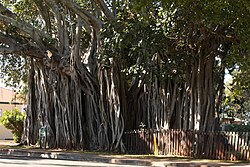
Not all trees fit the standard model. Edward Forrest Frank proposed a classification system to categorize unusual forms, including clonal colonies, conjoined trees, and Banyan-like trees. Because these forms are often too complex for simple numerical data, the best approach is to provide a detailed narrative description, GPS coordinates, and photographs to document their unique characteristics.
Finally, it is important to note that girth and volume growth change as a tree ages. While radial growth (the increase in diameter) often slows down in older trees, they may still contribute significant wood volume. For example, research has shown that even older white pine trees can continue to add substantial volume annually through increases in both height and girth.
Frequently Asked Questions
What is "breast height" in forestry?
Breast height is a standardized height used to measure tree girth to ensure consistency across different measurements. In the United States, this is set at 4.5 feet (1.4 m) above the ground.
How can I tell if a tree is single-trunk or multi-trunk?
The most accurate way to distinguish them is by looking at the pith (the central core) at ground level. If there is only one pith, it is a single-trunk tree; if there are two or more piths, it is a multi-trunk tree.
Why should I record girth instead of converting it to diameter?
Converting girth to a diameter can often overstate the actual cross-sectional area of the trunk, especially in irregular or heavily buttressed trees. It is best to record the raw girth and perform any necessary diameter calculations later.
Can you measure a tree's girth from a distance?
Yes. You can use a monocular with a built-in reticle scale and a laser rangefinder to determine the diameter, then multiply that diameter by π to calculate the girth.
Does a tree stop growing in girth as it gets older?
While the rate of radial growth (diameter) typically slows down as a tree ages, the tree may still continue to add significant wood volume through a combination of height and girth increases.