Trautonium: The Innovative Electronic Instrument of Oskar Sala
Long before the modern synthesizer became a staple of music production, the Trautonium emerged as a groundbreaking electronic instrument that challenged traditional notions of performance. Unlike the rigid structure of a piano keyboard, the Trautonium offered a fluid, expressive interface that allowed musicians to glide between notes and manipulate sound with tactile precision.
How the Trautonium Works
The Trautonium replaced the traditional keyboard with a manual consisting of a resistor wire stretched over a metal plate. To produce sound, the performer presses the wire against the plate. This action changes the effective length of the wire, which determines the pitch. Because the interface is a continuous wire rather than discrete keys, players can achieve portamento (a smooth glide between pitches), quarter tones, and vibrato through small, rapid movements.
Volume is controlled by the amount of pressure the finger applies to the wire and board. Internally, the instrument originally used neon-tube relaxation oscillators—later replaced by thyratrons and eventually transistors—to generate sawtooth-like waveforms. The oscillator output is then fed into two parallel resonant filter circuits, with a foot pedal allowing the performer to control the volume ratio between the two filters before the signal reaches the amplifier.
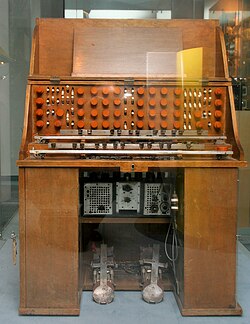
Key Facts
- Production: Marketed by Telefunken from 1933 to 1935, with approximately 200 units produced.
- Interface: Uses a resistive wire over a metal plate instead of a keyboard.
- Sound Generation: Originally powered by neon-tube relaxation oscillators producing sawtooth waveforms.
- Notable Collaborators: Developed and performed by Oskar Sala in collaboration with composers like Paul Hindemith.
- Cinematic Legacy: Used by Oskar Sala to create the bird sound effects for Alfred Hitchcock's The Birds.
Evolution and the Mixtur-Trautonium
While the early models were monophonic, Oskar Sala significantly expanded the instrument's capabilities. He introduced a switch for changing static tuning, a noise generator, and an envelope generator known as the Schlagwerk. He also integrated formant filters (multiple bandpass filters) and subharmonic oscillators.
Subharmonic oscillators are unique because they generate a main pitch and several subharmonics, which are fractions of the fundamental tone rather than multiples. By allowing the player to mix four of these waves across two manuals using predefined settings, the instrument evolved into the Mixtur-Trautonium.
| Feature | Early Trautonium | Mixtur-Trautonium |
|---|---|---|
| Oscillator Type | Neon-tube / Thyratron / Transistor | Enhanced with Subharmonic Oscillators |
| Control Interface | Single resistive wire manual | Two manuals with mixed wave settings |
| Additional Modules | Resonant filter circuits | Noise generator, Schlagwerk, Formant filters |
| Primary Use | Classical concertos and trios | Industrial films, cinema, and avant-garde ballet |
Performance History and Cultural Impact
The Trautonium made its public debut on June 20, 1930, at the Berliner Musikhochschule Hall during the "Neue Musik Berlin 1930" event, performed by Oskar Sala and Paul Hindemith. Hindemith became a key proponent of the instrument, composing several short trios for three Trautoniums tuned to bass, middle, and high voices, as well as a Concerto for Trautonium with String Quartet.
Other composers, such as Harald Genzmer, wrote concertos for both the monophonic version and the Mixtur-Trautonium. Beyond the concert hall, the instrument found a home in orchestral emulation; it was used in 1942 for the Dresden premiere of Richard Strauss's Japanese Festival Music to mimic gongs and bells, and in the 1950s at Bayreuth for the Monsalvat bells in Wagner's Parsifal.
In the mid-20th century, the instrument crossed into the world of dance and film. In 1961, Oskar Sala and Remi Gassmann utilized the Trautonium for George Balanchine's science fiction ballet Electronics, performed by the New York City Ballet.
Frequently Asked Questions
What makes the Trautonium different from a piano?
Unlike a piano, which uses keys for fixed pitches, the Trautonium uses a resistive wire. This allows the performer to slide between notes, create vibrato, and control volume through finger pressure.
What is a subharmonic oscillator?
A subharmonic oscillator generates frequencies that are fractions of the fundamental tone, rather than the integer multiples produced by standard harmonic oscillators.
Who was Oskar Sala?
Oskar Sala was a virtuoso performer and developer of the Trautonium who expanded the instrument into the Mixtur-Trautonium and used it for various cinematic and musical compositions.
How was the Trautonium used in cinema?
The most famous cinematic application was by Oskar Sala, who used the instrument to create the realistic yet eerie bird noises for Alfred Hitchcock's film The Birds.
Which company originally manufactured the Trautonium?
The first Trautoniums were marketed by Telefunken between 1933 and 1935, with a total production run of 200 units.