Trailer Types and Their Specialized Applications
Trailers are essential tools for transporting goods, equipment, and people across various industries. From small, personal-use frames towed by automobiles to massive industrial platforms moved by heavy-duty tractors, trailers are designed to optimize the capacity of a towing vehicle. While some are simple single-axle designs, others are complex engineering feats capable of moving thousands of tonnes of oversized cargo.
Key Facts
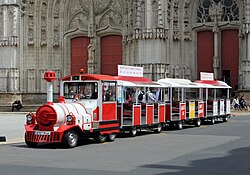
- Semi-trailers lack a front axle and rely on a tractor unit or dolly for support.
- Full trailers are supported by both front and rear axles, transmitting minimal static load to the tow vehicle.
- Hydraulic Modular Trailers (HMT) use high-tensile steel and independent steering to move oversized industrial loads.
- Utility trailers are general-purpose tools for light loads, often featuring folding sides or flatbeds.
- Livestock trailers are specialized for animal welfare, with horse trailers offering advanced suspension and ventilation.
General Purpose and Personal Trailers
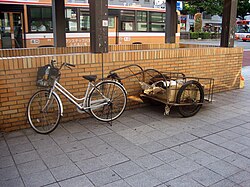
Many trailers are designed for small businesses or personal use and can be attached to any powered vehicle with a compatible hitch. These range from enclosed motorcycle and toy trailers, which typically require only a standard driver's license, to smaller bicycle trailers used for motorless cargo transport.
Utility trailers serve as general-purpose carriers for light, compact loads weighing up to a few metric tonnes. These typically lack a roof and may feature rigid or folding metal sides. When a utility trailer has no sides, it is referred to as a flatbed or flat-deck trailer. If it utilizes rails and ramps for transporting vehicles or mobile plant, it is known as an open car transporter or plant trailer. Fully enclosed, weatherproof versions are categorized as box trailers or cargo trailers.
Recreational and Travel Trailers
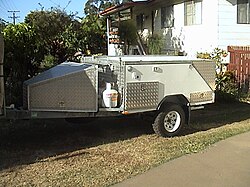
Travel trailers, or campers, vary widely in scale. Aerodynamic, lightweight models are designed to be lower than the tow vehicle to minimize drag. Larger versions can reach lengths of 40 to 57 feet (12.1 to 17.4 m), requiring heavy-duty tractor units and air brakes. Some high-end recreational vehicles also tow additional single-axle dolly trailers to transport small cars.
Commercial and Heavy-Duty Freight Trailers
Commercial transport relies on distinct trailer architectures to balance weight and maneuverability. The most common are semi-trailers and full trailers.
Semi-Trailers
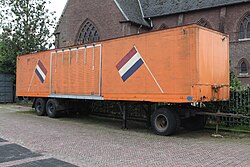
A semi-trailer is characterized by the absence of a front axle. A significant portion of its weight is supported by the towing tractor or a detachable front axle assembly called a dolly. To remain stable when uncoupled, they use "landing gear" (support legs). In the United States, interstate highway limits generally restrict single semi-trailers to 57 feet (17.37 m) unless a special permit is granted.
Semi-trailers include various designs such as refrigerated enclosures (reefers), dry vans, flatbeds, and grain haulers. Due to high costs, many companies lease this equipment to maintain capital liquidity.
Full Trailers
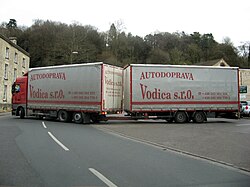
Known as A-frame drawbar trailers in Europe and dog trailers in Australia, full trailers are supported by both front and rear axles. They use a towing device that moves vertically and controls the front axle without transferring significant static weight to the towing vehicle. These are common in farming and commercial freight, with specific regional dimensions; for example, New Zealand limits them to 11.5 m in length.
Specialized Industrial Trailers
Certain tasks require highly engineered trailers that go beyond simple cargo hauling.
Hydraulic Modular Trailers (HMT)
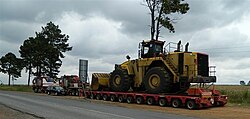
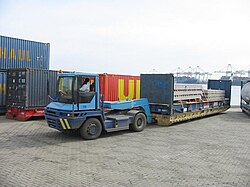
HMTs are platform units used for oversized, overweight loads that cannot be disassembled, such as bridge sections, oil rig modules, and turbines. They feature hydraulic suspension, swing axles, and independently steerable axles. These units are constructed from high-tensile steel and are moved by ballast tractors. Self-powered versions are known as SPMT (Self-Propelled Modular Transporters).
Fixed-Plant and Power Trailers
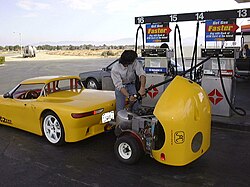
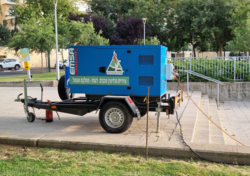
Fixed-plant trailers are built to carry immobile units like large pumps and generators. Similarly, genset trailers provide power to the towing vehicle or a specific worksite.
Logistics and Aviation Trailers
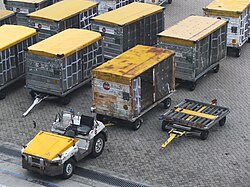
In aviation, baggage trailers (or baggage carts in the US) transport loose luggage and mail between aircraft and terminals. These often use plastic curtains for weather protection and include braking systems that engage when the tug is disconnected.
Niche Transport Solutions
Specific industries require tailored environments for their cargo, particularly for animals and specialized vehicles.
Livestock and Horse Trailers
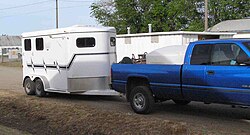
Stock trailers (bull haulers) are enclosed on the bottom with eye-level openings for ventilation. Horse trailers are more sophisticated, featuring adjustable vents, specialized suspension for a smoother ride, and internal partitions to keep animals upright. Some large horse trailers even include living quarters for humans.
Motorcycle and Boat Trailers
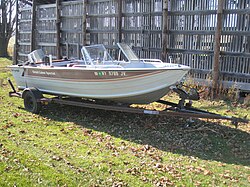
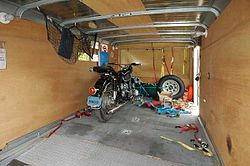
Motorcycle trailers can be open or enclosed, with some specialized single-wheeled versions using universal joints to lean with the bike. Boat trailers are designed specifically to launch and retrieve watercraft safely.
Trailer Comparison Summary
| Trailer Type | Axle Configuration | Primary Use | Key Feature |
|---|---|---|---|
| Utility | Single to Triple | Light cargo/General purpose | Open top, optional sides |
| Semi-Trailer | Rear only | Heavy commercial freight | Supported by tractor/dolly |
| Full Trailer | Front and Rear | Freight and Farming | Drawbar connection |
| HMT | Multiple Modular | Oversized industrial loads | Hydraulic steering/suspension |
| Horse Trailer | Variable | Equine transport | Advanced suspension/ventilation |
Frequently Asked Questions
What is the main difference between a semi-trailer and a full trailer?
A semi-trailer has no front axle and relies on the towing vehicle or a dolly for support, whereas a full trailer has both front and rear axles and is pulled by a drawbar, meaning it carries its own weight without putting significant static load on the tow vehicle.
What are the characteristics of a Hydraulic Modular Trailer (HMT)?
HMTs are made of high-tensile steel and feature hydraulic suspension and independently steerable axles. They are designed to move massive, indivisible loads like ship sections or industrial turbines.
How do horse trailers differ from standard stock trailers?
Horse trailers are more elaborate than standard stock trailers, offering better suspension for a smoother ride, adjustable ventilation, and internal partitions to ensure the safety and physical condition of the horses.
What is a "reefer" in the context of semi-trailers?
A "reefer" is a refrigerated semi-trailer enclosure used to transport temperature-sensitive goods. They typically measure around 13 ft 6 in by 53 ft 0 in.
Can any vehicle tow a utility trailer?
Utility trailers are designed to be towed by light vehicles, but the towing vehicle must have an appropriate hitch and the capacity to handle the weight of the load, which can reach a few metric tonnes.