Town Sights and Historical Landmarks
Blending medieval charm with a resilient spirit, this town offers visitors a glimpse into a rich architectural and social history. From its central marketplace to its innovative social institutions, the area maintains an "Old World" feel despite the challenges of the past.
The Heart of the Town
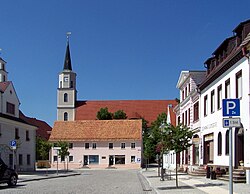
The center of town is defined by the Marketplace and the adjacent Town Park. At the focal point of the square stands the Evangelische Stadtkirche (Town Evangelical Church). Built in 1798, the church is a testament to the town's endurance; its tower was severely damaged during an air-raid bombing in April 1945, but it was later meticulously restored to its former glory.
Historical Sites and Architecture
The town's landscape is dotted with remnants of its complex history. One notable point of interest is the former site of Castle Rothenburg. Constructed in 1686, the castle once stood on the edge of the main town square before its destruction during World War II.
For those interested in nature and local leisure, the dam on the Neisse River serves as a historical landmark, having previously functioned as a popular bathing area for the local community.
The Legacy of Martinshof
Established in 1883, Martinshof represents a pioneering approach to social care. The brainchild of Friedrich von Martin, this complex serves as a home for individuals with mental and physical disabilities and remains operational today. Many of the original barns and houses are still standing, retaining the biblical names assigned by Martin, such as "Bethlehem."
Regional Context and Surroundings
While air raids during the Second World War impacted several landmarks, the town has successfully preserved much of its original medieval atmosphere. Visitors looking to expand their journey can find further interest in nearby locations:
- Niesky: Located to the southwest.
- Görlitz: Located directly south, this is a fully preserved medieval town featuring historic city walls, festivals, and grand hotels.
Key Facts
- Evangelische Stadtkirche: Built in 1798; tower restored after 1945 bombing.
- Castle Rothenburg: Built in 1686; destroyed during WWII.
- Martinshof: Founded in 1883 by Friedrich von Martin for the disabled.
- Neisse River: Site of a former local bathing dam.
- Nearby Cities: Niesky (southwest) and Görlitz (south).
| Landmark | Significance | Key Date/Period |
|---|---|---|
| Evangelische Stadtkirche | Central town church and focal point | 1798 |
| Castle Rothenburg | Former castle on the town square | 1686 - WWII |
| Martinshof | Care complex for disabled persons | 1883 |
| Neisse River Dam | Former local bathing area | Historical |
Frequently Asked Questions
When was the Town Evangelical Church built?
The Evangelische Stadtkirche was built in 1798.
What happened to the church tower in 1945?
The tower was badly damaged in April 1945 during an air-raid bombing, though it was restored later.
What is Martinshof?
Martinshof is an operational home and complex for the mentally and physically disabled, founded in 1883 by Friedrich von Martin.
What remains of Castle Rothenburg?
Castle Rothenburg, which was built in 1686, no longer stands; visitors can now visit its former site on the edge of the main town square.
Which nearby town is known for its city walls?
Görlitz, located directly south of town, is a medieval town complete with city walls, hotels, and festivals.