Tomnahurich Cemetery Hill
Perched on a prominent wooded hill in Inverness, Scotland, the Tomnahurich Cemetery is a striking example of Victorian funerary architecture and landscape design. Established in 1864, this public cemetery serves as both a place of rest and a significant local landmark, offering breathtaking views of the Moray Firth, the Ness Valley, and the city of Inverness.
Key Facts
- Established: 1864 by the Inverness Cemetery Company.
- Location: 1.5 km southwest of Inverness city centre, between the River Ness and the Caledonian Canal.
- Designation: Included in the Inventory of Gardens and Designed Landscapes in Scotland since March 30, 2003 (Ref: GDL00374).
- Topography: The hilltop reaches 70 meters with a topographic prominence of 53 meters.
- War Graves: Home to 169 Commonwealth War Graves Commission registered graves.
Etymology and Folklore
The name Tomnahurich is derived from the Scottish Gaelic tom na h-iubhraich, which translates to "hill of the yew wood." This meaning was established by Professor W. J. Watson in his 1926 work, The Celtic Place-Names of Scotland. Interestingly, Professor Watson is himself buried within the cemetery under a fine monument.
While some suggest the name refers to the "hill of the fairies," this is linguistically incorrect. However, the connection to the supernatural persists through local folklore, specifically the story of Aonghas Mòr Thom na h-Iubhraich agus na Sìthichean ("Big Angus of Tomnahurich and the Fairies").
Landscape and Layout
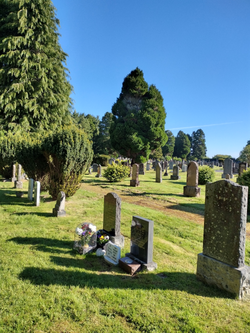
The cemetery is divided into two distinct sections. The upper plateau features a formal graveyard and a war memorial, while the Lower Cemetery occupies the surrounding low ground. These areas are connected by a network of footpaths.
The hillside is densely wooded, providing a natural habitat for various bird species. The elevation makes the site a prominent visual marker when viewed from the surrounding plains.
History and Development
Long before it became a burial ground, the hill was a hub for social activity. Its prominent location made it an ideal site for annual horse races, which traditionally took place on May 24th and 25th. Because the soil was considered too poor for agriculture, the hill was planted with trees—primarily Pinus sylvestris (Scots Pine)—in 1753.
The site's aesthetic appeal attracted 18th-century figures like Thomas Pennant, who documented the hill in his travels. In the latter half of the 19th century, the Inverness Cemetery Company developed the site. While the design is attributed to Charles Heath Wilson, much of the practical execution was handled by the Scottish civil engineer George Grant Mackay.
The Borough of Inverness acquired the cemetery in 1909. During the Second World War, the site contributed to the national war effort when various iron parts and metallic chains were removed from the grounds for recycling.
Architectural and Artistic Highlights
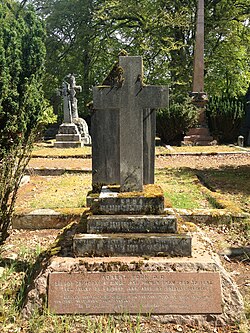
The cemetery is noted for its historic tombstones and ornate structures. Notable examples include the memorial to Mary Anne Lyall and the monument of Andrew Davidson (1841–1925). One of the most striking features is the mausoleum of Henry Christie, which features a marble door guarded by a statue of an armed angel.
Visitors will also find a lodge near the main entrance, designed by architect Alexander Ross in 1877.
War Graves and Remembrance
The cemetery serves as a place of international remembrance, maintaining 169 war graves registered with the Commonwealth War Graves Commission. This includes 89 personnel from World War I and 80 from World War II, among whom are six Polish personnel.
Summary of Site Details
| Feature | Details |
|---|---|
| Official Name | Tomnahurich Cemetery |
| Coordinates | 57°28′01″N 4°14′34″W |
| Designers | Charles Heath Wilson & George Grant Mackay |
| Key Flora | Pinus sylvestris (Scots Pine) |
| Reference No. | GDL00374 |
Frequently Asked Questions
What does the name Tomnahurich mean?
It is a Scottish Gaelic name meaning "hill of the yew wood."
Who designed the cemetery?
The design is attributed to Charles Heath Wilson, with significant engineering work completed by George Grant Mackay.
Are there any famous people buried there?
Professor W. J. Watson, the renowned expert on Celtic place-names, is buried in the cemetery.
How many war graves are located at the site?
There are 169 registered war graves, consisting of 89 from World War I and 80 from World War II.
What was the hill used for before the cemetery?
The hill was used for social events, including annual horse races in May, and was used for forestry starting in 1753.