Tolkien Calendars: A History of Middle-earth Illustration
For decades, the visual legacy of J.R.R. Tolkien's Middle-earth has been preserved and expanded through the tradition of the Tolkien Calendar. These publications have served as more than mere date-keepers; they have been galleries of imagination, evolving from simple fanzine prints to global commercial successes that inspired a generation of fantasy artists.
The Early Years of Middle-earth Calendars
The origin of these calendars dates back to December 1968, with the earliest known production appearing in the Meretricious fanzine in 1969, illustrated by Tim Kirk. By 1973, the scale of production grew when Ian and Betty Ballantine of Ballantine Books—the U.S. publishers of The Lord of the Rings—released a Tolkien Calendar. In a gesture of professional courtesy, Ian Ballantine sent a copy to J.R.R. Tolkien himself.
Simultaneously, the author's publishers, Allen & Unwin, began their own venture. After experimenting with posters, they launched an "official" calendar in 1974. This initial series was unique because it utilized Tolkien's own illustrations from The Hobbit, The Lord of the Rings, and his then-unpublished legendarium (the works that would eventually form The Silmarillion). This approach proved successful, leading to a series of calendars featuring the author's artwork from 1976 to 1979.
As Tolkien's own available artwork was exhausted, publishers shifted toward other artists. In 1980, stills from Ralph Bakshi's 1978 animated film The Lord of the Rings were used. Following permission from The Tolkien Estate to incorporate external artists, Allen & Unwin maintained a consistent annual release from 1984 to 2009.
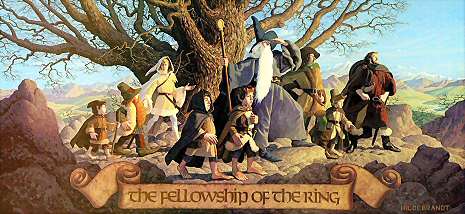
The Influence of the Brothers Hildebrandt
Few artists are as synonymous with the early calendar era as Tim and Greg Hildebrandt, known as the Brothers Hildebrandt. Their work appeared in calendars from 1976 until Tim's passing in 2006. Their impact was both commercial and artistic; the 1976 calendar was reported as the bestselling calendar of all time, and the 1977 edition sold nearly half a million copies.
Beyond sales, the Hildebrandts influenced the trajectory of Middle-earth art. Renowned illustrator John Howe noted that their work provided a "real spark," demonstrating that the complex narratives of Tolkien's novels could be effectively translated into visual art, which prompted Howe to pursue his own career as a Middle-earth artist.
Evolution and Modern Artists
The 1977 publication of The Silmarillion expanded the visual horizons for artists by introducing the tumultuous events of the Second Age of Arda. This era saw the rise of several legendary illustrators:
- Ted Nasmith: Served as the sole artist for numerous editions, including 1987, 1988, 1990, 1992, 1996, 2000, 2002, 2003, 2004, 2009, 2010, and 2022.
- John Howe: Featured in the 1987, 1991, 1995, and 2001 calendars; he later became a concept artist for Peter Jackson's film adaptations.
- Alan Lee: Another key concept artist for the Peter Jackson films, Lee illustrated the entire 2024 HarperCollins production.
Recent years have seen a diversification of styles. The 2015 calendar featured paintings by Mary Fairburn, whose work had been admired by Tolkien in 1968 but remained unpublished until its rediscovery by The Times Literary Supplement. More recent editions, such as the 2023 calendar, have moved toward multi-artist showcases, featuring diverse styles from creators like Jenny Dolfen and Donato Giancola.
The global reach of these publications is immense. Publishers in at least 12 English-speaking and European countries have produced their own versions, with approximately 433 different editions published by 2016.
Key Facts
- First Production: The 1969 calendar in the Meretricious fanzine.
- Peak Popularity: The 1976 calendar was cited as the bestselling calendar of all time.
- Author's Art: Allen & Unwin used J.R.R. Tolkien's own drawings from 1974 to 1979.
- Global Scale: Over 433 editions published across 12+ countries by 2016.
- Major Contributors: The Brothers Hildebrandt, Alan Lee, John Howe, and Ted Nasmith.
| Period/Year | Primary Artist/Source | Key Milestone |
|---|---|---|
| 1969 | Tim Kirk | Earliest known production (fanzine) |
| 1974–1979 | J.R.R. Tolkien | Official calendars using author's art |
| 1976–2006 | Brothers Hildebrandt | Mass commercial success; inspired John Howe |
| 1980s–Present | Lee, Howe, Nasmith, et al. | Transition to professional concept artists |
Frequently Asked Questions
Who created the first Tolkien calendar?
The earliest known production was illustrated by Tim Kirk and printed in the Meretricious fanzine in December 1968 for the year 1969.
Did J.R.R. Tolkien ever see these calendars?
Yes, Ian Ballantine of Ballantine Books sent a copy of the 1973 calendar to the author to express his aim of pleasing him.
Which calendars used the author's own artwork?
Allen & Unwin produced calendars from 1974 to 1979 that featured Tolkien's original illustrations for The Hobbit, The Lord of the Rings, and his legendarium.
How successful were the Brothers Hildebrandt's calendars?
They were immensely popular; the 1976 edition was reported as the bestselling calendar of all time, and the 1977 edition sold nearly 500,000 copies.
Which artists from the calendars worked on the Peter Jackson films?
Both Alan Lee and John Howe, who both illustrated various Tolkien calendars, served as concept artists for Peter Jackson's film adaptations.
How many different editions of Tolkien calendars exist?
By 2016, approximately 433 different editions had been published across at least 12 English-speaking and European countries.