Thelodonti: The Scaly Jawless Fish of the Palaeozoic
In the ancient waters of the Palaeozoic era, a unique group of vertebrates thrived, bridging the gap between the earliest jawless creatures and the more complex fish that followed. These were the Thelodonti, a class of extinct jawless fishes (Agnatha) characterized not by the heavy bony plates seen in many of their contemporaries, but by a shimmering coat of small, distinctive scales. From the Late Ordovician to the Late Devonian, these resilient creatures occupied a wide array of ecological niches, from deep marine shelves to freshwater streams.
Key Facts
- Temporal Range: Lived from the Sandbian (Late Ordovician) to the Late Devonian (approximately 458–359 million years ago).
- Defining Feature: Covered in small, tooth-like "thelodont scales" rather than large armor plates.
- Habitat: Inhabited both marine and freshwater environments, with a strong preference for reef ecosystems.
- Anatomy: Possessed a stomach and heterocercal tails, features previously thought to have evolved only in jawed fish.
- Fossil Record: Their durable scales are among the most common vertebrate fossils of their time.
Anatomy and Physical Description
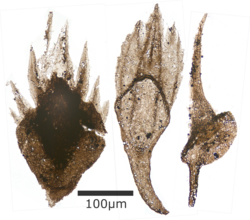
Because thelodonts lacked an internal ossified (bony) skeleton, complete specimens are incredibly rare. Most of what scientists know comes from their exoskeleton, which consisted of thousands of tiny, tooth-like scales measuring between 0.5 and 1.5mm. These scales were teardrop-shaped, mounted on bulky bases with rootlets that anchored them to the skin. Unlike the overlapping scales of modern fish, thelodont scales were aligned to point backward for streamlining, though they often appeared haphazardly arranged.
While most jawless fish of the era were encased in inflexible armor, thelodonts were more flexible. This agility allowed them to reach lengths of 15 to 30 cm and adopt a shark-like outline. Rare three-dimensional fossils have revealed a more developed braincase than that of modern lampreys and a complex gut morphology. Most surprisingly, these fossils show a clearly visible stomach, challenging the long-held scientific belief that stomachs only evolved after the appearance of jaws.
Their fin structure further suggests an active lifestyle. They possessed paired pectoral fins, a single dorsal fin, and an anal fin. Their tails were heterocercal—meaning the upper and lower lobes were unequal—which is a trait associated with the predatory agility seen in modern sharks.
The Science of Thelodont Scales
Thelodont scales are the primary tool for studying this class because they were shed throughout the animal's life and resisted decay. Each scale consists of a non-growing "crown" made of dentine (a hard tissue), an enameloid surface, and an aspidine base of acellular bony tissue.
Researchers have identified five distinct types of bone growth within these scales. This histological variety suggests that thelodonts may have been stem groups for later, more derived clades of fish. However, identifying species based solely on scales is difficult, as scale shape can vary significantly across different parts of a single fish's body.
Taxonomy and Classification
Due to the scarcity of intact bodies, thelodont taxonomy is largely based on scale morphology. Modern classifications, such as those by Wilson and Märss, organize them into several key orders. The Archipelepidiformes are considered the most basal (primitive) group, while the Furcacaudiformes are known for their deep bodies and large, forked tails.
| Order | Key Characteristics | Notable Families |
|---|---|---|
| Archipelepidiformes | Basal-most order; primarily Laurentian distribution. | Archipelepididae, Boothialepididae |
| Furcacaudiformes | Deep-bodied, large forked tails, lateral gill openings. | Furcacaudidae, Lanarkiidae |
| Thelodontiformes | Wide distribution; likely originated in Baltica. | Thelodontidae, Loganelliidae |
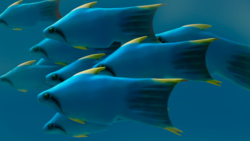
The Furcacauda fredholmae is a prime example of the deep-bodied forms that diverged from the flatter, spine-scaled varieties like Lanarkia.
Ecology and Evolutionary Impact
Initially, scientists believed thelodonts were simple bottom-dwellers that fed on deposits. However, recent evidence suggests they were diverse in their ecological roles. Many were active swimmers in the open water column (pelagic), and many others thrived in reef ecosystems. Their unique scales likely protected them from abrasion against coral and rocks, allowing them to explore habitats that were inaccessible to the heavily armored jawless fish.
From a geological perspective, thelodont scales are invaluable as biostratigraphic markers. Because certain species evolved and spread rapidly across the globe during the Silurian and Early Devonian, their fossils allow geologists to precisely date and correlate rock layers across different continents.
Thelodonts first appeared in the Late Ordovician, with early genera like Larolepis and Stroinolepis found in Canada and Russia. They reached their peak diversity in the Early Devonian before a sharp decline. The last known member of the group, Arianalepis, survived until the Famennian stage of the Late Devonian in Australia and Iran, eventually perishing shortly after the Frasnian–Famennian extinction event.
Frequently Asked Questions
What does the name "Thelodonti" mean?
The name is derived from the Greek words for "nipple teeth," referring to the distinctive shape of their small, tooth-like scales.
How did thelodonts differ from other jawless fish?
Unlike most other agnathans that were covered in large, flat plates of armor, thelodonts were covered in small, flexible, spiny scales, which gave them greater mobility.
Why are thelodont fossils so common despite the fish being rare?
While complete skeletons are rare because they lacked internal bone, their scales were made of highly resistant materials that were shed frequently and fossilized easily.
Did thelodonts have stomachs?
Yes. Rare three-dimensional fossils have revealed the presence of a stomach, which was a surprising discovery because it was previously believed that stomachs only evolved in fish with jaws.
Where did thelodonts live?
They were found in a variety of environments, including open marine shelves, near-shore areas, and some freshwater settings, with many species preferring reef ecosystems.