The Wilberforce School
Located in the heart of Princeton, New Jersey, The Wilberforce School is a private, nondenominational Christian institution dedicated to academic excellence and joyful discovery. Named in honor of the abolitionist William Wilberforce, the school provides a comprehensive educational journey for students from pre-kindergarten through twelfth grade, blending faith with a rigorous classical framework.
Since its inception, the school has grown from a small gathering of students into a robust academic community. Today, it serves a diverse student body drawn from a 30-mile radius, including families from Mercer, Middlesex, and Somerset counties in New Jersey, as well as Bucks County, Pennsylvania.
Key Facts
- Founded: September 8, 2005, by David and Awilda Rowe, and Howe and Brenda Whitman.
- Motto: Gratia et Veritas (Grace and Truth).
- Curriculum: Classical Christian, utilizing the trivium.
- Accreditation: Middle States Association of Colleges and Schools.
- Student Body: Approximately 357 students (including PreK) as of the 2023–24 school year.
- Academic Performance: Students consistently rank in the 95th percentile in math and 92nd in verbal compared to national norms.
History and Growth
Founding and Early Years
The Wilberforce School began in the fall of 2005 after two years of planning by its founders to create better educational options for their children. The school initially operated out of the Lutheran Church of the Messiah in Princeton Borough, offering classes for kindergarten through third grade under the leadership of its first head of school, Sara Capps.
In 2006, Karen Ristuccia took over as principal. Under her leadership, the school expanded its offerings to sixth grade and relocated to the Princeton Church of Christ in Princeton Township to accommodate a growing enrollment.
Campus Expansion
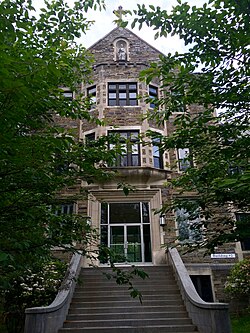
As the school grew to 114 students and expanded to eighth grade, it moved in 2011 to the former Saint Joseph's Seminary. This 47-acre campus provided the necessary space for separate lower and middle school wings, as well as dedicated athletic facilities.
To establish a high school for the 2014–15 academic year, the school utilized space at the Windsor Athletic Club in West Windsor. This expansion added 22,000 square feet of classroom space and provided access to a full-size basketball court and saltwater pool. During this period, the school partnered with Trinity Schools, becoming the first Trinity Member School to license their curriculum and receive specialized teacher training.
By 2019, the school consolidated its operations by returning to the former Saint Joseph's Seminary through the renovation and long-term lease of the campus's main building.
Academic Philosophy
The Classical Framework
The school's educational approach is centered on the trivium—a three-stage pedagogical model that aligns with a child's cognitive development:
- Grammar Stage: Focused on the lower school, where students utilize their natural aptitude for memorization to learn the basic rules and vocabulary of a subject.
- Logic Stage: Emphasized in the middle school, where students develop the capacity for abstract thought and begin organizing principles and interpreting facts.
- Rhetoric Stage: The focus of the upper school, where students learn to write, debate, and apply their knowledge through discourse.
The Study of Classics and Latin
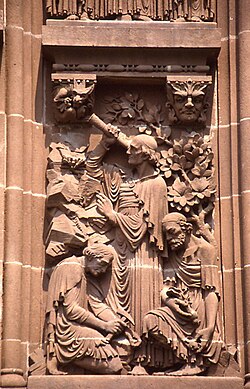
Wilberforce defines a "classic" as any work of art, literature, or history that remains relevant across generations due to its beauty, excellence, or influence. These works are integrated into the curriculum, moving from memorization in the grammar years to analysis in the logic years and debate in the rhetoric years.
Latin language study begins in the third grade (Class Three). The school views Latin as essential for developing an ordered mind, understanding the roots of the English language, facilitating the study of other European languages, and accessing original classical texts.

Student Demographics and Admissions
Admissions to the school are competitive, and students are required to wear uniforms. The student body is nearly evenly split by gender (51% male, 49% female) and represents a variety of Christian traditions, including Protestant, Coptic, Orthodox, Roman Catholic, and Non-denominational. To ensure accessibility, 30% of students receive financial aid.
Athletics and Extracurriculars
The Wilberforce Wolverines compete against other private and charter schools, such as The Lawrenceville School and The Pennington School. The school utilizes the facilities at the Windsor Athletic Club, including a saltwater pool.
The athletic program offers a variety of seasonal sports:
- Fall: Boys and Girls Soccer, Cross-Country, and Bowling.
- Winter: Boys and Girls Basketball, Coed Swimming.
- Spring: Boys and Girls Lacrosse, Coed Track.
The school has seen significant athletic success, including a state championship title won by the girls' cross country team in the NJSIAA Non-Public Group B category. The coaching staff has included high-level talent such as Olympic hopeful Rebeka Stowe.
School Overview Summary
| Category | Details |
|---|---|
| Location | Princeton, Mercer County, New Jersey |
| Grades Served | PreK - 12 |
| Student-Teacher Ratio | 18.1:1 |
| Average Class Size | 12 |
| Upper School Tuition (2025-26) | $30,970 |
| Team Name | Wolverines |
Frequently Asked Questions
What is the trivium in the context of the Wilberforce School?
The trivium is a classical educational model consisting of three stages: grammar (facts and rules), logic (interpretation and organization), and rhetoric (application and discourse). The school applies these stages both to individual academic disciplines and to the developmental stages of the students as they progress from lower to upper school.
When do students start learning Latin?
Students begin the study of Latin in Class Three (third grade). The school considers Latin a vital tool for mental discipline and a foundation for understanding English and other European languages.
Is the school affiliated with a specific Christian denomination?
No, the school is nondenominational. Its student body includes families from various backgrounds, including Roman Catholic, Orthodox, Coptic, and Protestant traditions.
What are the school's athletic achievements?
The school's girls' cross country team achieved a historic milestone by winning the New Jersey State Interscholastic Athletic Association (NJSIAA) Non-Public Group B state title.
How does the school define a "classic" work?
The school defines a classic as any work of art, literature, or history that every generation has studied or cared about because of its inherent beauty, excellence, or its lasting influence and commentary on life.