The Village Voice: The Legacy of America's First Alternative Newsweekly
Founded in the heart of Greenwich Village, The Village Voice holds a distinguished place in American media history as the country's first alternative newsweekly. Launched as a platform for New York City's creative community, it evolved from a local neighborhood paper into a national symbol of independent journalism, arts criticism, and political investigation.
For decades, the publication challenged the mainstream media landscape, providing a voice for the counterculture and documenting the social upheavals of the 20th century. While it has faced significant financial and operational hurdles in the digital age, its influence persists through its archives and its periodic returns to print.
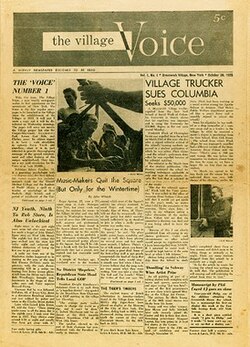
Key Facts
- Founded: October 26, 1955, by Ed Fancher, Dan Wolf, John Wilcock, and Norman Mailer.
- Format: Originally a paid tabloid; transitioned to a free alternative weekly in 1996.
- Major Awards: Recipient of three Pulitzer Prizes (1981, 1986, and 2000).
- Cultural Contributions: Established the Obie Awards for alternative theater and the Pazz & Jop music poll.
- Current Status: Relaunched as a quarterly print publication in April 2021.
The Early Years and Cultural Impact
The Village Voice began in a two-bedroom apartment in Greenwich Village. By the 1960s, its coverage expanded across New York City, and it moved through several landmark locations, including a triangular building near the Stonewall Inn. In 1991, it relocated to Cooper Square in the East Village before eventually moving to the Financial District in 2013.

The publication became a hub for legendary writers and critics. Early contributors included Jonas Mekas, who documented the underground film movement, and Linda Solomon, who covered the club scene. The paper's commitment to the arts was cemented through the Obie Awards, which recognize excellence in off-Broadway and alternative theater, and the Pazz & Jop poll, an influential annual survey of music critics started by Robert Christgau.
Journalistic Excellence and Recognition
Beyond the arts, The Voice was renowned for its muckraking—a style of investigative journalism aimed at exposing corruption—particularly within New York City politics. This dedication to high-quality reporting earned the publication three Pulitzer Prizes:
- 1981: Teresa Carpenter for feature writing.
- 1986: Jules Feiffer for editorial cartooning.
- 2000: Mark Schoofs for international reporting.
Ownership Transitions and Digital Struggles
The latter part of the publication's history was marked by ownership changes and the struggle to adapt to a digital-first media environment. In October 2015, Peter Barbey, through Black Walnut Holdings LLC, purchased the paper from Voice Media Group (VMG). Barbey, who also leads the Reading Eagle Company, attempted to steer the publication through a period of instability.
Despite these efforts, the print edition ceased publication on August 22, 2017, with the final issue featuring Bob Dylan on the cover. The publication continued as a digital-only venture until August 31, 2018, when it stopped producing new editorial content and laid off half of its staff.
The Return to Print
After a hiatus of new content, the publication saw a revival. In December 2020, editor R. C. Baker announced that the paper would resume publishing. Original stories returned to the website in January 2021, followed by the release of a spring print edition on April 17, 2021. Under the ownership of Brian Calle, The Village Voice now operates as a quarterly publication, maintaining its legacy while adapting to a new publishing cadence.
| Category | Details |
|---|---|
| Founders | Ed Fancher, Dan Wolf, John Wilcock, Norman Mailer |
| Headquarters | 36 Cooper Square, New York City, NY |
| ISSN | 0042-6180 |
| Circulation (2017) | 105,000 |
| Current Format | Quarterly Print & Digital |
Frequently Asked Questions
Who founded The Village Voice?
The publication was founded on October 26, 1955, by Dan Wolf, Ed Fancher, John Wilcock, and Norman Mailer.
What are the Obie Awards?
The Obie Awards are honors established by The Village Voice to recognize excellence in New York City's alternative and off-Broadway theater.
Did The Village Voice ever stop publishing?
Yes. The print edition ceased in 2017, and new editorial content stopped entirely on August 31, 2018. However, it was relaunched in 2021.
How many Pulitzer Prizes has the publication won?
The Village Voice has won three Pulitzer Prizes: one for feature writing in 1981, one for editorial cartooning in 1986, and one for international reporting in 2000.
What is the current status of the paper?
As of April 2021, The Village Voice has returned as a quarterly print publication and continues to publish original stories and archival material on its website.