The Stamford Advocate: A History of Stamford's Oldest Continuing Business
Known as the oldest continuing business in Stamford, The Advocate has served as a cornerstone of local journalism for nearly two centuries. From its humble beginnings in a small downtown office to its evolution into a modern news operation, the publication has mirrored the growth and transformation of the city itself.
The Early Years: From The Intelligencer to The Sentinel
The roots of the publication trace back to April 1829 with a newspaper called The Intelligencer. Founded by William Henry "Hen" Holly in a small office on the south side of West Park (now Columbus Park), the venture was short-lived. Despite community support, Holly was forced to close the paper after a few months due to a lack of revenue.
However, the drive for local news persisted. With financial backing from town leaders, the publication was revived on February 16, 1830, under the name The Sentinel. This marked the beginning of an unbroken streak of local newspaper availability in Stamford.
The Ferguson Library currently houses the oldest known copy of The Sentinel, dated June 22, 1830. This specific issue (Volume 1, No. 19) consisted of four sheets measuring 15 by 20 inches, featuring six columns per page. The paper operated under the motto: "Pledged to no party's arbitrary way, we follow Truth wher'er she leads the way."
Interestingly, early editions focused less on local events and more on sermons, poetry, and "literary gems," alongside news from major cities. One notable early columnist, writing under the pseudonym "Aristides the Younger," was known for criticizing the anti-Masonic views of Rev. Joel Mann of Greenwich.
The Rise of The Stamford Advocate and Family Ownership
A pivotal shift occurred in May 1848 when Edgar Hoyt and Andrew Smith took ownership and renamed the publication The Stamford Advocate. In a move toward editorial purity, they banned advertising from the front page.
The late 19th century brought the influence of the Gillespie family. William and Edward Gillespie joined the staff in 1861, with Edward reporting from the front lines of the Civil War. The brothers eventually purchased the paper, initiating three generations of Gillespie family ownership.
Under their leadership, the publication evolved rapidly. It became a daily newspaper in 1892 and was briefly known as The Daily Advocate around the turn of the century before returning to its name as The Stamford Advocate.
The Atlantic Street Era and Cultural Impact
In 1894, the newspaper moved to a Neo-Italian Renaissance building at 258 Atlantic Street. The architecture was functional, featuring a narrow front that widened in the rear to accommodate the printing presses. The Advocate remained at this location until 1980.
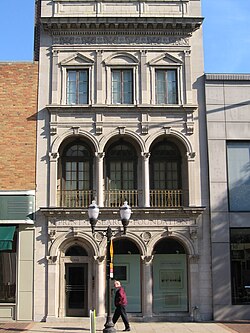
The offices became a piece of cinematic history in the late 1940s. The 1947 film Boomerang, directed by Elia Kazan, was filmed largely in Stamford, using the Atlantic Street offices as a set and featuring members of the actual editorial staff.
Corporate Transitions and Pulitzer Success
The era of family ownership ended in 1977 when the Gillespie family sold the paper to the Times Mirror Company, the owners of the Los Angeles Times. This period was marked by high-caliber journalism; in 1978, staff writer Anthony Dolan won a Pulitzer Prize for his reporting on city corruption.
Dolan's path to the paper was unique; he had previously interviewed William F. Buckley Jr. for the Yale Daily News. After a stint with Gannett, Buckley helped Dolan secure a position at The Advocate. Dolan eventually transitioned from journalism to politics, serving as a speechwriter in Ronald Reagan's White House.
Modern Ownership and Relocations
The 21st century brought a series of corporate acquisitions and physical moves:
- 2000: The Tribune Company acquired Times Mirror, bringing The Advocate into its portfolio.
- 2003: The paper expanded its footprint by opening an office at 605 West Avenue in Norwalk to support its Norwalk editions.
- 2007: After a failed deal with Gannett due to union contract disputes, the paper and its sister publication, the Greenwich Time, were sold to Hearst for $62.4 million.
Following the Hearst acquisition, the newspaper shifted its production. Printing plant employees were laid off at the end of 2007, and printing was moved to the Danbury News-Times plant. In 2008, the Stamford offices moved to the Riverbend office complex in Springdale, and the Norwalk office moved to Westport Avenue.
In 2018, The Advocate returned to the heart of the city, establishing its current operations on the first floor of 1055 Washington Boulevard.
Key Facts
- Oldest Business: Regarded as Stamford's oldest continuing business.
- Original Names: Started as The Intelligencer (1829), then The Sentinel (1830).
- Family Legacy: Owned by three generations of the Gillespie family.
- Pulitzer Prize: Won by Anthony Dolan in 1978 for reporting on city corruption.
- Current Owner: Hearst Corporation (acquired in 2007).
| Year/Period | Entity/Owner | Key Event |
|---|---|---|
| 1829 | William Henry Holly | Founded as The Intelligencer |
| 1830 | Town Leaders | Relaunched as The Sentinel |
| 1848 | Hoyt & Smith | Renamed The Stamford Advocate |
| Late 1800s | Gillespie Family | Became a daily publication (1892) |
| 1977 | Times Mirror Co. | End of family ownership |
| 2000 | Tribune Company | Acquired from Times Mirror |
| 2007 | Hearst Corporation | Acquired for $62.4 million |
Frequently Asked Questions
What was the first newspaper in Stamford?
The first was The Intelligencer, started by William Henry "Hen" Holly in April 1829, though it only operated for a few months.
Who were the Gillespie brothers?
William and Edward Gillespie were printers who joined the staff in 1861 and eventually bought the paper, leading it through three generations of family ownership.
Why did the sale to Gannett in 2007 fail?
The deal fell through because Gannett refused to honor the union contract of 35 newsroom workers with Local 2110 of the United Auto Workers.
Where is the oldest copy of The Sentinel located?
The oldest known copy, dated June 22, 1830, is preserved at the Ferguson Library in Stamford.
Has the newspaper always been located downtown?
While it spent many years downtown—including the Atlantic Street and Tresser Boulevard locations—it moved to the Springdale section in 2008 before returning downtown to Washington Boulevard in 2018.