The Oregonian: A History of Portland's Leading Newspaper
Before the town of Portland, Oregon, was even incorporated in 1851, its prospective leaders recognized that a local newspaper was a prerequisite for urban growth. In the fall of 1850, community organizers Col. W.W. Chapman and businessman Henry W. Corbett traveled to San Francisco to find a capable editor. They recruited Thomas J. Dryer, an energetic writer from New York with his own printing equipment and experience in community journalism, to launch the publication.
The Early Years and the Pittock Era
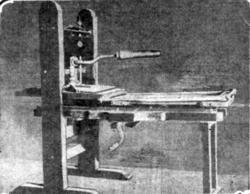
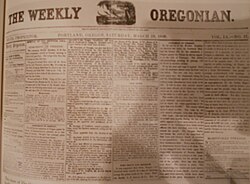
The publication began as a weekly, but its trajectory changed significantly in 1861 when Henry Pittock took ownership as compensation for unpaid wages. Pittock shifted the paper's focus from the "bully pulpit" style of Dryer toward a more news-centric approach. To achieve this, he transitioned the paper to a daily schedule (excluding Sundays) and modernized the delivery of information. He ordered a new press in December 1860 and established a complex news pipeline: reports were sent via telegraph to Redding, California, then by stagecoach to Jacksonville, Oregon, and finally by pony express to Portland.
![First steam press used by the Oregonian, installed in 1862 (more than a year after the advent of a daily edition), and used until 1871. Subsequently used by the Hillsboro Argus until at least 1911.[13]](/images/b6/fc/b6fcd441a5cf8c8bcab9d76e33c4b16de7ec0c7b8f83ea1df683751998c72f44.png)
Editorial Shifts and the Scott Era
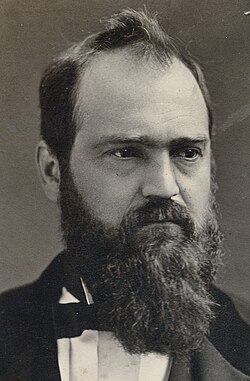
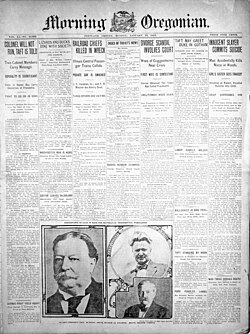
From 1866 to 1872, Harvey W. Scott served as editor. The paper's ownership fluctuated during this period; Henry W. Corbett purchased it from Pittock in 1872, but after a period of instability and a brief stint where the paper went out of print in 1876, Corbett sold it back to Pittock in 1877. This return saw Scott resume his role as editor-in-chief, a position he held until shortly before his death in 1910. Under Scott, the paper became a prominent voice for business-oriented Republicans, a political leaning that persisted in presidential endorsements until 1992.
Expansion and Architectural Landmarks
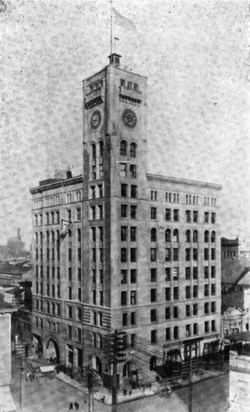
As the publication grew, so did its physical footprint. Originally housed in a two-story building at First and Morrison Streets, the paper moved in 1892 to a nine-story structure at 6th and Alder streets. This Oregonian Building, standing nearly 200 feet tall with a signature clock tower, was the tallest structure in Portland until 1911.
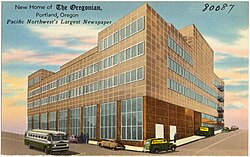
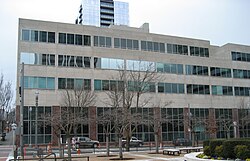
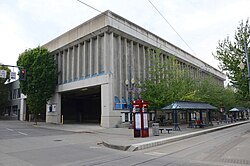
In 1948, the paper moved again to a new headquarters on SW Broadway, designed by architect Pietro Belluschi. This building occupied a full city block and served as the paper's home for 66 years.
Diversification into Radio and Television
In the early 20th century, the organization expanded beyond print. In 1922, it launched KGW, Oregon's first commercial radio station, which affiliated with NBC in 1927. The company later acquired KEX in 1933 and launched KGW-FM (now KKRZ) in 1946, the first FM station in the Northwest. These broadcast assets were eventually sold to King Broadcasting Co in 1953.
The Newhouse Era and Labor Conflict
In 1950, S.I. "Si" Newhouse, founder of Advance Publications, purchased the paper for $5.6 million—the largest price ever paid for a single newspaper at the time. Newhouse later acquired a 50% stake in KOIN-TV, Portland's first VHF station.
The late 1950s were marked by intense labor strife. A strike began in November 1959 led by Stereotypers Local 49, protesting the introduction of automated German plate-casting machinery that reduced the required operators from four to one. For six months, The Oregonian and its rival, The Oregon Journal, published a joint, typo-ridden paper. The strike eventually led to the creation of a short-lived union paper, The (Portland) Reporter, and the eventual transition of the major dailies to open shops by 1965.
Modern Journalism and Pulitzer Success
The late 20th and early 21st centuries saw a commitment to high-impact reporting. William A. Hilliard became the paper's first African-American editor in 1987. Under the leadership of Sandra Rowe and Peter Bhatia in the 1990s and 2000s, the newsroom achieved significant critical acclaim.
The paper earned several Pulitzer Prizes, including:
- 1999: Explanatory Reporting for "The French Fry Connection" by Richard Read.
- 2006: Editorial Writing for coverage of the Oregon State Hospital.
- 2014: Editorial Writing for coverage of the state's public employee retirement system.

Transition to the Digital Age
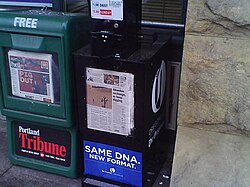
The 21st century brought significant structural changes. In 2014, the paper transitioned to a tabloid format and moved its headquarters to the Crown Plaza office building. In 2015, printing was outsourced, leading to the closure and eventual demolition of its longtime printing plant in Goose Hollow.
To adapt to the changing media landscape, the paper implemented a paywall for "Exclusive" content in July 2020. In January 2024, the print edition was reduced to four days a week (Wednesday, Friday, Saturday, and Sunday), while maintaining daily online updates. Most recently, in January 2025, the print format reverted from tabloid back to broadsheet.
Key Facts
- Founded: 1850 by Thomas J. Dryer, Col. W.W. Chapman, and Henry W. Corbett.
- First Daily Edition: Launched under Henry Pittock in 1861.
- Major Ownership: Purchased by S.I. Newhouse (Advance Publications) in 1950.
- Pulitzer Prizes: Multiple wins in Explanatory and Editorial writing.
- Print Evolution: Shifted from weekly to daily, then to tabloid (2014), and back to broadsheet (2025).
- Digital Shift: Paywall introduced in 2020; print frequency reduced in 2024.
| Year | Event | Significance |
|---|---|---|
| 1850 | Establishment | First newspaper in Portland |
| 1861 | Pittock Ownership | Transition to daily publication |
| 1892 | New Building | Tallest structure in Portland until 1911 |
| 1922 | KGW Launch | Entry into commercial radio |
| 1950 | Newhouse Purchase | Record-breaking sale price for a newspaper |
| 2014 | Format Change | Switch to tabloid style |
| 2025 | Format Reversion | Return to broadsheet style |
Frequently Asked Questions
Who founded The Oregonian?
The paper was established in 1850 through the efforts of Col. W.W. Chapman and Henry W. Corbett, who recruited Thomas J. Dryer from San Francisco to serve as the first editor.
How did the paper get its news in the 1860s?
Under Henry Pittock, news was delivered via a multi-stage process: telegraph to Redding, California, stagecoach to Jacksonville, Oregon, and finally pony express to Portland.
What was the significance of the 1959 strike?
The strike was triggered by the introduction of automated German plate-casting machinery. It led to a temporary joint publication with The Oregon Journal and the creation of a short-lived union paper called The (Portland) Reporter.
Has The Oregonian won any major awards?
Yes, the paper has won multiple Pulitzer Prizes, including awards for Explanatory Reporting in 1999 and Editorial Writing in 2006 and 2014.
What are the current print publication days?
As of January 1, 2024, the printed version is published on Wednesdays, Fridays, Saturdays, and Sundays, while news continues daily online.