The Odyssey: Legacy of Homer's Epic Journey
The Odyssey is one of the most influential works of Western literature. Attributed to the poet Homer and composed around the 8th century BC, this epic poem serves as a sequel to the Iliad. Written in Homeric Greek, it tells the harrowing story of Odysseus's ten-year struggle to return home to Ithaca after the fall of Troy.
The poem is composed in dactylic hexameter, a rhythmic meter traditional to epic poetry, and spans a total of 12,109 lines. While it began as an oral tradition, the oldest known manuscript fragment was produced in Ptolemaic Egypt during the 3rd century BC and later unearthed in Medinet Ghoram.
Key Facts
- Author: Attributed to Homer.
- Composition Date: Approximately 8th century BC.
- Language: Homeric Greek.
- Form: Epic poem consisting of 12,109 lines.
- Metre: Dactylic hexameter.
- First Printed Edition: Produced in 1488 by Demetrios Chalkokondyles.
Literary Structure and Themes
The Odyssey is more than a simple adventure story; it is a complex study of human nature, endurance, and social codes. The narrative explores several recurring patterns that define the ancient Greek world.
Homecoming and Wandering
The central tension of the poem lies in the contrast between the stability of home and the chaos of wandering. Odysseus's journey is a physical and psychological struggle to reclaim his identity as a king, husband, and father.
Guest-Friendship (Xenia)
A pivotal concept in the poem is guest-friendship, or xenia. According to scholar J. B. Hainsworth, this social code follows a very specific pattern of hospitality and mutual respect between hosts and guests, the violation of which often leads to divine retribution.
Testing and Omens
The plot frequently employs testing—where characters must prove their identity or loyalty—and omens, which serve as divine signals guiding the characters' fates.
Historical Reception and Evolution
The Odyssey has been interpreted and reinterpreted for millennia, evolving from a foundational educational text in the ancient Mediterranean to a subject of intense academic debate in the early modern era.
From Antiquity to the Byzantine Era
In late antiquity and the Byzantine period, interpretations were shaped by Neopythagorean and Neoplatonic scholars. The archbishop Eustathios of Thessalonike (c. 1115 – c. 1195/6 AD) produced authoritative commentaries on the poem, with his work on the Odyssey alone spanning nearly 2,000 pages in modern editions.
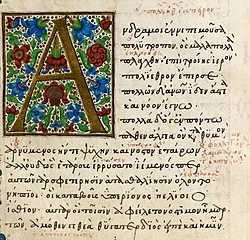
The Quarrel of the Ancients and Moderns
During the late 17th and early 18th centuries in France, the Odyssey became a flashpoint in the "quarrel of the Ancients and Moderns." Critics like Charles Perrault and Pierre Bayle questioned the relevance of Homeric texts, while defenders such as Jean de La Fontaine and Nicolas Boileau-Despréaux fought to preserve their status. This intellectual battle continued through the translations of Anne Dacier and Antoine Houdar de la Motte until a rhetorical ceasefire was reached in 1716.
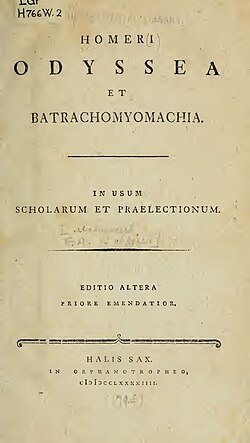
Cultural Legacy and Modern Influence
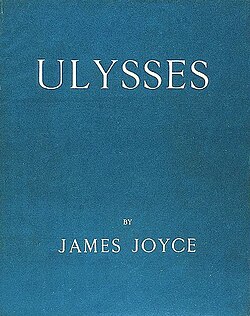
The influence of the Odyssey extends far beyond the classroom, permeating art, music, and modern literature. From the 1802 paintings of Johann Heinrich Wilhelm Tischbein to James Joyce's landmark 1922 novel Ulysses, the themes of the poem continue to resonate.
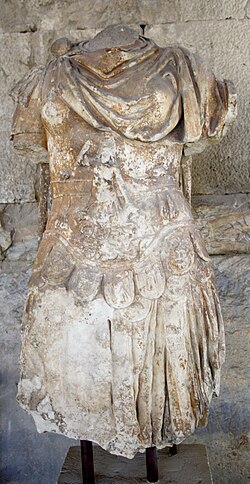
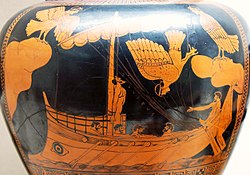
In the visual arts, the story has been captured in countless forms, from ancient mosaics to 19th-century canvases depicting the reunion of Odysseus and Penelope.
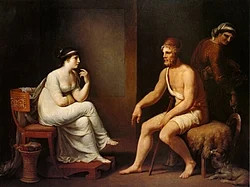
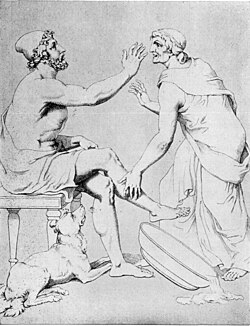
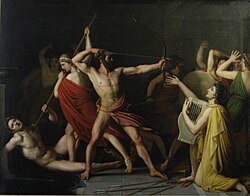
Modern adaptations continue to emerge in film and television, including works by the Coen brothers and upcoming projects by Christopher Nolan. The poem's exploration of combat trauma and the trials of homecoming also remains a subject of psychological study.
Summary of the Epic
| Feature | Detail |
|---|---|
| Original Title | Ὀδύσσεια |
| Genre | Epic Poem |
| Total Lines | 12,109 |
| Key Themes | Homecoming, Xenia (Guest-friendship), Testing |
| First Printed Edition | 1488 (Milan) |
Frequently Asked Questions
Who is credited with writing the Odyssey?
The poem is traditionally attributed to the ancient Greek poet Homer, though it originated from a long oral tradition before being written down.
What is dactylic hexameter?
Dactylic hexameter is the specific rhythmic metre used in the Odyssey and other ancient Greek epics, characterized by six feet of dactyls (one long syllable followed by two short ones) per line.
What is the significance of 'xenia' in the story?
Xenia, or guest-friendship, is the ancient Greek social code of hospitality. The poem uses this concept to contrast the civilized behavior of those who welcome Odysseus with the barbarism of those who do not.
When was the first printed version of the Odyssey published?
The first printed edition, known as the editio princeps, was produced in 1488 by the scholar Demetrios Chalkokondyles and printed in Milan by Antonios Damilas.
How did the 'Quarrel of the Ancients and Moderns' affect the poem's history?
This French artistic debate in the 17th and 18th centuries saw some writers criticize Homer's work as outdated, while others defended it as the foundation of all arts, leading to extensive scholarly rebuttals and new translations.