The National WWII Museum: Honoring America's Role in Global Victory
Located in the heart of the Central Business District in New Orleans, Louisiana, the National WWII Museum stands as a premier institution dedicated to the American contribution to the Allied victory in World War II. Situated on Andrew Higgins Drive, this expansive military history museum blends immersive storytelling with an extensive collection of artifacts to bring the complexities of the 1940s to life.
From its humble beginnings as a focused tribute to the Normandy landings to its current status as a congressionally designated national institution, the museum serves as a vital link between the present generation and the veterans of the Second World War. It is also a proud affiliate of the Smithsonian Institution's outreach program.
Key Facts
- Established: June 6, 2000, as the National D-Day Museum.
- Official Designation: Named America's official National WWII Museum by the U.S. Congress in 2003.
- Location: New Orleans, Louisiana, U.S.
- Attendance: Recorded 706,664 visitors in 2017.
- Key Artifacts: Includes the LCVP (Higgins boat), B-17E Flying Fortress, and various historic aircraft.
The History and Evolution of the Museum
The seeds for the museum were sown in 1964 during a conversation between General Dwight Eisenhower and historian Stephen Ambrose. Eisenhower credited the inventor of the LCVP (Landing Craft, Vehicle, Personnel), commonly known as the Higgins boat, with helping win the war. These critical vessels were designed and built by Andrew Higgins in New Orleans, making the city a fitting location for the museum.
The project gained momentum through the efforts of historian Nick Ambrose and academic Nick Mueller, with initial funding provided by real estate developer Peter Kalikow. Later, the U.S. Congress appropriated $4 million to support the vision. Public interest surged in 1998 following the release of the film Saving Private Ryan, prompting the museum to expand its scope to cover the entirety of D-Day.
The museum officially opened on June 6, 2000, housed in the historic Weckerling Brewery building, which dates back to 1888. While Congress designated it the official national museum in 2003, the formal name change occurred in 2006 following the disruptions caused by Hurricane Katrina.
Over the following two decades, the museum underwent several major expansions:
- 2009: Opening of the Solomon Victory Theater, Stage Door Canteen, and American Sector.
- 2011: Opening of the John E. Kushner Restoration Pavilion.
- 2013: Opening of the US Freedom Pavilion: The Boeing Center.
- 2014-2015: Opening of the Campaigns of Courage Pavilion, featuring the Road to Berlin and Road to Tokyo exhibits.
- 2023: Opening of the Liberation Pavilion, funded by a $15 million Boeing donation and a $20 million Department of Defense grant.
Museum Design and Immersive Exhibits
The visitor experience begins with a simulation exhibit where guests board a "train," mimicking the journey of soldiers departing for war. The original building, now the Louisiana Memorial Pavilion, focuses on the home front and the amphibious landings in Europe. This pavilion features a large atrium with a Supermarine Spitfire and a Douglas C-47 Skytrain suspended from the ceiling.
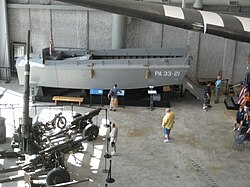
The Louisiana Memorial Pavilion also houses the "Dog Tag Experience," an interactive exhibit featuring a real train car. Visitors can explore galleries dedicated to the D-Day Beaches and the planning phases of the invasion, as well as a third-floor gallery focusing on the Pacific War.
The US Freedom Pavilion: The Boeing Center
As the museum's largest building, the Boeing Center is a hub for aviation and naval history. It houses an impressive array of aircraft, including the B-25J Mitchell bomber, SBD-3 Dauntless, TBF Avenger, P-51D Mustang, and the Corsair F4U-4. A highlight is the B-17E Flying Fortress, My Gal Sal, which was recovered from Greenland 53 years after it went missing.
The center also features an interactive submarine experience based on the final mission of the USS Tang. Nearby, the Campaigns of Courage Pavilion provides detailed narratives of the European and Pacific theaters, including a displayed Messerschmitt Bf 109.
The Liberation Pavilion and Interactive Learning
The newest addition, the Liberation Pavilion, examines the meaning of freedom and the lasting impact of the war. To personalize the experience, visitors receive a dog tag that can be touched to screens throughout the museum to reveal the real-life stories of specific individuals. This pavilion also includes the U.S. Merchant Marine Gallery and the D-Day Invasion of Normandy exhibit.
For a cinematic overview, the Solomon Victory Theater presents the 4-D film Beyond All Boundaries.
Museum Overview Summary
| Feature | Details |
|---|---|
| Primary Focus | U.S. contributions to the Allied victory in WWII |
| Key Pavilions | Louisiana Memorial, US Freedom (Boeing Center), Campaigns of Courage, Liberation |
| Notable Aircraft | B-17E Flying Fortress, P-51D Mustang, Supermarine Spitfire, C-47 Skytrain |
| Interactive Elements | Dog Tag Experience, Submarine simulation, 4-D Cinema |
| Affiliation | Smithsonian Institution |
Frequently Asked Questions
What is a Higgins boat and why is it important?
The Higgins boat, or LCVP (Landing Craft, Vehicle, Personnel), was a landing craft designed and built by Andrew Higgins in New Orleans. It was critical for amphibious operations, allowing troops and equipment to land on beaches, a capability General Eisenhower credited as essential to winning the war.
How does the Dog Tag Experience work?
Upon entering the museum, visitors are given a dog tag. By touching this tag to interactive screens throughout the exhibits, visitors can unlock personal stories and historical data about the specific individual associated with that tag.
Which aircraft are displayed at the museum?
The museum displays several historic aircraft, including the B-17E Flying Fortress (My Gal Sal), B-25J Mitchell, P-51D Mustang, Corsair F4U-4, SBD-3 Dauntless, TBF Avenger, Supermarine Spitfire, Douglas C-47 Skytrain, and a Messerschmitt Bf 109.
When did the museum become the official national museum?
The United States Congress passed a law designating it as the official national World War II Museum in 2003, although the name was not officially updated until 2006 due to the impact of Hurricane Katrina.
What is the purpose of the Liberation Pavilion?
Opened in 2023, the Liberation Pavilion is designed to explore the costs, joys, and meaning of liberation and freedom, while examining how the events of World War II continue to affect the world today.