The Dam Busters: Behind the Scenes of a Cinematic Classic
To capture the grit and intensity of one of World War II's most daring missions, director Anderson made the strategic decision to shoot The Dam Busters in black and white. This artistic choice was not merely for aesthetic reasons; it allowed the production to seamlessly integrate original footage of the actual bomb trials, lending the film a documentary-style reality that resonated with audiences.
Key Facts
- Aircraft: Four modified Avro Lancaster B.VIIs were used, costing £130 per hour to operate.
- Locations: Principal ground filming took place at RAF Hemswell and RAF Scampton.
- Music: The iconic march was composed by Eric Coates, while the main score was by Leighton Lucas.
- Authenticity: The Upper Derwent Valley served as a double for the Ruhr valley.
- Cast Detail: The dog used in the film was a mine-tracking Labrador handled by Lance Corporal Peter Reid.
Aviation and Aerial Production
The flight sequences relied on authentic hardware supplied by the RAF. Four of the final production Avro Lancaster B.VII bombers were retrieved from storage and modified by removing their mid-upper gun turrets to accurately mimic the specialized aircraft of 617 Squadron. These aircraft were expensive to maintain, with operating costs reaching £130 per hour—representing roughly a tenth of the film's total budget.
While Avro Lincolns were used as set dressing, a specific American cut of the film featured a Boeing B-17 Flying Fortress (using stock footage from Warner Bros. Pictures) to depict a more dramatic crash into a hill.
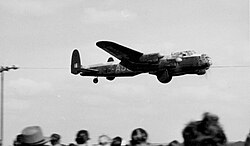
The flying was handled by serving RAF pilots from No. 109 and No. 139 Squadrons. These pilots, who typically flew high-level solo missions in English Electric Canberras, found the low-level formation flying over Windermere and Derwentwater to be an exhilarating change of pace. One notable incident occurred during the early days of filming when a Lancaster's tail wheel accidentally caught the roof of a hangar.
Filming Locations and Set Design
The production spanned several key locations across the UK to recreate the journey to the dams:
- RAF Hemswell: The primary airfield for ground shots. It was a former Lancaster base and the final posting of Guy Gibson. At the time of filming, it housed squadrons operating English Electric Canberras.
- RAF Scampton: The actual launch site of the real raid. The former operations briefing room, which had become the NCO mess, was used for interior scenes.
- Upper Derwent Valley: Used to double for the Ruhr valley, as it was the actual test area for the real raids.
- Coastal Scenes: The crossing of the Dutch coast was filmed between Boston, Lincolnshire, and King's Lynn, Norfolk, with additional scenes near Skegness.
- The "Dutch River": A canal on the way to Goole was used for the canal flight sequence due to the perfectly flat terrain of the Goole area.
Other locations included Weybridge railway station and the Chelsea Palace Theatre, where the spotlight scene was filmed using Mole-Richardson Type150-FX carbon arc lights. The dance troupe seen in the theatre was The Television Toppers, on loan from the BBC.
Cast and Character Details
The film utilized a mix of professional actors and military personnel. The German anti-aircraft troops were played by the 247 (Ulster) LAA Regiment, filmed at Stiffkey in north Norfolk. In a touch of authenticity, Mr. E. Taylor, a former intelligence officer at RAF Woodhall Spa and a teacher at Skegness Grammar School, appeared as an Air Commodore extra.
The role of the dog, Nigger, was played by a black Labrador mine-tracking dog from Melton Mowbray. Lead actor Richard Todd developed a close bond with the animal, even housing the dog in his hotel bathroom in Lincoln, though the RAF ultimately would not allow him to keep the dog after production.
The Soundtrack and Musical Score
While The Dam Busters March by Eric Coates is the most famous piece associated with the film, it was not originally intended for cinema. Coates only agreed to provide the overture after being convinced of the film's national importance. Interestingly, much of the march as it is known today is not actually featured in the film's soundtrack.
The bulk of the score, including the music during the raid, was composed by Leighton Lucas. Music historian Philip Lane notes that Lucas's theme and Coates's march essentially "vied for supremacy" throughout the film, creating a dynamic auditory experience.
| Category | Details |
|---|---|
| Primary Aircraft | Avro Lancaster B.VII |
| Main Airfield Location | RAF Hemswell |
| Ruhr Valley Double | Upper Derwent Valley, Derbyshire |
| Overture Composer | Eric Coates |
| Score Composer | Leighton Lucas |
Frequently Asked Questions
Why was the film shot in black and white?
The director chose black and white to allow the integration of original bomb trial footage and to create a gritty, documentary-style feel.
Which aircraft were used in the flight sequences?
The film primarily used four modified Avro Lancaster B.VIIs. Avro Lincolns were used as background set dressing, and a Boeing B-17 was used in a specific American cut of the film.
Where was the Ruhr valley represented in the film?
The Upper Derwent Valley in Derbyshire was used to double for the Ruhr valley, as this location had been the actual test site for the real-life raids.
Who composed the famous music for the film?
Eric Coates composed the famous overture march, while Leighton Lucas composed the majority of the film's orchestral soundtrack.
Was the dog in the movie a professional animal?
Yes, the dog was a mine-tracking Labrador from Melton Mowbray, handled by Lance Corporal Peter Reid.