The Canadian Encyclopedia: A Comprehensive History of Canada's National Reference
Often described as "The Biggest Publishing Project in Canadian History," The Canadian Encyclopedia (TCE) serves as the definitive national resource for understanding the complex tapestry of Canada. From its origins as a massive print undertaking to its current status as a dynamic, multi-media digital hub, the encyclopedia has evolved to meet the changing needs of scholars, educators, and the public alike.
Whether exploring Canadian biographies, the arts, First Nations history, or scientific innovation, the encyclopedia provides a non-partisan and non-political window into the nation's identity. Today, it is managed by the Toronto-based non-profit organization Historica Canada and is available in both English and French.
Key Facts
- Original Publication: First released in print in 1985.
- Scale: The online version features over 25,000 entries and 60,000 multimedia items.
- Contributors: Compiled by more than 5,000 scholars and specialists.
- Accessibility: Available for free online in both English and French.
- Ownership: Published by Historica Canada.
The Origins of a Megaproject
Before the mid-1980s, Canada lacked a comprehensive, modern national encyclopedia. While various specialized works existed—such as the Encyclopedia of Music in Canada or the Oxford Companion to Canadian History and Literature—the most significant general reference, John Everett Robbins' Encyclopedia Canadiana, had become outdated by the 1970s.
Recognizing this gap, Edmonton-based publisher Mel Hurtig launched an ambitious project to create a new, accurate, and wholly Canadian reference work. To support this vision, the Alberta government, under Premier Peter Lougheed, provided significant funding. In 1979, the Alberta Legislature pledged CA$3.4 million to underwrite development costs and an additional $600,000 to ensure free copies reached every school and library in the country.
Rigorous Scholarly Standards
To ensure unparalleled accuracy, Hurtig hired James Harley Marsh as editor-in-chief in 1980. The production process was incredibly meticulous: more than 3,000 authors contributed content, every fact was verified using three separate sources, and every article underwent a rigorous three-reader review process followed by independent proofreading.
Evolution Through the Decades
The encyclopedia has transitioned through several major formats, reflecting the technological advancements of the last forty years.
The Print and CD-ROM Eras
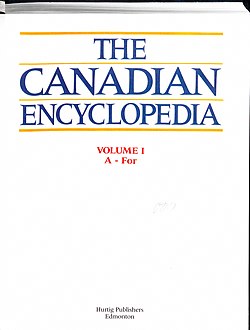
The first edition of the print version was published in 1985. It was an immediate success, selling out within days and becoming a Canadian bestseller. By 1988, a revised and expanded fourth volume was released, notable for being one of the first encyclopedias in the world to utilize computer technology for compilation and typesetting.
In the 1990s, the project expanded into specialized formats, including The Junior Encyclopedia of Canada for younger readers. As digital technology emerged, the encyclopedia moved into the electronic age with The Canadian Encyclopedia Plus, a CD-ROM released in 1995 that introduced searchable text and multimedia elements.
The Digital Revolution
The transition to a fully online platform began in earnest in 1999 when ownership was transferred to the Historica Foundation. By 2001, a robust online version was launched, providing a platform for continuous updates. This digital evolution allowed for the integration of specialized content, such as the Encyclopedia of Music in Canada, and the creation of an educational hub featuring instructional materials and study aids for teachers and guardians.
Summary of Publication Formats
| Format | Period | Key Features |
|---|---|---|
| 1985–1995 | Multi-volume sets; original 9,000+ articles. | |
| CD-ROM | 1995–2001 | Searchable text, hot links, and multimedia. |
| Online | 1999–Present | 25,000+ entries; 60,000+ multimedia items; free access. |
Organization and Funding
Today, The Canadian Encyclopedia is a non-partisan initiative. It is published by Anthony Wilson-Smith, the President and CEO of Historica Canada. The project is supported financially by the federal Department of Canadian Heritage and the Society of Composers, Authors and Music Publishers of Canada (SOCAN).
Frequently Asked Questions
Is The Canadian Encyclopedia free to use?
Yes, the online version of the encyclopedia has been available for free in both English and French since 2001.
Who writes the articles for the encyclopedia?
The content is compiled by a vast network of more than 5,000 scholars and specialists to ensure academic accuracy.
Is the encyclopedia politically biased?
No, the publication is a non-partisan and non-political initiative, maintaining that it is not affiliated with any government or political party.
What subjects are covered in the encyclopedia?
The encyclopedia covers a wide range of topics, including Canadian biographies, places, history, the arts, First Nations, science, and Canadian innovation.
Does the website include multimedia?
Yes, the website features over 60,000 multimedia items, including images, maps, charts, videos, and interactive games.