Kingdom of Thailand
The Kingdom of Thailand, formerly known as Siam, is a vibrant nation in Southeast Asia characterized by its rich cultural heritage, strategic geographic location, and a dynamic transition from ancient kingdoms to a modern constitutional monarchy. From the bustling skyscrapers of Bangkok to the serene temples of the north, Thailand blends deep-rooted traditions with rapid economic development.
Historically, the region was shaped by the migration of Tai-speaking tribes and the influence of early civilizations. The evolution of the Thai state is marked by a series of powerful kingdoms, including Sukhothai, Ayutthaya, Thonburi, and the current Rattanakosin era.
![Map showing geographic distribution of Kra–Dai linguistic family. Arrows represent general pattern of the migration of Tai-speaking tribes along the rivers and over the lower passes.[27]: 27](/images/a1/3c/a13c66300e91787a72321c3cba7dc9e68bfdb3cefba261c2a1859ef19c820609.webp)
Key Facts

- Capital: Bangkok (Krung Thep Maha Nakhon)
- Government: Unitary parliamentary constitutional monarchy
- Official Language: Thai
- Primary Religion: Buddhism (93.46%)
- Currency: Thai baht (฿)
- Population: Approximately 65.9 million (2024 estimate)
- GDP (PPP): Estimated $1.964 trillion by 2026
Historical Evolution

Prehistory and Early Kingdoms
The foundations of Thailand were laid by early Tai confederate cities and the influence of the Mon and Lavo Kingdoms between the 5th and 13th centuries. The Dvaravati culture, spanning the 6th to 9th centuries, left a significant mark on the region's early urban settlements.


The Great Kingdoms
The Sukhothai Kingdom (1238–1438) is often regarded as the dawn of Thai independence. This was followed by the Ayutthaya Kingdom (1351–1767), which became a major regional power and center of trade. After the fall of Ayutthaya, the Thonburi Kingdom (1767–1782) provided a brief but critical period of reunification.


The Rattanakosin Era and Modernization
Established on April 6, 1782, the Rattanakosin Kingdom shifted the capital to Bangkok. This era saw significant modernization efforts, particularly under the leadership of monarchs like King Mongkut and King Chulalongkorn, ensuring Thailand remained independent during the colonial era.

Political Transition
Thailand transitioned to a constitutional monarchy on June 24, 1932. The subsequent century has been characterized by a complex interplay between military governance and democratic movements, including the era of Field Marshal Plaek Phibunsongkhram and more recent political shifts in the 21st century.


Geography and Environment

Thailand covers a total area of 513,120 square kilometers. Its landscape varies from the mountainous regions of the north to the tropical coastlines of the south. The climate is primarily tropical, as detailed in the Köppen climate classification.


Biodiversity
The nation is home to diverse wildlife, though conservation remains a challenge. For instance, the wild population of Asian elephants has declined to an estimated 2,000–3,000 individuals.
![The population of Asian elephants in Thailand's wild has dropped to an estimated 2,000–3,000.[139]](/images/cf/90/cf902e9e1a73aeb0702a27809a4393824c07d0ae8ead3c3df8ea2919a9145a7a.jpg)
Economy and Infrastructure

Thailand possesses one of the largest economies in Southeast Asia. Its economic strength is built on a diverse foundation of manufacturing, tourism, and agriculture. Notably, Thailand is one of the world's leading rice exporters, with 49% of its labor force employed in the agricultural sector.

![Thailand has long been one of the largest rice exporters in the world. Forty-nine per cent of Thailand's labour force is employed in agriculture.[249]](/images/9a/20/9a20e30f64cb389b5724817fc99652d56495afb33f5f16be41bc25d6b81005db.jpg)
Urbanization and Transport
Bangkok serves as the economic heart of the country, featuring a sophisticated infrastructure including the BTS Skytrain and a dense business district in Sathorn. The country also maintains a strong military presence with assets like the HTMS Chakri Naruebet aircraft carrier.


Society and Culture

Demographics and Religion
The population is predominantly Thai (approx. 80%), with significant minorities including Thai Chinese, Thai Malays, and Northern Khmer. Theravada Buddhism is the most practiced religion, deeply influencing the nation's art, architecture, and daily life.

Cultural Heritage
Thai culture is expressed through vibrant festivals like Songkran (the Thai New Year) and Loi Krathong. The arts include the traditional Khon masked dance and the epic poetry of Sunthorn Phu. In sports, Muay Thai stands as the nation's signature martial art.


Education and Health
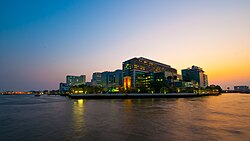
Thailand has established robust institutions for public welfare, such as Chulalongkorn University (the oldest university) and Siriraj Hospital (the oldest and largest hospital).

| Category | Detail |
|---|---|
| Official Name | Kingdom of Thailand (Ratcha-anachak Thai) |
| Capital City | Bangkok |
| Government Type | Unitary parliamentary constitutional monarchy |
| Main Religion | Buddhism (93.46%) |
| Key Export | Rice |
| Currency | Thai Baht (THB) |
Frequently Asked Questions


What was Thailand called before it was renamed?
Thailand was formerly known as Siam.
What is the primary religion practiced in Thailand?
Theravada Buddhism is the most practiced religion, accounting for 93.46% of the population according to the 2018 census.
Which city is the capital and largest municipality of Thailand?
Bangkok, officially known as Krung Thep Maha Nakhon, is the capital and largest city.
What is the significance of Muay Thai?
Muay Thai is Thailand's signature sport and a world-renowned form of martial arts.
What is the role of the monarch in Thailand's government?
Thailand is a constitutional monarchy where the King serves as the Head of State within a parliamentary system.