Tercera División: The History and Evolution of Spain's Former Fourth Tier
The Tercera División (English: Third Division) served as a cornerstone of the Spanish football league system for nearly a century. From its inception in 1929 until its dissolution in 2021, it acted as the vital bridge between regional amateur football and the professional tiers of the Spanish game.
While its name suggests a third-tier status, the league's position in the football pyramid shifted over time. For the majority of its existence, specifically from 1977 to 2021, it functioned as the fourth tier, sitting below the Primera División (La Liga), the Segunda División, and the semi-professional Segunda División B.
Key Facts
- Founded: 1929
- Folded: 2021
- Peak Scale: 397 clubs involved across its history.
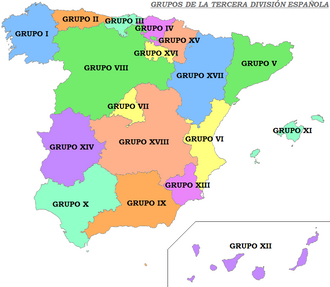
- Structure: 18 regional groups based on Spain's autonomous communities.
- Successor: Replaced by Tercera División RFEF in the 2021–22 season.
- Cup Eligibility: Group champions qualified for the Copa del Rey.
League Structure and Format
The Tercera División was characterized by its massive scale and regional organization. It typically featured 360 teams divided into 18 regional groups. These groups corresponded to the autonomous communities of Spain, with Andalusia being the only region large enough to require two separate groups (East and West). Ceuta was allocated to West Andalusia, while Melilla joined the East.
Each group was managed by its respective regional football federation. The competitive stakes were high, with the top four teams in each group qualifying for promotion play-offs to reach the Segunda División B. Conversely, the bottom three teams in each group generally faced relegation to the Divisiones Regionales (regional divisions).
Promotion and Play-off Mechanics
Until the 2018–19 season, group winners had a path to direct promotion via a two-legged series. The nine winners of these series were promoted immediately, while the nine losers entered a secondary play-off round for the remaining spots.
The process for runners-up, third-place, and fourth-place teams was more complex, involving a series of two-legged knockout rounds. In these matchups, the lower-ranked club always hosted the first leg. If teams held the same rank, a draw determined the home-field advantage.
The Pandemic Impact (2019–2020)
The COVID-19 pandemic forced a significant alteration of the rules during the 2019–20 season. After the season was curtailed, the RFEF (Royal Spanish Football Federation) determined that the top four teams at the time of suspension would qualify for play-offs held at neutral venues. This period also saw a temporary expansion of the third tier to 100 teams for the 2020–21 season before the system was fully overhauled.
Regional Grouping and Relegation
| Group | Region | Relegation Destination |
|---|---|---|
| 1 | Galicia | Preferente de Galicia |
| 2 | Asturias | Preferente de Asturias |
| 3 | Cantabria | Preferente de Cantabria |
| 4 | Basque Country | Basque lower levels |
| 5 | Catalonia and Andorra | Primera Catalana |
| 6 | Valencian Community | Preferente Comunidad Valenciana |
| 7 | Community of Madrid | Preferente de Madrid |
| 8 | Castile and León | Preferente de Castilla y León |
| 9 | Eastern Andalusia and Melilla | Primera Eastern Andaluza |
| 10 | Western Andalusia and Ceuta | Primera Western Andaluza |
| 11 | Balearic Islands | Preferente |
| 12 | Canary Islands | Interinsular Preferente |
| 13 | Murcia | Preferente de Murcia |
| 14 | Extremadura | Preferente de Extremadura |
| 15 | Navarre | Preferente de Navarra |
| 16 | La Rioja | Preferente de La Rioja |
| 17 | Aragon | Preferente de Aragón |
| 18 | Castile-La Mancha | Preferente de Castilla-La Mancha |
Historical Evolution and Records
The league's history is one of constant reorganization. While a third level existed as early as 1928–29, the Tercera División as we know it was born in 1929. The most pivotal change occurred in 1977 with the revival of the Segunda División B, which pushed the Tercera División down to the fourth tier.
In May 2020, the RFEF announced a sweeping reform to create a new semi-professional third division called Primera División RFEF. This change, effective for the 2021–22 season, resulted in the Tercera División being replaced by the Tercera División RFEF, which now operates as the fifth tier of Spanish football.
Notable League Records
- Longevity: Murcia Imperial holds the record for most seasons played (68).
- Points: Constància accumulated the most total points (2,955).
- Goal Scoring: Cacereño scored the most goals in the league's history (3,894).
- Attendance: The record attendance was 27,214 for a match between Oviedo and Mallorca B in 2009.
- Group Titles: Caudal has won the most group titles (16).
Frequently Asked Questions
What happened to the Tercera División in 2021?
It was replaced by the Tercera División RFEF. Due to the creation of the Primera División RFEF as a new third tier, the former Tercera División dropped from the fourth tier to the fifth tier of the Spanish football pyramid.
How did promotion work in the Tercera División?
Generally, the top four teams from each of the 18 regional groups entered play-offs. Depending on the era, group winners could achieve direct promotion through a two-legged series, while other qualifying teams competed in knockout rounds for the remaining spots in Segunda División B.
Which teams were ineligible for the Copa del Rey?
While the 18 group champions qualified for the Copa del Rey, reserve teams (B teams) were ineligible to compete in the tournament.
What was the Copa Federación?
The Copa Federación was a domestic cup competition for teams from the Tercera División and Segunda División B who did not qualify for the Copa del Rey.
Which club played the most games in the Tercera División?
Murcia Imperial holds the record for the most games played, with a total of 2,205 matches.