Temporal Interference Stimulation: Precision Targeting for Deep Brain Modulation
Temporal Interference (TI) stimulation represents a significant advancement in non-invasive brain modulation. Unlike traditional methods that often struggle to reach deeper structures without affecting the surface, TI stimulation utilizes the physics of wave interference to target specific regions of the brain with high precision.
How Temporal Interference Stimulation Works
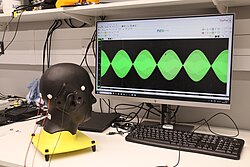
TI stimulation is delivered using two separate current sources. Both sources operate at high frequencies, typically in the kilohertz (kHz) range, but they are set with a specific, defined difference in frequency between them. When these two high-frequency currents overlap in the brain, they create an "envelope"—a low-frequency modulation that affects only the target region where the interference is maximal.
The currents are applied to the scalp using specialized electrodes, typically made of carbon-rubber or silver-silver chloride. Because the currents operate at high frequencies and low amplitudes (generally between 1–2 mA), patients typically experience very little skin sensation. This is a notable advantage over methods like transcranial alternating current stimulation (tACS), as the human skin is most sensitive to stimulation frequencies in the low range (below 4Hz).
Precision and Depth of Targeting
One of the primary limitations of traditional transcranial electrical stimulation is that it is largely restricted to the cortical regions—the outer layer of the brain. TI stimulation overcomes this barrier, allowing clinicians and researchers to target both cortical regions and deep brain regions.
The strength and location of the stimulation are not determined by absolute amplitude alone. Instead, they depend on the relative amplitude and the orientation of the applied electrical fields. This interplay allows for precise three-dimensional targeting of deep-seated neural structures. To ensure accuracy, these fields are often modeled using advanced software such as Sim4Life or SimNIBS.
Key Facts
- Frequency Range: Operates in the kHz range to minimize skin sensation.
- Current Amplitude: Typically low, ranging from 1 to 2 mA.
- Targeting Capability: Can reach both deep brain regions and the cerebral cortex.
- Electrode Materials: Uses silver-silver chloride or carbon-rubber electrodes.
- Modeling Tools: Precision is achieved via software like SimNIBS and Sim4Life.
| Feature | Traditional tES (e.g., tACS) | TI Stimulation |
|---|---|---|
| Target Depth | Primarily Cortical | Cortical and Deep Brain |
| Skin Sensation | Higher (especially <4Hz) | Low (due to kHz frequencies) |
| Current Amplitude | Varies | Typically 1–2 mA |
| Mechanism | Direct Current/Oscillation | Frequency Interference Envelope |
Frequently Asked Questions
What makes TI stimulation different from other electrical stimulation methods?
Unlike traditional methods that target only the cortex, TI stimulation can reach deep brain regions by using two high-frequency currents that interfere with each other to create a low-frequency effect at a specific target point.
Why is there less skin sensation with TI stimulation?
Skin sensation is strongest at low frequencies (below 4Hz). Because TI stimulation uses high-frequency currents in the kHz range, it bypasses the frequencies that typically cause discomfort.
What materials are used for the electrodes?
The currents are delivered to the scalp using either carbon-rubber or silver-silver chloride electrodes.
How is the target area determined in the brain?
Targeting is based on the relative amplitude and orientation of the applied fields, which can be precisely modeled in 3D using software such as Sim4Life or SimNIBS.
What is the typical current amplitude used in TI stimulation?
The currents used in TI stimulation are typically low, ranging between 1 and 2 mA.