Temperance Hall: A History of a Prosperous DeKalb County Community
Nestled within DeKalb County, Tennessee, Temperance Hall stands as a testament to the resilience and industry of early American settlers. Once a thriving hub of commerce, education, and agriculture, this unincorporated community evolved from a wild frontier into a prosperous town before transitioning into the quiet residential area it is today.
Early Settlement and Frontier Life
The region's recorded history began in 1780 when a hunting party visited the area. This expedition was remarkably successful, harvesting 105 bears, 74 buffalo, and over 80 deer—a bounty sufficient to feed the entirety of Fort Nashborough for the winter season.
Permanent settlement began in 1798 when Stephen Robinson Sr., arriving from Cumberland County, Virginia, settled the land alongside Adam Dale and brothers Leonard and John Fite. Despite facing hostility from Native Americans, these four pioneers successfully established the foundations of the community. Originally part of Smith County, the area was reclassified as part of DeKalb County following a border realignment on February 1, 1850.
Industrial Growth and the Smith Fork
The geography of the area, specifically the Smith Fork of the Caney Fork River (commonly known as Smith Fork Creek), drove the town's early economy. Settlers were drawn to the fertile farmland, leading to the establishment of several mills. The most prominent was built by Samuel Caplinger at the confluence of the Smith Fork and a smaller branch, located about half a mile northwest of town.
Caplinger also constructed a unique home on a nearby hill in 1821. This residence was noted for its architectural singularity in Tennessee and was listed on the National Register of Historic Places on February 12, 1980, though it was removed in 1989 and subsequently demolished. The Caplinger mill operated until a devastating flood in 1946; today, some remains can still be found approximately 500 feet southwest of the State Highway 264 bridge.
A Thriving 19th-Century Hub
By the 1890s, Temperance Hall had grown into a bustling community of approximately 150 residents. The town boasted a diverse economy that included three dry good stores, a drug store, two blacksmith shops, and two mills. While many residents were skilled carpenters or professionals, the primary industry was farming, with livestock, corn, wheat, and sorghum being produced for sale in larger cities.
The community's infrastructure was advanced for its time, featuring one of the first telephone offices in DeKalb County and a dedicated stockyard for transporting livestock via train from nearby Hickman. The town also supported a bank—The Temperance Hall Bank & Trust Company—and a variety of professional services, including several physicians and an undertaking business.
One of the most distinguished residents was Colonel William Brickly Stokes, a politician and Union general during the American Civil War. Stokes was also known for owning a legendary quarter horse named "Ariel." The horse was so dominant in racing that it was banned from most tracks; Stokes famously attempted to bypass this by painting the horse a different color until the paint damaged the animal's hair.
Education and Community Spirit
Education was a priority for the settlers. The first school was a simple one-room log house near the Methodist Church. This was eventually replaced by Earl Academy, a sophisticated two-story frame building with large columns, which opened on January 23, 1895. With over 100 students enrolled by February of that year, it was widely regarded as the best school in the county.
The school underwent several iterations: a new two-story building constructed in 1920 (which burned down in June 1949) and a one-story replacement built in the early 1950s. Due to a declining student population, the school closed in the 1960s.
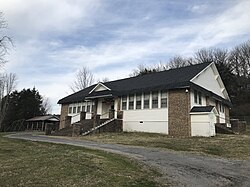
On October 31, 1971, the former school building was renovated and reopened as a community center. Today, it continues to serve the public as a polling place for Temperance Hall, Long Branch, and Cove Hollow, and as a venue for private events.
The Origin of the Name
The town's unique name is derived from the Sons of Temperance, a local branch of the organization that met in the 1800s. The group gathered on the second floor of the town's hotel—a building that still stands today. The hotel's long hallway became a venue for lectures and speeches regarding temperance (the practice of moderation or abstinence from alcoholic beverages). This specific location became known as "Temperance Hall," eventually lending its name to the entire community.
Economic Decline and Modern Legacy
Despite its early prosperity, Temperance Hall never officially incorporated as a town. The Great Depression triggered a significant exodus as residents moved north in search of employment. This led to the closure of the bank, the post office (which had already closed in 1904), the school, and the Temperance Hall Hotel's business operations (though the building remains as a private residence).
By the 1990s, only three small churches and the community center remained. Interestingly, the area also had a history of pearl hunting in the Caney Fork River, where mussels yielded pearls that sold for hundreds or even thousands of dollars.
In more recent decades, the town has found a place in popular culture as a filming location for country music videos. John Anderson filmed there in 1986, and the group Alabama filmed their hit "Song of the South" in late 1988, drawing a massive crowd to the community.
Key Facts
- Founded: Permanent settlement began in 1798 by Stephen Robinson Sr., Adam Dale, Leonard Fite, and John Fite.
- Naming: Named after the "Temperance Hall" hallway in the local hotel where the Sons of Temperance met.
- Economy: Historically driven by milling on the Smith Fork Creek and farming of corn, wheat, and sorghum.
- Notable Figure: Colonel William Brickly Stokes, a Union general and owner of the famous racehorse Ariel.
- Education: Earl Academy opened in 1895 and was considered a premier school in the county.
- Cultural Site: The former school building now serves as a community center and polling place.
| Year/Period | Event |
|---|---|
| 1780 | First recorded visit by a hunting party. |
| 1798 | Arrival of first permanent settlers. |
| 1821 | Samuel Caplinger builds his unique home. |
| 1850 | Town reclassified into DeKalb County; Post Office opens. |
| 1895 | Earl Academy opens; a major mill fire occurs. |
| 1904 | Post office closes. |
| 1946 | Caplinger's mill is mostly destroyed by a flood. |
| 1971 | Former school building reopens as a community center. |
Frequently Asked Questions
How did Temperance Hall get its name?
The town was named after a long hallway on the second floor of the local hotel, which was used by the Sons of Temperance for lectures and speeches. This space became known as "Temperance Hall," and the name eventually extended to the community.
Who was Colonel William Brickly Stokes?
Colonel Stokes was a prominent citizen of Temperance Hall, a politician, and a Union general during the American Civil War. He is also remembered for owning a highly successful, though controversial, racehorse named Ariel.
What happened to the schools in Temperance Hall?
The community had several schools, starting with a one-room log house and later the prestigious Earl Academy. After a series of buildings and a fire in 1949, the final school closed in the 1960s due to a lack of students. The last building was converted into a community center in 1971.
What was the primary industry of the town?
The primary industry was agriculture, specifically the production of corn, wheat, sorghum, and livestock. This was supported by several mills located along the Smith Fork of the Caney Fork River.
Is there any remaining architecture from the town's peak?
Yes, the original hotel where the Sons of Temperance met still stands as a private house, and the former school building continues to operate as the community center.