Teddy Boys: The History and Style of Britain's First Youth Subculture
Emerging in the early 1950s, the Teddy Boys (or "Teds") represented a seismic shift in British social history. They were among the first groups of teenagers to consciously differentiate themselves from adults, creating a distinct identity through a blend of provocative fashion and a passion for high-energy music. While often associated with the birth of rock and roll, the Teds were a complex phenomenon, blending upper-class Edwardian elegance with working-class rebellion.
Key Facts
- Origin: Started in London in the early 1950s among working-class youth.
- Fashion: Inspired by Edwardian-era dandies and American zoot suits.
- Music: Initially jump blues and R&B, later evolving into rock and roll.
- Impact: Helped establish the first distinct "youth market" in the United Kingdom.
- Revivals: Experienced a significant resurgence in the 1970s and again in the 1990s.
The Origins of the Teddy Boy
The subculture began when Savile Row tailors attempted to reintroduce Edwardian styles—clothing from the era of King Edward VII—to demobilized officers after World War II. When the target market rejected the look, tailors sold the remaining stock cheaply to menswear shops across London. Suburban working-class youth adopted these styles, adapting them into a bold statement of identity.
The term "Teddy Boy" was popularized by a Daily Express article on September 23, 1953, which shortened "Edwardian" to "Teddy." Before this, similar youth gangs were sometimes referred to as "Cosh Boys" or "Edwardians."
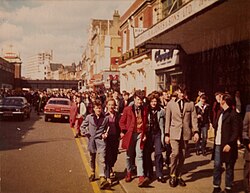
The Rise of Youth Rebellion
The Teds were pioneers of the teenage identity. A watershed moment occurred in 1956 during the UK release of the US film Blackboard Jungle. In south London, Teddy Boy audiences rioted, dancing in the aisles and tearing up seats—a pattern of unrest that spread to other cinemas across the country.
However, the subculture also had a darker side. Some Teds formed gangs involved in violent clashes. Most notably, they were implicated in the 1958 Notting Hill race riots and the St Ann's riots in Nottingham, where mobs targeted Caribbean communities with weapons such as iron bars and butcher's knives.
The Iconic Teddy Boy Style
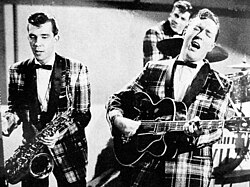
The Teddy Boy aesthetic was a meticulous blend of luxury and rebellion. The centerpiece was the drape jacket, a long coat reminiscent of American zoot suits, often featuring velvet trim on the collars and pockets.
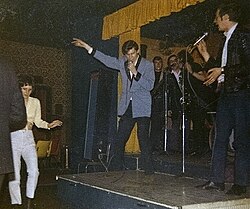
The full ensemble typically included:
- Trousers: High-waist "drainpipe" trousers that were tapered to expose the socks.
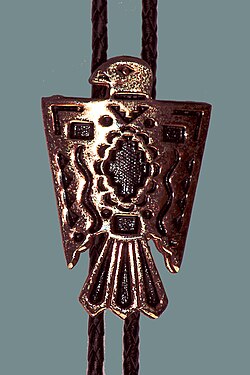
- Shirts and Ties: High-necked white shirts (the "Mr. B. collar") paired with a narrow "Slim Jim" tie or a western bolo tie.
- Waistcoats: Ornate brocade waistcoats.
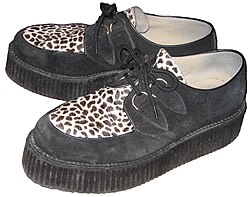
- Footwear: Highly polished Oxfords, chunky brogues, or suede crepe-soled shoes, famously known as brothel creepers or "beetle crushers."
Hair was equally important, characterized by heavily greased quiffs at the front and a "duck's arse" (a combed-back shape) at the rear. An alternative was the "Boston," where hair was greased straight back and cut square at the nape.
Teddy Girls: The "Judies"
While often overlooked in historical accounts, Teddy Girls (or "Judies") were an integral part of the movement. These young working-class women, often leaving school at 14 or 15 to work in factories, used fashion to reject post-war austerity.
Their wardrobe mirrored the Teds' tailored approach, featuring drape jackets with velvet collars, pencil or hobble skirts, and straw boater hats. Over time, they incorporated American trends such as voluminous circle skirts, ponytails, and toreador trousers.
Music, Dancing, and the Rock and Roll Era
Before the explosion of rock and roll, Teds listened to jazz, skiffle, R&B, and jump blues. They were particularly fond of "The Creep," a slow shuffle dance recorded by Ken Mackintosh in 1953, which earned them the nickname "Creepers."
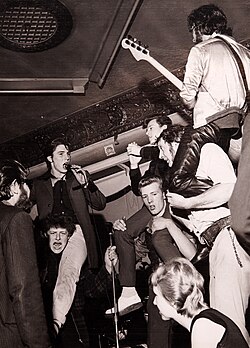
By 1955, the subculture fully embraced American rock and roll stars like Elvis Presley, Bill Haley, and Eddie Cochran. This influence extended to British artists such as Cliff Richard and Tommy Steele. Even the early members of The Beatles, John Lennon and George Harrison, emulated the Teddy Boy style during the band's formation.
Revivals and Cultural Legacy
The Teddy Boy spirit returned in the 1970s, sparked by the 1972 London Rock and Roll Show at Wembley Stadium and films like American Graffiti. This revival was further fueled by Vivienne Westwood and Malcolm McLaren's shop, Let it Rock, on King's Road.
The 1970s Teds adopted a more flamboyant look, using louder colors and adding hairspray to their pomade. This era also saw violent street battles between the Teds and the emerging punk movement in 1977. In the 1990s, a more traditionalist group called "The Edwardian Drape Society" (T.E.D.S.) formed in North London to reclaim the original 1950s style from the glam rock influences of the 70s.
| Category | Key Elements |
|---|---|
| Clothing | Drape jackets, drainpipe trousers, brocade waistcoats, bolo ties. |
| Footwear | Brothel creepers, polished Oxfords, chunky brogues. |
| Hair | Greased quiffs, duck's arse, the "Boston" cut. |
| Music | Rock and roll, R&B, jump blues, skiffle. |
| Key Figures | Bill Haley, Elvis Presley, Vivienne Westwood (revival). |
Frequently Asked Questions
Where did the name "Teddy Boy" come from?
The name is a diminutive of "Edwardian," referring to the style of clothing from the era of King Edward VII. It became official after being used in a 1953 Daily Express article.
What are "brothel creepers"?
Brothel creepers are chunky, crepe-soled shoes, often made of suede, that became a signature footwear choice for the Teddy Boy subculture.
Who were the Teddy Girls?
Also known as "Judies," Teddy Girls were the female counterparts to the Teds. They were working-class women who adopted tailored jackets, pencil skirts, and other Edwardian-inspired fashions to reject post-war austerity.
Did Teddy Boys influence any famous musicians?
Yes, early members of The Beatles, including John Lennon and George Harrison, emulated the Teddy Boy style during the early stages of the band's development.
What was the relationship between Teds and Punks?
In the late 1970s, the two subcultures became rivals, leading to street battles on London's King's Road in the spring of 1977.