Teatro El Círculo: A Historic Cultural Landmark in Rosario
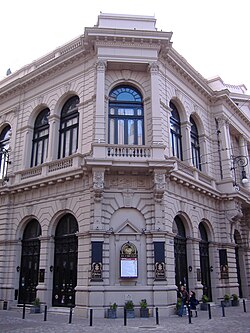
Located near the historical center of Rosario, Argentina, Teatro El Círculo stands as a testament to the city's rich artistic heritage. Situated at the intersection of Laprida and Mendoza Streets, this architectural gem has evolved from a grand lyric theater—a venue specifically designed for opera and musical drama—into a versatile modern cultural center.
The theater's journey began with Emilio O. Schiffner, who purchased a society called Teatro La Ópera in 1889. To ensure world-class sound quality, Schiffner hired George Goldammer, a German engineer and acoustician, to modify the original designs. The construction was handled by the firm Bianchi, Vila y Compañía. Although the project faced significant delays due to the debts of the previous society and the economic turmoil of the Panic of 1890, construction finally commenced in 1903.
The aesthetic beauty of the theater was crafted by Italian artists under the direction of Luggi Levoni. One of the most striking features was the stage curtain, designed by Giuseppe Carmignani, which depicted scenes from Greek mythology inspired by the Teatro Regio di Parma. The venue officially opened its doors on June 4, 1904, debuting with a performance of Giuseppe Verdi's Otello.
A Legacy of Artistic Excellence
During its early years, the theater became a global destination for renowned opera singers, orchestras, and ballet companies. A highlight of its golden era occurred in 1915 when the legendary tenor Enrico Caruso performed on its stage. Caruso was so impressed by the venue's acoustics that he compared them favorably to those of the Metropolitan Opera House in New York.
However, this period of splendor eventually gave way to a decline. By 1940, the building had decayed to the point where the city of Rosario actively considered its demolition. During this precarious time, the theater's abandoned catacombs were repurposed to house the Museum of Sacred Art, showcasing the extensive work of sculptor Eduardo Barnes.
Preservation and Modern Era
The theater was saved in 1943 when it was acquired by El Círculo de la Biblioteca (The Library Circle), a cultural association that had previously met at the Biblioteca Argentina. The association preserved the structure and renamed it Teatro El Círculo.
To celebrate its centenary in 2004, the theater underwent a full restoration. Since then, it has hosted prestigious events, including the Third International Congress of the Spanish Language. To complement the building's grandeur, the surrounding sidewalks and streets were transformed into a plaza featuring cobblestones and period-accurate lampposts to evoke an early 20th-century atmosphere.
Key Facts
- Location: Intersection of Laprida and Mendoza Streets, Rosario, Argentina.
- Capacity: 1,450 people across five levels.
- Original Name: Teatro La Ópera.
- Inauguration Date: June 4, 1904.
- Notable Performer: Enrico Caruso (1915).
- Architectural Influence: Italian decoration and German acoustic engineering.
| Feature | Detail |
|---|---|
| Original Architect/Engineer | George Goldammer (Acoustics) |
| Construction Firm | Bianchi, Vila y Compañía |
| Opening Performance | Verdi's Otello |
| Current Use | Cultural Center |
| Restoration Year | 2004 |
Frequently Asked Questions
Who was responsible for the theater's acoustics?
The acoustics were modified and developed by George Goldammer, a German engineer and acoustician, to ensure the venue met the high standards of a lyric theater.
What is the capacity of Teatro El Círculo?
The theater can accommodate 1,450 people and is organized across five different levels.
How did the theater survive the threat of demolition in 1940?
The building was saved in 1943 when it was purchased by El Círculo de la Biblioteca, a cultural association that sought a permanent meeting place and committed to preserving the structure.
What is located in the catacombs of the theater?
The abandoned catacombs beneath the theater were converted into the Museum of Sacred Art in 1940 to house the works of sculptor Eduardo Barnes.
Which famous singer praised the theater's sound quality?
Enrico Caruso performed there in 1915 and compared the theater's acoustic quality to that of the Metropolitan Opera House in New York.