Tata Motors Commercial Vehicles: A Global Leader in Transport Solutions
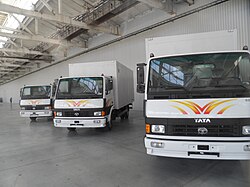
Tata Motors is a powerhouse in the global automotive landscape, specializing in the manufacture of trucks, vans, and buses. Headquartered in Mumbai, Maharashtra, and operating as a key part of the Tata Group, the company has evolved from a regional manufacturer into a multinational entity serving markets worldwide.
The company recently underwent a significant corporate restructuring. In March 2024, it was announced that the commercial vehicles business would be split from the passenger vehicle segment. This led to the incorporation of TML Commercial Vehicles Limited on June 23, 2024. By October 1, 2025, the demerger was finalized: the commercial entity was renamed Tata Motors, while the original parent company became Tata Motors Passenger Vehicles.
Key Facts
- Founded: September 1, 1945, by JRD Tata.
- 2025 Revenue: ₹ 59,094 crore (approximately US$6.1 billion).
- Core Products: A comprehensive range of buses, vans, and trucks.
- Global Reach: Operates worldwide with key subsidiaries in South Korea and joint ventures in Brazil.
- Key Subsidiaries: Tata Daewoo and Tata Marcopolo.
Corporate Evolution and History
Early Foundations and Partnerships
The Tata Group's journey in the commercial sector began in 1954 through a joint venture with Mercedes-Benz of Germany. This partnership established a manufacturing facility in Jamshedpur, where the first goods carrier chassis (3-5 ton capacity) were produced by November 1954.
Following India's economic liberalization in 1991, the partnership with Mercedes-Benz expanded into the luxury segment with the launch of the W124 E-Class. While initially facing challenges due to market perception, the W124 eventually became respected for its reliability. This was followed by the production of the W210 E-Class in 1998 using CKD (Completely Knocked Down) kits—a process where parts are imported and assembled locally.
Strategic Acquisitions and Growth
The 2000s marked a period of aggressive global expansion. Tata Motors acquired the South Korea-based truck manufacturer Daewoo and formed a joint venture with Brazil's Marcopolo to create Tata Marcopolo Bus. The company also acquired Hispano Carrocera to strengthen its presence in the coach market.
Operational Infrastructure and Subsidiaries
Manufacturing Hubs
Tata Motors maintains a robust production network across India, with primary manufacturing plants located in:
- Jamshedpur, Jharkhand
- Lucknow, Uttar Pradesh
- Pantnagar, Uttarakhand
- Dharwad, Karnataka
Tata Daewoo
Acquired in 2004, Tata Daewoo is based in Gunsan, South Korea. As the second-largest heavy commercial vehicle manufacturer in South Korea, it helped Tata Motors reduce its reliance on the Indian market and expand its heavy-tonnage portfolio. Together, they developed the Novus and World Truck series.
Tata Marcopolo
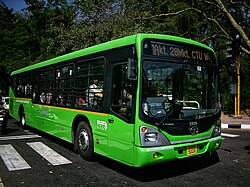
Originally a joint venture with Marcopolo S.A. of Brazil, this entity focuses on fully built buses and coaches for mass rapid transit. Tata Motors eventually acquired the full 49% stake held by Marcopolo in August 2022, though it continued to use the trademark for a specified period. Their low-floor city buses are staples in many Indian urban transport systems.
Product Portfolio and Notable Vehicles
Tata Motors offers an extensive lineup ranging from sub-one-ton mini-trucks to ultra-heavy-duty haulers.
Light Commercial Vehicles (LCV)
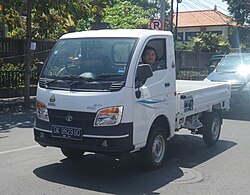
The Tata 407, launched in 1986, remains a legendary LCV, with over 500,000 units sold by the 2011-2012 period. In 2005, the company revolutionized the market with the Tata Ace, India's first indigenous sub-one-ton mini-truck. The Ace created the "small commercial vehicle" segment and has since been exported globally, including electric versions sold via Polaris Industries.
Pickups and Heavy Trucks
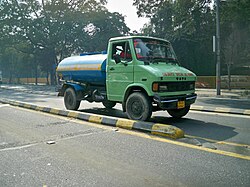
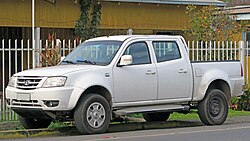
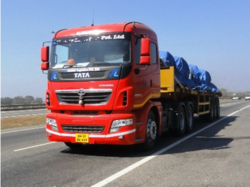
The Tata Xenon (also known as the Yodha) serves as the company's mid-size pickup offering. For the heavy-duty sector, the Tata Prima range, introduced in 2008 as a "global truck," has earned multiple "Commercial Vehicle of the Year" awards.
| Metric | Value (INR) | Value (USD) |
|---|---|---|
| Revenue | ₹ 59,094 crore | $6.1 billion |
| Operating Income | ₹ 4,088 crore | $420 million |
| Net Income | ₹ 3,195 crore | $330 million |
| Total Assets | ₹ 46,851 crore | $4.9 billion |
| Total Equity | ₹ 10,533 crore | $1.1 billion |
Frequently Asked Questions
What happened during the 2025 Tata Motors demerger?
The company split its commercial and passenger vehicle businesses into two separate listed entities. The commercial vehicle business became the new Tata Motors, while the passenger vehicle business (including Jaguar Land Rover) became Tata Motors Passenger Vehicles.
What is the significance of the Tata Ace?
The Tata Ace was India's first indigenously developed sub-one-ton mini-truck. It created an entirely new market segment for small commercial vehicles, becoming a primary choice for urban and rural transporters.
Which international companies has Tata Motors partnered with?
Tata Motors has had significant partnerships with Mercedes-Benz (Germany), Marcopolo (Brazil), Daewoo (South Korea), Hitachi (Japan), and Stellantis.
Where are Tata Motors' commercial vehicles manufactured in India?
The company operates manufacturing plants in Jamshedpur (Jharkhand), Lucknow (Uttar Pradesh), Pantnagar (Uttarakhand), and Dharwad (Karnataka).