Tapirs: Biology, Evolution, and Species Diversity
Tapirs are large, herbivorous mammals belonging to the family Tapiridae. Known for their distinctive flexible snouts and solitary nature, these animals are members of the order Perissodactyla, making them odd-toed ungulates related to horses and rhinoceroses. While they may appear prehistoric, tapirs have a rich evolutionary history spanning millions of years across several continents.
Key Facts
- Extant Species: Four widely recognized species exist today, all within the genus Tapirus.
- Physical Traits: Most adults weigh between 150 and 300 kg and stand about 1 meter high at the shoulder.
- Unique Feature: A flexible proboscis (elongated snout) used for foraging.
- Lifespan: Typically 25 to 30 years in both wild and captive environments.
- Reproduction: Females typically give birth to a single calf after a gestation period of approximately 13 months.
The Four Living Species of Tapir
Currently, there are four recognized species of tapirs. While a fifth species, the kabomani tapir, was proposed in 2013, genetic evidence suggests it is actually a part of the South American tapir population.
| Common Name | Scientific Name | Primary Distribution |
|---|---|---|
| Baird's Tapir | Tapirus bairdii | Mexico, Central America, NW South America |
| South American Tapir | Tapirus terrestris | South America |
| Mountain Tapir | Tapirus pinchaque | South America (Highlands) |
| Malayan Tapir | Tapirus indicus | Indonesia, Malaysia, Myanmar, Thailand |
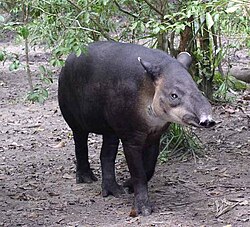
Baird's tapir is found across Central America and the northwestern reaches of South America.
The mountain tapir is distinguished by its longer, woollier fur, an adaptation for its colder, high-altitude habitat.
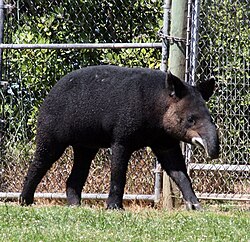
The Malayan tapir is perhaps the most visually striking, featuring a white, saddle-shaped marking on its back that serves as camouflage in the dappled light of the forest.
Physical Characteristics and Anatomy
Tapirs are built for life in muddy and soft terrain. They possess splayed, hooved toes—four on the front feet and three on the hind feet—which prevent them from sinking into soft ground. Their coats vary from reddish-brown to grey or black.
The Proboscis and Dentition
The most defining feature of the tapir is its proboscis, a prehensile snout used to grasp leaves and fruit. Their dental structure is characterized by brachyodont (low-crowned) teeth that lack cementum. Their dental formula is typically 3.1.4.3 or 3.1.3–4.3.
Juvenile Camouflage
Interestingly, baby tapirs of all species are born with striped-and-spotted coats. This pattern provides essential camouflage, helping calves blend into the forest floor to avoid predators.
Behavior and Life Cycle
Tapirs are primarily solitary animals, with the exception of mothers and their calves. They reach sexual maturity between three and five years of age, with females maturing faster than males. In optimal conditions, a female can reproduce every two years.
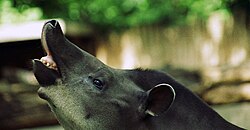
Tapirs exhibit a variety of social and sensory behaviors, including the flehmen response, a facial expression used to analyze pheromones in the air.
Evolutionary History
The lineage of tapirs began with the "tapiroids," primitive perissodactyls that lived in North America and Asia during the Eocene epoch. They likely originated from the family Helaletidae.
Global Migration and Extinction
The family Tapiridae, including early members like Protapirus, appeared in Europe during the Early Oligocene. By the Mid-Miocene, the modern genus Tapirus emerged in Europe and subsequently dispersed into Asia and North America. Europe's last native tapir, Tapirus arvernensis, went extinct roughly 2.6 million years ago at the end of the Pliocene.
Tapirs entered South America during the Pleistocene as part of the Great American Biotic Interchange, with records dating back 1 to 2.6 million years.
Paleontology and Extinct Genera
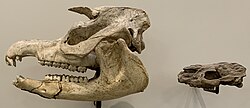
The fossil record reveals a diverse array of extinct genera, including Eotapirus, Miotapirus, and Protapirus. Some extinct species, such as Tapirus augustus (the Giant Tapir), were significantly larger than modern species.
Genetics and Conservation
Genetic analysis shows varying chromosomal numbers across species: the Malayan tapir has 2n = 52, the mountain tapir has 2n = 76, and both Baird's and South American tapirs have 2n = 80. This genetic proximity allowed for the creation of hybrids between Baird's and South American tapirs in captivity during the late 1960s.
Interactions with Humans
While generally shy and avoidant of humans, tapirs can be dangerous when threatened. They possess powerful jaws capable of inflicting severe injuries. Documented incidents include attacks on zookeepers and hikers when the animals felt cornered or were protecting their young.
Frequently Asked Questions
Are tapirs related to pigs?
Despite their physical resemblance to pigs, tapirs are not closely related. They are perissodactyls (odd-toed ungulates), meaning they are more closely related to horses and rhinoceroses.
Why do baby tapirs have spots and stripes?
The spots and stripes act as camouflage, allowing the calves to blend into the sunlight and shadows of the forest floor to hide from predators.
How long do tapirs live?
The natural lifespan of a tapir is approximately 25 to 30 years, whether they are living in the wild or in a zoo.
What is the purpose of a tapir's snout?
The proboscis is a flexible, prehensile organ used to grab vegetation, strip leaves from branches, and navigate through dense undergrowth.
Where do tapirs live today?
Living tapirs are found in South America (South American and Mountain tapirs), Central America and Mexico (Baird's tapir), and Southeast Asia (Malayan tapir).