Taiwan-US Diplomatic Transits and Historical Tensions
The diplomatic relationship between Taiwan and the United States is characterized by a complex balance of unofficial contacts and strategic caution. Since the formal severance of ties decades ago, the mechanism of the transit—a brief stopover during international travel—has become a critical, albeit sensitive, tool for maintaining communication between the two entities.
The Shift in Official Recognition
The foundation of the current diplomatic landscape was set in 1979. During this year, the United States officially recognized the People's Republic of China (PRC) and severed its formal diplomatic ties with the Taiwanese government. This move ended official government-to-government contacts, forcing future interactions into unofficial channels.
The 1994 Hawaii Incident
The friction inherent in these unofficial arrangements was highlighted in 1994 during a trip to Costa Rica by Taiwanese President Lee Teng-hui. President Lee requested a brief stopover in Hawaii, which the Clinton administration permitted for refueling purposes. However, the U.S. government refused to allow the President to enter Honolulu for an overnight stay.
Further tension arose when the designated reception for President Lee was scheduled to take place in a small, dingy room at Hickam Air Force Base. In a gesture of protest, Lee refused to disembark the aircraft. When a U.S. representative boarded the plane to greet him, Lee remained in his sweater and slippers, sarcastically remarking, "I might slip and enter America," to highlight the restrictive nature of the visit.
Escalation and the Third Taiwan Strait Crisis
Diplomatic tensions reached a peak in 1995. Following a visit by President Lee Teng-hui to his alma mater, Cornell University, the PRC government responded by breaking off semiofficial contacts. This event escalated military tensions and initiated the Third Taiwan Strait Crisis, a period of significant instability in the region.
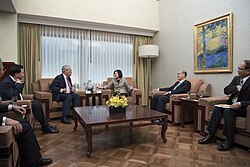
Despite these historical flashpoints, transits continue to serve as a vital bridge. While categorized as "unofficial," these stopovers provide Taiwanese presidents or vice presidents with rare opportunities to conduct phone calls with high-level U.S. officials or engage in private, clandestine meetings.
Key Facts
- 1979: The U.S. recognized the PRC and ended official ties with Taiwan.
- 1994: President Lee Teng-hui protested U.S. restrictions during a Hawaii stopover by refusing to leave his plane.
- 1995: A visit to Cornell University triggered the Third Taiwan Strait Crisis.
- Purpose of Transits: They allow for unofficial high-level communication and private meetings.
| Year | Event | Outcome |
|---|---|---|
| 1979 | U.S. Recognition of PRC | Severance of official ties with Taiwan |
| 1994 | Hawaii Stopover | President Lee Teng-hui protests restricted access |
| 1995 | Cornell University Visit | Initiation of the Third Taiwan Strait Crisis |
Frequently Asked Questions
Why are Taiwanese presidential stopovers called "unofficial"?
They are termed unofficial because the United States severed formal diplomatic ties with the Taiwanese government in 1979 upon recognizing the People's Republic of China.
What happened during President Lee Teng-hui's 1994 Hawaii visit?
President Lee refused to disembark his plane in protest after the U.S. denied him entry to Honolulu and arranged a reception in a small room at Hickam Air Force Base.
What triggered the Third Taiwan Strait Crisis?
The crisis was initiated in 1995 after the PRC government broke off semiofficial contacts following President Lee Teng-hui's visit to Cornell University.
What is the strategic value of these transits today?
Transits provide a window for Taiwanese leaders to hold private meetings or phone calls with high-level U.S. officials, bypassing the lack of formal diplomatic channels.