The Evolution and Mastery of Table Tennis: From Parlour Game to Olympic Sport
Table tennis is a high-speed, precision-based racquet sport that captivates millions of spectators worldwide. While often associated with casual recreation, the professional game is a sophisticated discipline governed by the International Table Tennis Federation (ITTF). From its humble beginnings in Victorian England to its status as a premier Olympic event, table tennis has undergone dramatic transformations in equipment, rules, and athleticism.
Key Facts
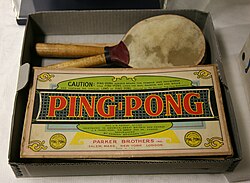
- Origins: Developed in 19th-century England as an after-dinner parlour game.
- Olympic Status: A regular Olympic sport since 1988.
- Governing Body: The International Table Tennis Federation (ITTF).
- Standard Ball: 40 mm diameter, made of poly material.
- Scoring: Modern matches use an 11-point scoring system.
A Brief History of the Game
The sport traces its roots back to Victorian England, where it was played by the upper class as a social pastime. Historical accounts suggest that British military officers in India may have developed makeshift versions of the game during the 1860s or 1870s. These early players used upright books as a net, more books as rackets, and a golf ball for play.
As the game formalized, the industry grew. In 1883, the British company Slazenger patented a specific net for the sport. By 1926, the ITTF was founded, and the first official World Championships were held in London that same year. The sport saw a massive technological shift in the 1950s when manufacturers introduced sponge layers under rubber sheets on paddles, which significantly increased the speed and spin of the ball.
Modern Rules and Regulation Changes
To ensure table tennis remained engaging for television audiences, the ITTF has implemented several strategic rule changes over the last two decades. These adjustments were designed to slow the game down slightly and increase the length of rallies, making the sport more spectator-friendly.
Scoring and Service Adjustments
In September 2001, the scoring system transitioned from a 21-point format to a more fast-paced 11-point system. Additionally, the service rotation was reduced from five points to two. To prevent players from gaining an unfair advantage by hiding the ball during a serve, the ITTF mandated that the ball must be tossed at least 16 centimeters (6.3 inches) into the air.
Equipment Evolution
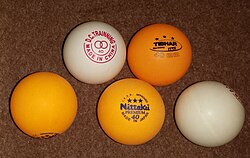
One of the most significant changes occurred in October 2000, when the standard ball size was increased from 38 mm to 40 mm. This increase in size created more air resistance, effectively slowing the ball's velocity. Since July 2014, all official competition balls have been manufactured using a poly material.

Equipment and Playing Specifications
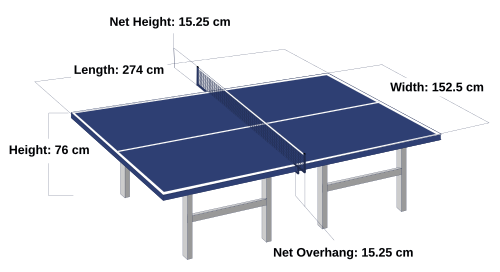
Professional table tennis requires highly standardized equipment to ensure fair competition. The playing surface, or table, must be made of wood or a derivative and must provide a uniform bounce of approximately 23 cm when a standard ball is dropped from a height of 30 cm.
| Feature | Dimension / Specification |
|---|---|
| Table Length | 2.74 m (9.0 ft) |
| Table Width | 1.525 m (5.0 ft) |
| Table Height | 76 cm (2.5 ft) |
| Net Height | 15.25 cm (6.0 in) |
| Ball Diameter | 40 mm |
| Ball Weight | 2.7 g (0.095 oz) |
The Playing Area
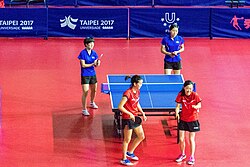
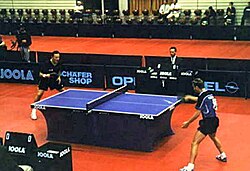
For standard ITTF competitions, the playing space must be at least 14 m long by 7 m wide, with a minimum height clearance of 5 m. For wheelchair events, the requirements are slightly adjusted to a minimum of 8 m by 6 m.
Techniques and Gameplay
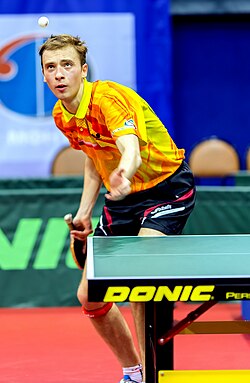
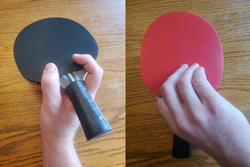
Players utilize various grips to control the racket, the most common being the shakehand grip and the penhold grip. These grips influence how a player executes different strokes.
Strokes in table tennis are categorized into offensive and defensive types. Offensive players may use loops, smashes, or counter-hits to apply heavy spin and speed. Defensive players often rely on pushes, chops, or blocks to neutralize an opponent's attack.
![India's Manika Batra hits the ball. She specialises in playing long-pimples on her backhand, a rubber which is not often played by top players.[34]](/images/ed/54/ed54efe89567840e88d39a3dc903f1ef62313cb1aee1ef5fd6bde76565cdb7c3.jpg)
The game is also defined by the effects of spin, which players can apply in several ways:
- Topspin: Causes the ball to dip and accelerate forward.
- Backspin: Causes the ball to slow down and potentially "stop" upon hitting the table.
- Sidespin: Causes the ball to curve laterally.
- Corkspin: A specialized type of spin.
Notable Athletes and Global Impact
Table tennis has produced legendary figures who have dominated the sport for decades. China has been a particularly dominant force in international competition. Players like Ma Long, Zhang Yining, and Deng Yaping have secured multiple Olympic and World Championship titles.
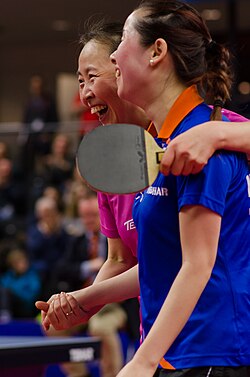
The sport also features incredible diversity in talent. For example, Natalia Partyka is one of the rare athletes to have competed in both the Paralympic and Olympic Games.

In countries like Japan, table tennis stars such as Ai Fukuhara and Mima Ito are among the most marketable athletes in the nation.
![In Japan, table tennis stars like Ai Fukuhara, Mima Ito, and Kasumi Ishikawa[76] are consistently ranked among the country's most marketable athletes.[77][78][79]](/images/f6/76/f676be9d2b885eba9166ef4968c3ff68c624e6872356b661ba3fca88b397c4c9.jpg)
Frequently Asked Questions
What is a "let" in table tennis?
A let is a rally where no point is scored. This occurs under specific circumstances, such as when a serve hits the net but otherwise lands correctly in the opponent's court.
How do players serve in doubles?
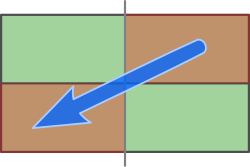
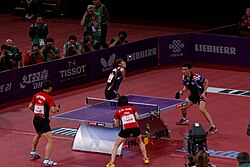
In doubles, the service must be delivered from the server's right-hand court to the receiver's right-hand court. The service zone is strictly regulated to ensure fairness in the rotation of play.
What are the different types of grips?
The most common grips are the shakehand grip (resembling a handshake) and the penhold grip (resembling how one holds a pen). There is also the Seemiller grip.
Who governs international table tennis?
The International Table Tennis Federation (ITTF) is the highest governing body for the sport, overseeing rules, international competitions, and equipment standards.
Why did the ball size change?
The ball size was increased from 38 mm to 40 mm to increase air resistance. This was done to slow down the game, making it easier for spectators to follow on television broadcasts.