Sydney Gay and Lesbian Mardi Gras: A History of Pride and Protest
The Sydney Gay and Lesbian Mardi Gras is a vibrant celebration of LGBTQIA+ history and culture. While it shares its name with the Christian holiday of Mardi Gras—derived from the French words for "Tuesday" (Mardi) and "fat" (Gras)—the Sydney event is entirely unrelated to the religious observance. Instead, the name was adopted in 1978 because "Mardi Gras" had become a global synonym for street festivals and positive public celebrations.
The 1970s: From Protest to Parade
The event began on June 24, 1978, when a group of young gay and lesbian Australians organized a series of events to commemorate the Stonewall riots. What started as a morning protest march evolved by 10:00 PM into a nighttime street festival on Oxford Street in Darlinghurst. More than 500 people initially gathered to demand an end to police harassment, the repeal of anti-homosexual laws, and an end to discrimination in housing and employment.
As the night progressed, the crowd grew to approximately 2,000 people. Despite the organizers' efforts to obtain permission, the police revoked it and broke up the parade. In the aftermath, 53 participants were arrested in Kings Cross. While most charges were eventually dismissed, The Sydney Morning Herald published the full names of those arrested. This led to many individuals being "outed," resulting in job losses because homosexuality remained a crime in New South Wales (NSW) until 1984.
Rather than silencing the movement, the police response transformed a local protest into a nationally significant catalyst for law reform. The second parade took place in 1979 with the theme "Power in the Darkness," attracting 3,000 people. That same year, the NSW Labor Government, led by Neville Wran, repealed the Summary Offences Act 1988 (NSW), the legislation used to justify the 1978 arrests.
Growth and Evolution (1980–1999)
In 1981, the event moved to February to take advantage of the summer weather and was renamed the "Sydney Gay Mardi Gras." The event grew rapidly, with 5,000 spectators in 1981 and 100,000 by 1987. However, the decade was not without tension; a rift developed between gay and lesbian participants over the inclusion of corporate floats, leading many lesbians to exclude themselves from the event for several years.
The mid-1980s brought the challenges of the AIDS crisis. Despite intense media controversy and calls for a ban, the 1985 parade proceeded under the poignant theme "Fighting for Our Lives." By 1988, the event was officially renamed the "Sydney Gay and Lesbian Mardi Gras."
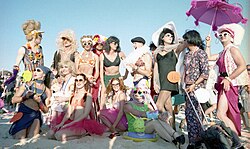
The 1990s saw the festival reach global proportions. By 1992, it was the largest gay and lesbian festival in the world, spanning four weeks. In 1993, the parade became the largest nighttime outdoor parade globally, contributing an estimated A$38 million to the Australian economy. The 1994 parade, themed "We are Family," drew 600,000 spectators and achieved record-breaking ratings when broadcast by ABC TV for the first time.
A landmark moment occurred in 1988 when Aboriginal dancers Malcolm Cole and Rodney Junga-Williams, collaborating with artist Panos Couros, presented the first Aboriginal float. The entry depicted the story of the First Fleet, with Cole as Captain Cook and Junga-Williams as Joseph Banks, commemorating the 218th anniversary of Cook's landing.
Commercialization and Community Conflict (2000–2019)
The new millennium brought financial and ideological struggles. In 2002, the organizing company went bankrupt after a loss of A$400,000, leading to a more grassroots approach in 2003 to combat claims of over-commercialization. By 2009, the parade reached a peak of 134 floats and 9,500 participants.
![Drag queen, Carmen Geddit from Sydney Drag Royalty[47] dressed as Anthony "Tick" Belrose / Mitzi Del Bra (Hugo Weaving)[48] from the film The Adventures of Priscilla, Queen of the Desert during the 2007 parade.](/images/7e/5c/7e5cd5412cbd602a6cd668c9cf60f96f63007da31696eb23375209d9d1676121.jpg)
The event has frequently faced criticism from various sectors. Religious figures, such as former minister Fred Nile, have consistently opposed the festivities. In 2008, the Anglican bishop of South Sydney condemned a play opening the Mardi Gras for its depiction of a gay Jesus. Internally, the organization struggled with inclusivity. In 2011, the name was briefly changed to "Sydney Mardi Gras" to be more inclusive of the LGBTQIA+ acronym (including intersex, bisexual, transgender, queer, and asexual identities), but the change was met with backlash from those who felt the "Gay and Lesbian" identity was being erased. The original name was subsequently restored.
Other controversies included disputes over the participation of the Raelians (a UFO-related group) and the inclusion of polyamorists. In 2012, the theme "universal and infinite love" led to the inclusion of a "Queer Polyamory" float.
The Modern Era (2020–Present)
The 2020 event took place just before the COVID-19 pandemic hit Australia, featuring a performance by singer Dua Lipa. In 2021, the pandemic forced the parade to move to the Sydney Cricket Ground as a ticketed event with 36,000 spectators.
![Australian Defence Force 2013[55]](/images/bc/4c/bc4c6b05a62b62019f188162131b060cc65cb8fb7360c51564547037cd235f7f.jpg)
Recent years have seen the parade used as a platform for political activism. In 2023, Senator Lidia Thorpe disrupted the event to highlight Indigenous incarceration rates. In 2024, following the alleged murder of Jesse Baird and Luke Davies by a police officer, the board initially banned NSW Police from participating. This was later amended to allow officers to march as a group, provided they did not wear uniforms or use a float.
Key Facts
- Origin: Started on June 24, 1978, as a protest and celebration of the Stonewall riots.
- Legal Impact: The 1978 arrests helped stimulate the repeal of the Summary Offences Act in 1979.
- Economic Value: By 1993, the event contributed approximately A$38 million to the Australian economy.
- The 78ers: A group of original 1978 participants who have led the parade every year since 1998.
- Global Scale: In 1993, it was the largest nighttime outdoor parade in the world.
| Year/Period | Key Milestone | Significance |
|---|---|---|
| 1978 | First Parade | Protest against discrimination; 53 arrests. |
| 1979 | Second Parade | Repeal of Summary Offences Act. |
| 1981 | Seasonal Shift | Moved to February for summer celebrations. |
| 1988 | Renaming | Became "Sydney Gay and Lesbian Mardi Gras." |
| 1994 | ABC Broadcast | First TV broadcast; 600,000 spectators. |
| 2011 | LGBTQIA+ Adoption | Formal inclusion of intersex and expanded acronym. |
| 2021 | Pandemic Adaptation | Relocated to Sydney Cricket Ground. |
Frequently Asked Questions
Why is it called Mardi Gras if it is not a religious holiday?
The organizers chose the name because "Mardi Gras" was already synonymous with street festivals and positive celebrations, though it is unrelated to the Christian holiday of the same name.
What happened during the first parade in 1978?
The parade began as a protest for gay and lesbian rights but was broken up by police, leading to 53 arrests. The subsequent publication of the names of those arrested led to many people losing their jobs.
Who are the 78ers?
The 78ers are a group of individuals who participated in the original 1978 events. They have led the Mardi Gras parade every year since 1998 to commemorate the event's origins.
How has the name of the event changed over time?
It began as a street festival in 1978, became the "Sydney Gay Mardi Gras" in 1981, and was renamed the "Sydney Gay and Lesbian Mardi Gras" in 1988. A brief attempt to rename it "Sydney Mardi Gras" in 2011 was reversed due to community feedback.
Can the police participate in the parade?
Following controversies in 2024, the board agreed that NSW Police may participate, but they must march as a group without uniforms and without a float.