Swatch Group: The Strategic Revival of Swiss Watchmaking
In the early 1980s, the Swiss watchmaking industry faced an existential crisis. Competition from Japanese manufacturers had pushed two major firms, ASUAG and SSIH, into turmoil. To manage the fallout, a group of Swiss banks appointed Nicolas Hayek to oversee the liquidation of these companies. However, Hayek saw a path to survival where others saw only failure.
Rather than dismantling the firms, Hayek believed that the industry could remain competitive through a rigorous restructuring of operations and a strategic repositioning of its brands.
Identifying Systemic Inefficiencies
Upon analyzing the organizations, Hayek discovered deep-seated issues regarding leadership, distribution, policies, and product development. He noted that ASUAG, in particular, suffered from extreme fragmentation, owning over 100 separate companies of varying sizes and technological capabilities. This decentralized structure was highly inefficient, as most of these entities conducted their own independent research and development (R&D), marketing, and assembly.
Modernizing Production and the Birth of Swatch
To solve these inefficiencies, Hayek implemented a strategy focused on automation and the use of standardized parts and tooling. By centralizing production, the group achieved economies of scale—the cost advantage that arises with increased output of a product—which simultaneously improved overall quality.
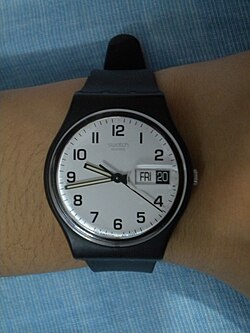
This operational overhaul coincided with the launch of the Swatch watch. Designed to be colorful and marketed aggressively, the Swatch watch allowed Switzerland to reclaim a significant portion of the lower-end market from Japanese competitors. A key innovation was its simplified design, which utilized nearly half the number of parts found in a traditional wristwatch, reducing costs without sacrificing quality.
Corporate Evolution and Legacy
Following the successful reorganization, ASUAG and SSIH merged to form the Société Suisse de Microélectronique et d'Horlogerie, the precursor to the modern Swatch Group. The leadership of the organization eventually transitioned to the next generation; Nick Jr. Hayek became the CEO in 2003, and Nayla Hayek succeeded her father as chairperson.
Key Facts
- Founding Crisis: The group emerged from the turmoil of ASUAG and SSIH during the 1980s due to Japanese competition.
- Operational Shift: Transitioned from over 100 fragmented companies to a centralized system using automation and standardized tooling.
- Product Innovation: The Swatch watch reduced the part count by nearly 50% compared to traditional watches.
- Market Impact: Successfully regained the lower-end watch market share for Switzerland.
- Leadership: Led by Nicolas Hayek, followed by Nick Jr. (CEO, 2003) and Nayla Hayek (Chairperson).
| Feature | Before Restructuring | After Restructuring |
|---|---|---|
| Organizational Structure | Fragmented (100+ separate companies) | Centralized and Merged |
| Manufacturing Process | Independent R&D and assembly | Automation and standardized parts |
| Market Position | Losing ground to Japanese makers | Regained lower-end market share |
| Product Design | Traditional high part count | Simplified design (approx. 50% fewer parts) |
Frequently Asked Questions
Why were ASUAG and SSIH in turmoil?
These two Swiss watch-making firms were struggling primarily due to intense competition from Japanese manufacturers in the early 1980s.
How did Nicolas Hayek reduce the cost of the Swatch watch?
He reduced costs by designing the watch to use almost half the number of parts required by a traditional wristwatch, ensuring quality was not compromised.
What was the primary operational change made to ASUAG?
Hayek moved the company away from a fragmented system of over 100 independent companies toward a centralized model utilizing automation and standardized tooling.
What was the original name of the merged entity?
After the reorganization and merger of ASUAG and SSIH, the company initially became the Société Suisse de Microélectronique et d'Horlogerie.
Who took over leadership after Nicolas Hayek?
His son, Nick Jr., became the CEO in 2003, and his daughter, Nayla, succeeded him as chairperson.